

Last Updated on March 31, 2026 by Snout0x
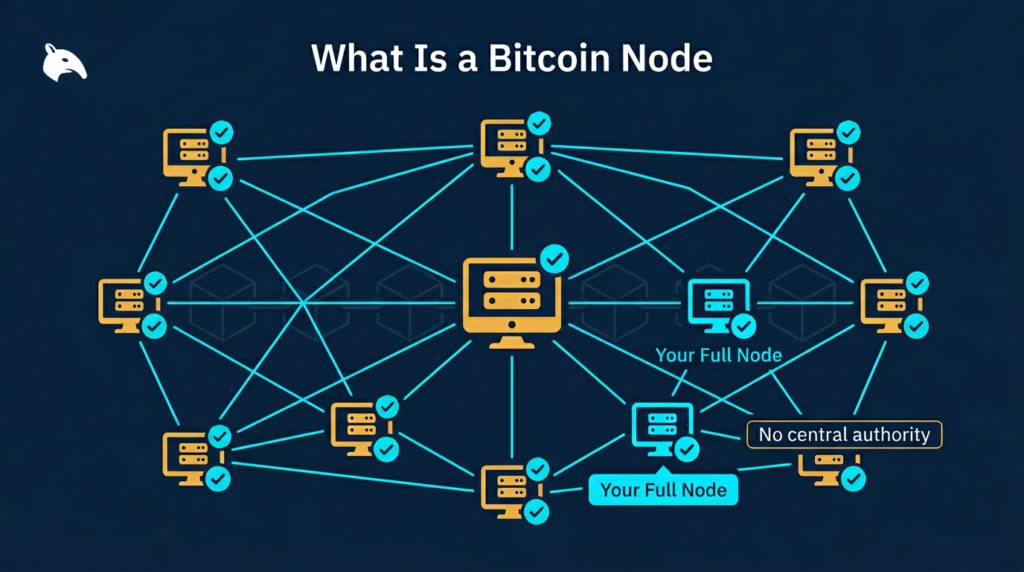
A node in Bitcoin is a computer running software that participates in the peer-to-peer network. Nodes communicate with each other to share transactions and blocks, and they independently enforce Bitcoin’s rules. There is no central server, no administrator, and no authority that decides what is valid. This architecture is the foundation of what makes Bitcoin a blockchain. Every node that chooses to checks for itself. This independence is what makes Bitcoin censorship-resistant: no single party can invalidate a transaction that the software considers legitimate.
For a closely related follow-up, see Bitcoin Mempool Congestion: Why Fees Spike and Transactions Stall.
A simple way to think about a Bitcoin node is as your own rule-checking referee. It does not create Bitcoin’s rules and it does not need permission to enforce them. It just watches what the network broadcasts and refuses anything that breaks the rulebook it is already running.
This content is for educational purposes only and should not be considered financial or investment advice.
Full Nodes vs Light Nodes
There are two primary node types that regular users encounter: full nodes and lightweight (SPV) nodes.
A full node downloads and stores the entire Bitcoin blockchain, currently over 600 GB of data. It validates every transaction in every block against all of Bitcoin’s consensus rules: the supply limit, the block size, the proof-of-work, the signature formats, the spending rules. When a new transaction arrives, the full node checks it independently. When a new block arrives, the full node validates it completely before accepting it. A full node trusts no one. It verifies everything.
A lightweight or SPV (Simplified Payment Verification) node does not download the full blockchain. Instead, it downloads only block headers (each header is 80 bytes; the entire header chain is small) and requests relevant transaction data from full nodes. SPV nodes trust that the block headers are valid based on proof-of-work, but they rely on full nodes to supply accurate transaction data. Most mobile Bitcoin wallets use SPV because downloading the full blockchain on a phone is impractical.

What a Full Node Does for the Network
Full nodes form the backbone of Bitcoin’s security. They enforce the rules. When a miner produces an invalid block (wrong reward, invalid transaction, oversized block), every full node that receives it rejects it. The miner loses the block reward without compensation. This is how Bitcoin’s rules are enforced without any central authority: it is the collective rejection by thousands of independent full nodes that makes rule violations unproductive.
Full nodes also relay transactions. when you broadcast a Bitcoin transaction, it first enters the Bitcoin mempool before propagating across the peer-to-peer network as nodes relay it to their peers. The more nodes in the network, the faster and more reliably transactions propagate, and the harder it is for any geographic or network-level censorship to prevent your transaction from reaching miners.
What a Full Node Does for You Personally
Running your own full node is the most sovereign way to use Bitcoin. When you use a wallet connected to your own node, you do not rely on anyone else’s node to tell you your balance, confirm your transactions, or verify that the blockchain you are reading is the real one. You have verified the entire chain yourself from the genesis block to the present.
Without a full node, your wallet queries someone else’s node. That node could theoretically lie to you: showing you a fake balance, suppressing your transactions, or presenting a minority chain fork as the main chain. In practice, reputable wallet providers run honest nodes. But the core point of self-verification is to remove that trust dependency where it matters most.
For users managing significant Bitcoin holdings in self custody, running a full node on a dedicated device such as a Raspberry Pi 4, NUC, Umbrel box, or RaspiBlitz setup is a realistic and not particularly expensive commitment.
Practical Usage: When Running Your Own Node Makes Sense
Running your own verifier makes the most sense when you want independent balance checks, private transaction lookup, or direct wallet-to-node communication. A common real-world setup is a desktop wallet or hardware wallet connected to a local Bitcoin Core instance instead of a public server. That removes a third party from the chain of trust when you check balances or broadcast transactions.
For example, a user holding long-term savings may run Bitcoin Core on a small dedicated box and point Sparrow or Electrum to that machine. The practical check is simple: if privacy, self-verification, or censorship resistance matters to you, a self-hosted full node is worth the storage and sync time. If you only need occasional mobile access, an SPV wallet is usually the lighter trade-off.
What Hardware Is Required
A Bitcoin full node (Bitcoin Core) has modest requirements. The main constraint is storage: the full blockchain requires over 600 GB and grows at roughly 50 to 100 GB per year. A minimum viable setup is:
- A 2 TB SSD (to accommodate several years of growth)
- 4 GB RAM minimum (8 GB comfortable)
- A stable internet connection with reasonable upload bandwidth
- An always-on or frequently-on device (a desktop that runs overnight is sufficient)
Initial blockchain synchronization (IBD) can take 1 to 3 days depending on hardware and internet speed. Once synced, maintaining the node requires minimal CPU and bandwidth for normal block propagation.
Mining Nodes vs Validating Nodes
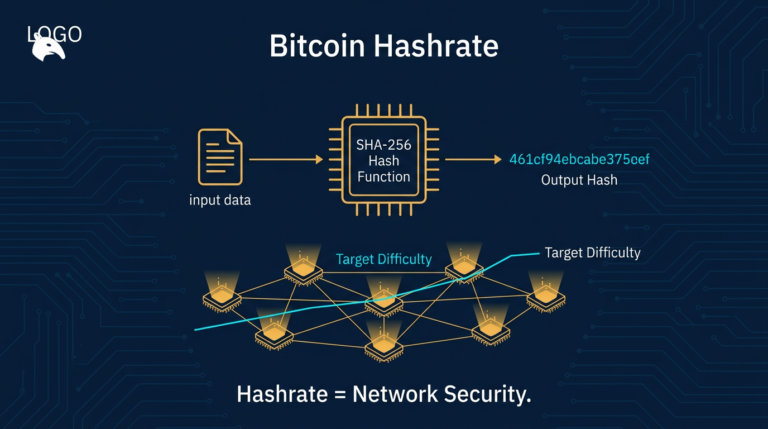
Miners run full nodes too, but with additional mining software that allows them to produce new blocks. A mining node validates the blockchain (full node function) and also performs proof-of-work hashing — contributing to the network’s overall hashrate — to find valid blocks (mining function). The two functions are separate: you can run a full node without mining, and theoretically a miner could use an external node for validation.
For the queueing and relay side of this relationship, Bitcoin Mempool Explained is the more relevant local follow-up. Nodes do not just validate blocks. They also decide which pending transactions they are willing to hold and relay.
The full node is the validation layer. The miner is the production layer. You can learn more about the mining side of this relationship in What Is Bitcoin Hashrate. Bitcoin’s security requires both: miners to produce blocks and full nodes to enforce that those blocks meet all rules. If most full nodes defected from enforcing the rules, miners could potentially change them. This is why the number of independent full nodes is a key decentralization metric.
The intuitive distinction is that miners add blocks, but nodes decide whether those blocks count. That is why running a node is not about earning rewards. It is about participating in rule enforcement instead of outsourcing that job to someone else’s infrastructure.
Risks and Common Mistakes
The most common mistake is assuming that merely turning on Bitcoin Core gives you privacy and sovereignty by default. In practice, users often still leave their wallet connected to a third-party server, or they expose their node to the internet without understanding port forwarding, Tor, or firewall rules. That creates a setup where the machine is running, but the trust reduction they expected never actually happens.
Another mistake is underestimating initial sync and storage requirements. A user may start with a nearly full drive, let the chain grow until the machine runs out of space, and then end up with a stalled or corrupted setup that no longer tracks the network reliably. The consequence is not lost funds, but broken verification and a false sense that your local copy is still current when it is not.
Frequently Asked Questions
How many public nodes exist?
The number of publicly reachable (listening) full nodes is tracked by services like bitnodes.io and typically sits between 10,000 and 20,000. The number of non-listening (private) full nodes is much higher but harder to count. Estimates of total full nodes range from 50,000 to over 100,000 globally.
Does running a node earn Bitcoin rewards?
No. Full nodes receive no block rewards or transaction fees. The incentive to run one is non-economic: it is sovereignty (verify your own transactions), network contribution (improve relaying and decentralization), and alignment with Bitcoin’s values (participate in enforcement of the rules rather than delegating trust).
What is pruned mode?
Bitcoin Core supports pruning, which allows the node to validate and then discard old block data after verification, keeping only the current UTXO set and recent blocks. A pruned node can operate on as little as 10 to 20 GB of storage. It cannot serve historical block data to other nodes, which reduces its contribution to the network, but it provides full validation for your own use.
Is an Umbrel or RaspiBlitz box a full node?
Yes. Both Umbrel and RaspiBlitz are consumer-friendly software packages that run Bitcoin Core (and optionally Lightning Network) on a Raspberry Pi. The underlying Bitcoin validation is identical to Bitcoin Core running on any other hardware. They simply add a convenient web interface for management.