

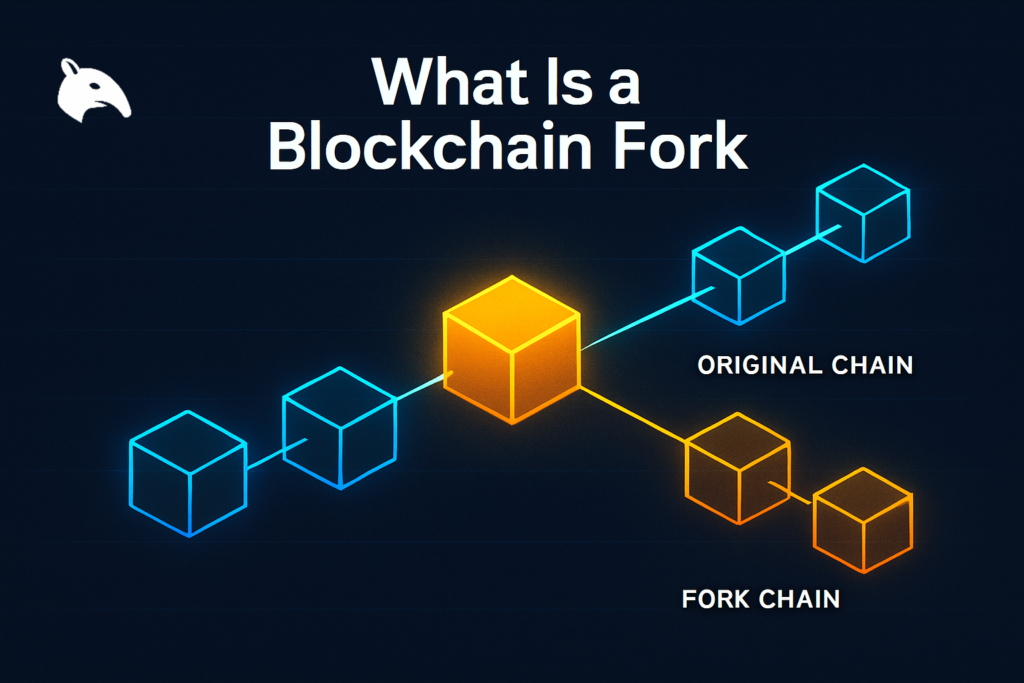
A fork in a blockchain is a change in how the network’s rules are interpreted or followed. Sometimes that means a deliberate protocol upgrade. Sometimes it simply means two valid blocks were found at nearly the same time and the network temporarily disagrees about which chain tip to follow. In both cases, the word “fork” describes a divergence from one shared path into two competing paths, even if one path disappears quickly.
The practical idea is simple: blockchains only work when nodes agree on the rules. A fork happens when software versions, recent blocks, or consensus rules create a temporary or lasting split in that agreement. Understanding forks helps you separate normal network behavior from major rule changes, and helps explain why terms like hard fork and soft fork matter.
This content is for educational purposes only and should not be considered financial or investment advice.
Key Takeaways
- A fork means divergence: It happens when a blockchain briefly or permanently splits into different paths or rule sets.
- Not all forks are dramatic: Temporary forks happen naturally when two blocks are found close together and one chain later wins.
- Soft forks are backward-compatible rule tightenings: Older nodes may still follow the chain even if they do not enforce the new rules themselves.
- Hard forks are not backward-compatible: Nodes that do not upgrade can end up following a separate chain.
- Forks are really about node agreement: The key question is whether different software versions still accept the same blocks as valid.
What “Fork” Means in a Blockchain Context
In ordinary software, a fork often means copying code into a new project. In blockchain systems, the meaning is more specific. A fork is a divergence in chain history, rule enforcement, or both. That divergence may be temporary and harmless, or it may become a lasting split with separate communities, assets, and node networks.
A useful mental model is to think of a fork like a road that briefly branches into two lanes. If both lanes merge back quickly, traffic continues normally and most users barely notice. If the lanes never merge and each keeps going to a different destination, the branch becomes a permanent separation. Chain forks follow the same logic. Some are short-lived consensus events; some become entirely separate networks.
Temporary Forks: Normal Chain Reorganizations
Not every fork is an upgrade dispute. Sometimes two miners or validators produce competing blocks at nearly the same height. Different nodes may see different blocks first, so for a short time the network has two candidate chain tips. When the next block arrives on one branch, that branch becomes the heavier or longer valid chain and the other branch is abandoned.
This is a normal part of distributed systems. It does not mean the blockchain is broken. It means propagation delays and decentralized block production occasionally create short-lived disagreement. The losing block becomes stale or orphaned, and nodes reorganize to the winning chain.
Intentional Forks: Protocol Rule Changes
The more famous meaning of fork is a deliberate protocol change. These forks happen when developers and node operators want to change some consensus rule, such as transaction format, script behavior, block validation rules, or resource limits. Once different nodes start enforcing different rule sets, compatibility becomes the central question.
This is where the difference between soft forks and hard forks matters. Both are protocol changes. The difference is whether older nodes can still recognize blocks from upgraded nodes as valid.
What a Soft Fork Is
A soft fork is a rule change that is backward-compatible. In practice, it tightens the rules rather than loosening them. Upgraded nodes begin rejecting some blocks or transactions that older nodes would have accepted, but the new valid chain still appears valid to older nodes as long as enough of the network follows the new rules consistently.
That backward compatibility is why soft forks can allow a network to remain on one chain even if not every node upgrades immediately. Older nodes may not fully understand the new features, but they can still accept the resulting blocks as valid under the older, looser rule set.
A practical example is a rule change that narrows what kinds of transactions are allowed. If the new rules are stricter, upgraded nodes reject anything outside that narrower set. Older nodes still accept the stricter blocks because they already fit inside the broader rule set the older software understands.
One operator insight is that “backward-compatible” does not mean “coordination-free.” Soft forks still require careful activation, broad support, and attention to miner or validator behavior. They reduce split risk relative to hard forks, but they do not eliminate governance or rollout complexity.
What a Hard Fork Is
A hard fork is a rule change that is not backward-compatible. Upgraded nodes begin accepting blocks or transactions that older nodes consider invalid. If not everyone upgrades, the network can split into two separate chains: one following the new rules and one staying on the old rules.
This is why hard forks are often described as creating a cleaner break. They can introduce broader changes because they are not constrained by old compatibility assumptions. But that same freedom makes them riskier from a coordination standpoint. If the community does not move together, the fork can produce a persistent chain split rather than a single upgraded network.
A second operator insight is that hard forks are as much social events as technical ones. Code can define the new rules, but the lasting outcome depends on which chain exchanges, wallets, miners, validators, developers, and users decide to support. The software change alone does not decide the whole market outcome.
Hard Fork vs Soft Fork in Simple Terms
- Soft fork: New rules are stricter than old rules. Older nodes can often continue following the upgraded chain.
- Hard fork: New rules allow something old nodes reject. Older nodes cannot stay in consensus unless they upgrade.
- Soft fork outcome: Usually aims to keep one chain with upgraded enforcement.
- Hard fork outcome: Can keep one chain if everyone upgrades, or create two chains if the network splits.
The easiest summary is this: a soft fork narrows the valid rule set, while a hard fork expands or changes it in a way older software cannot accept.
Why Nodes Matter So Much
Forks are really about which blocks nodes accept as valid. That is why node software matters more than headlines about upgrades. A blockchain does not change because a developer says so. It changes when enough economically important nodes enforce a different set of rules.
For Bitcoin-specific context, What Is a Bitcoin Node? is the most relevant follow-up. For proof-of-stake systems, what is a validator node helps explain who is participating in block production and rule enforcement there.
How Users Experience Forks
Most users never notice temporary forks because wallets and exchanges usually wait for confirmation depth and follow the winning chain automatically. Intentional forks are more visible. They may require wallet or node software upgrades, exchange maintenance windows, and careful communication about which chain or asset a service will support.
If a hard fork results in two lasting chains, users may end up with assets on both networks if they controlled their keys before the split. But the practical handling can be messy because replay protection, address reuse risks, exchange support, wallet compatibility, and ticker naming all matter. That is one reason forks are not just protocol events. They are operational events too.
Practical Usage: How to Think About Fork News
When you hear about a fork, the first useful question is: what kind of fork is this? Is it a normal short-lived chain reorganization, a soft-fork upgrade, or a hard-fork proposal that may create a separate network? That classification tells you much more than the word “fork” on its own.
- Check whether the change is backward-compatible: That tells you whether you are looking at a soft fork or a hard fork candidate.
- Check whether your wallet or node needs an update: Some upgrades matter only for node operators; others affect wallet support and transaction handling.
- Check whether exchanges and custodians have announced plans: Operational support often shapes how ordinary users experience a fork.
- Check whether the network is likely to split permanently: That risk is much higher with controversial hard forks than with routine temporary forks.
- Focus on rule compatibility, not just headlines: The real issue is which blocks different nodes will accept after the change.
A simple practical frame is to ask: “Will old software still accept blocks from upgraded software?” If yes, you are probably looking at a soft fork. If no, you are looking at a hard fork or a full chain split scenario.
Risks and Common Mistakes
- Thinking every fork creates a new coin: Many forks are temporary consensus events or single-chain upgrades, not permanent asset splits.
- Ignoring backward compatibility: This is the core distinction between soft forks and hard forks.
- Assuming code alone decides the outcome: Node operators, miners, validators, exchanges, and users all shape whether a fork sticks.
- Confusing temporary reorganizations with governance disputes: One is normal network behavior; the other is a protocol coordination event.
- Reacting to fork headlines without checking wallet support: Operational details matter if you hold assets through a contested split.
Sources
- Blockstream Glossary: Fork
- Bitcoin Optech: Soft Fork Activation
- Bitcoin Core Academy: Making Forking Changes
Frequently Asked Questions
What is a fork in a blockchain?
A fork in a blockchain is a divergence in chain history or rule enforcement. It can describe a temporary split between competing blocks or a deliberate protocol upgrade that changes how nodes validate the chain.
What is the difference between a hard fork and a soft fork?
A soft fork is backward-compatible and usually tightens the rules. A hard fork is not backward-compatible and can produce a separate chain if not all nodes upgrade.
Do all forks create a new cryptocurrency?
No. Many forks are temporary and disappear quickly. Even intentional upgrades do not always create a second lasting asset. A new cryptocurrency usually appears only when a hard fork produces a persistent separate chain.
Why are nodes important during a fork?
Nodes decide which blocks are valid. A fork only matters because different nodes may enforce different rules or temporarily follow different branches. The chain users experience depends on what their software accepts.
How should users react to fork announcements?
First identify whether it is a temporary fork, a soft fork, or a hard fork proposal. Then check wallet support, exchange notices, and whether your software needs updating. Most confusion comes from reacting to the word “fork” without checking the type.