

Last Updated on April 19, 2026 by Snout0x
The halving is a programmed event that cuts the block subsidy paid to miners in half. It happens every 210,000 blocks, which is roughly every four years, though the exact timing depends on how quickly blocks were found during that period. The event does not split the network, change the total supply cap, or alter the ten-minute block target. It simply reduces the number of newly issued bitcoins that enter circulation with each block.
The easiest way to think about the halving is as Bitcoin’s built-in issuance schedule. Instead of creating new coins at a constant pace forever, the protocol releases fewer new coins over time. That is how Bitcoin approaches its fixed maximum supply of 21 million without stopping issuance abruptly in its early years.
This content is for educational purposes only and should not be considered financial or investment advice.
Key Takeaways
- The halving cuts the block subsidy by 50%: It reduces the amount of new BTC miners receive for each block they mine.
- It occurs every 210,000 blocks: That works out to roughly four years, but the exact date is not fixed on a calendar.
- It controls Bitcoin’s issuance rate: New supply enters the market more slowly after each halving cycle.
- Miners feel the economic impact first: Revenue from newly issued BTC drops immediately, which can pressure inefficient operators.
- The network keeps functioning through difficulty adjustment: If some miners shut down, difficulty eventually adjusts so blocks move back toward the intended rhythm.
What Actually Gets Halved
IN PLAIN TERMS
The halving cuts the block subsidy — the newly created BTC awarded to miners for each block. It does not halve your balance, reduce transaction fees, or change the 21 million supply cap. New issuance slows; nothing else is divided.
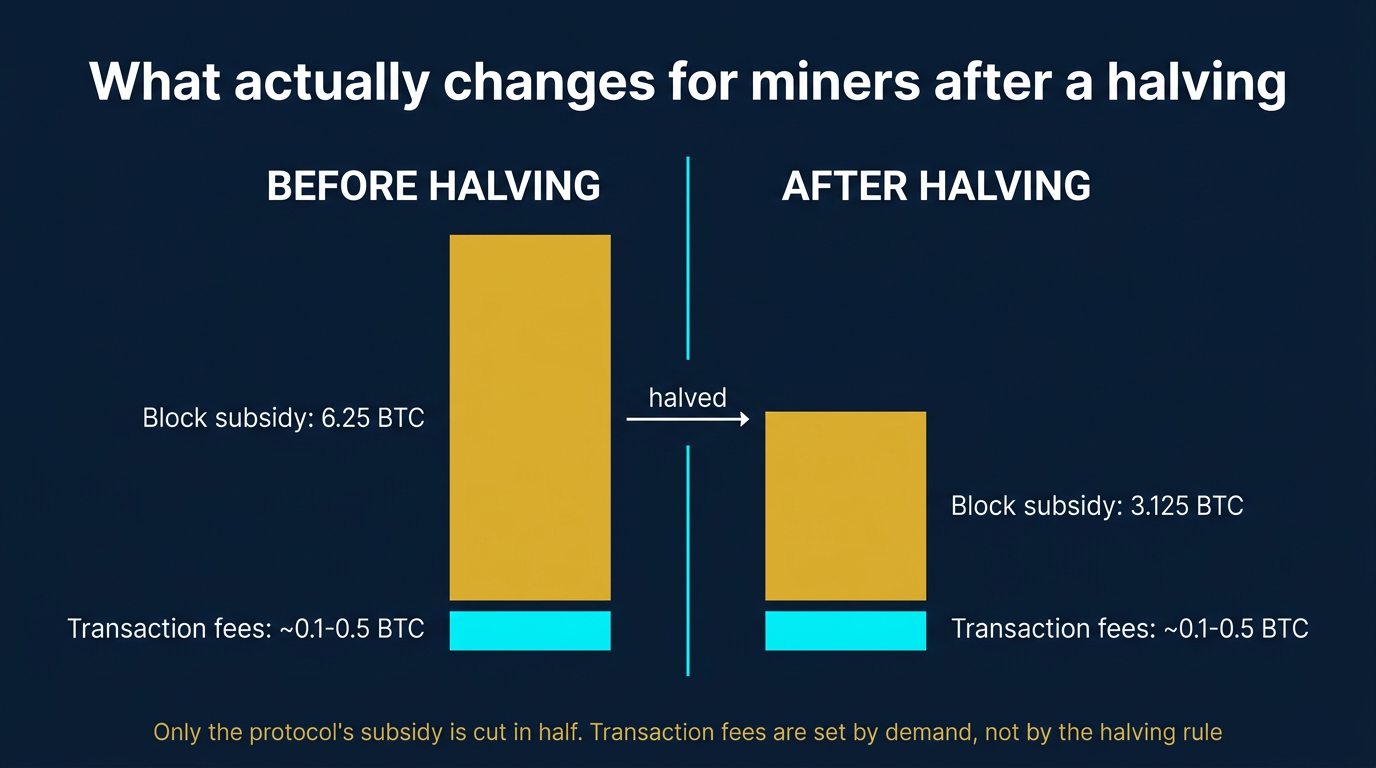
The thing that gets halved is the block subsidy, not the transaction fees and not users’ balances. The block subsidy is the newly created bitcoin that the protocol awards to the miner of a valid block. In Bitcoin’s early years that subsidy was 50 BTC per block. It then fell to 25 BTC, then 12.5 BTC, then 6.25 BTC, and after the 2024 halving it became 3.125 BTC.
Miners also receive transaction fees from the transactions included in the block. Those fees do not get halved by protocol rule. That distinction matters because miner revenue is really a combination of subsidy plus fees. The halving affects only the subsidy side of that equation.
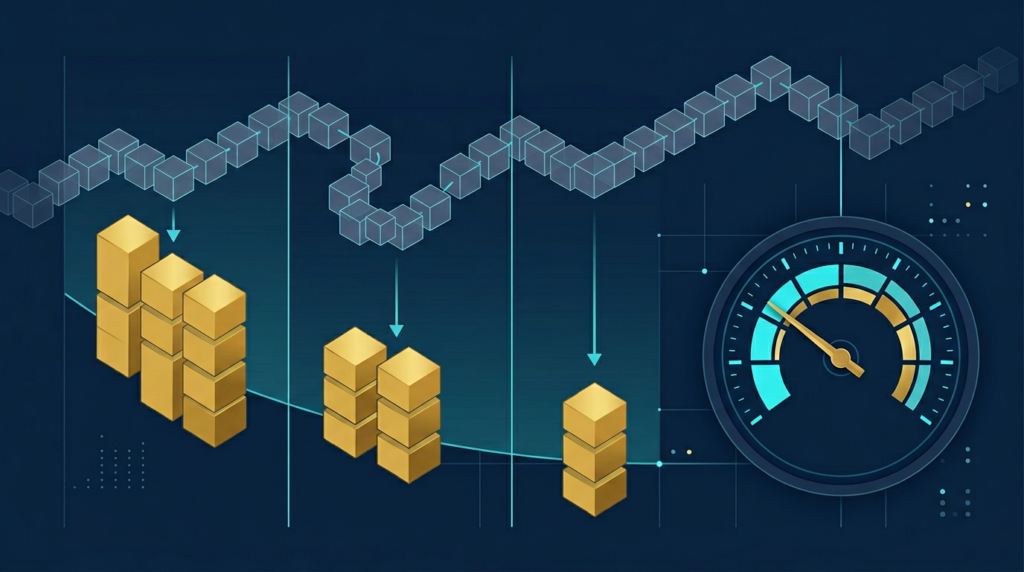
A useful mental model is to think of the subsidy as Bitcoin’s faucet of new issuance. The faucet does not shut off all at once. It narrows in steps. Each halving makes the flow smaller, which is how supply growth slows over time while the network keeps producing blocks.
Why the Halving Exists
Bitcoin was designed with a fixed maximum supply, but the network still needed a way to distribute coins over time and reward miners for securing the chain. The halving schedule solves both goals at once. Early on, a larger subsidy bootstrapped mining and distribution. Over time, the subsidy declines so that total issuance approaches the 21 million cap in a predictable way.
That predictability is one of Bitcoin’s core monetary features. No committee votes on the issuance rate every few years. The reduction schedule is part of the consensus rules that full nodes enforce. As long as users run software that respects those rules, the issuance path remains transparent and hard to change.
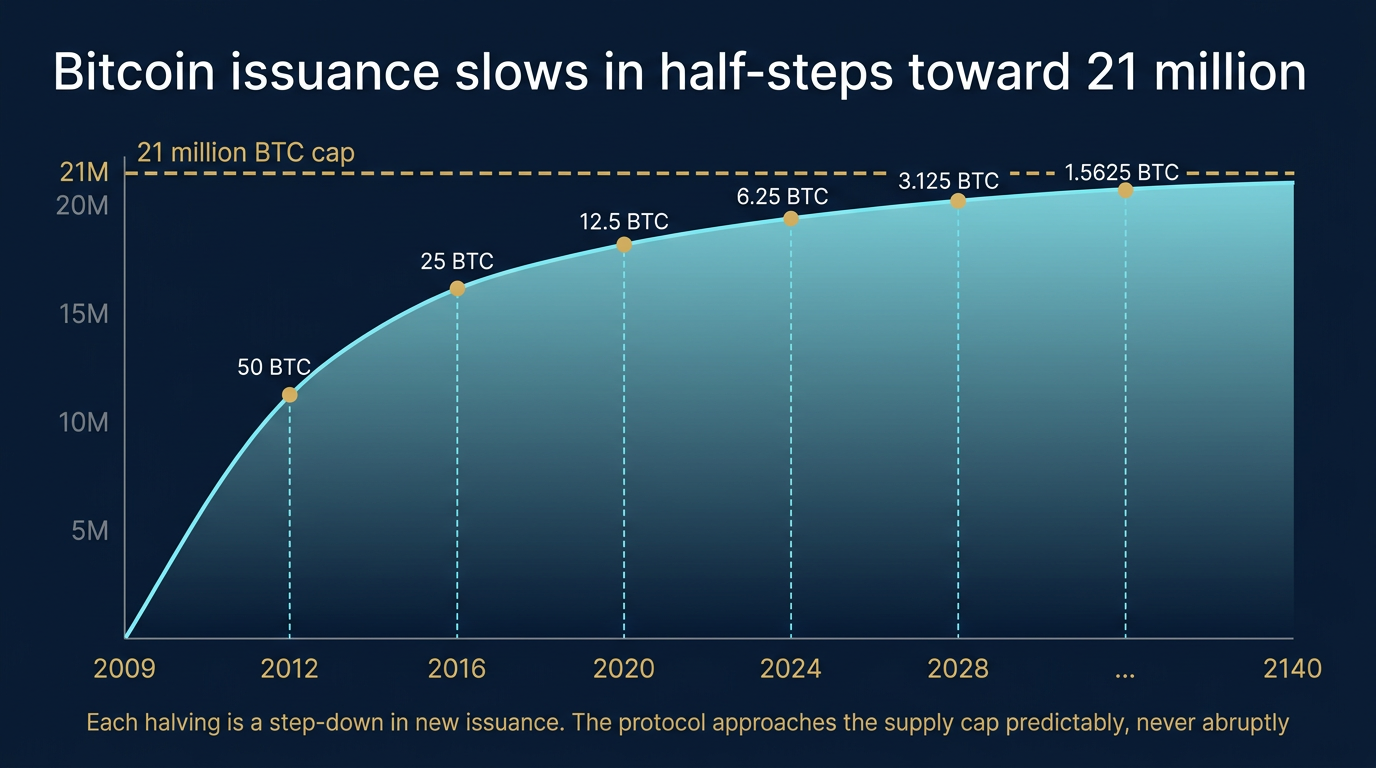
Another mental model helps here: the halving is less like a surprise economic policy change and more like a countdown timer baked into the machine from day one. Markets may react to it, miners may have to adapt to it, but the rule itself is not discretionary.
How the 210,000-Block Schedule Works
Bitcoin targets an average block time of about ten minutes. At that pace, 210,000 blocks works out to roughly four years. Because block production is probabilistic, the exact calendar date of each halving shifts slightly. Blocks may be found a little faster or slower than average depending on hash rate and difficulty during that era.
The protocol does not ask whether four calendar years have passed. It only checks block height. Once the chain reaches the next halving height, the subsidy for new blocks drops automatically according to the rule.
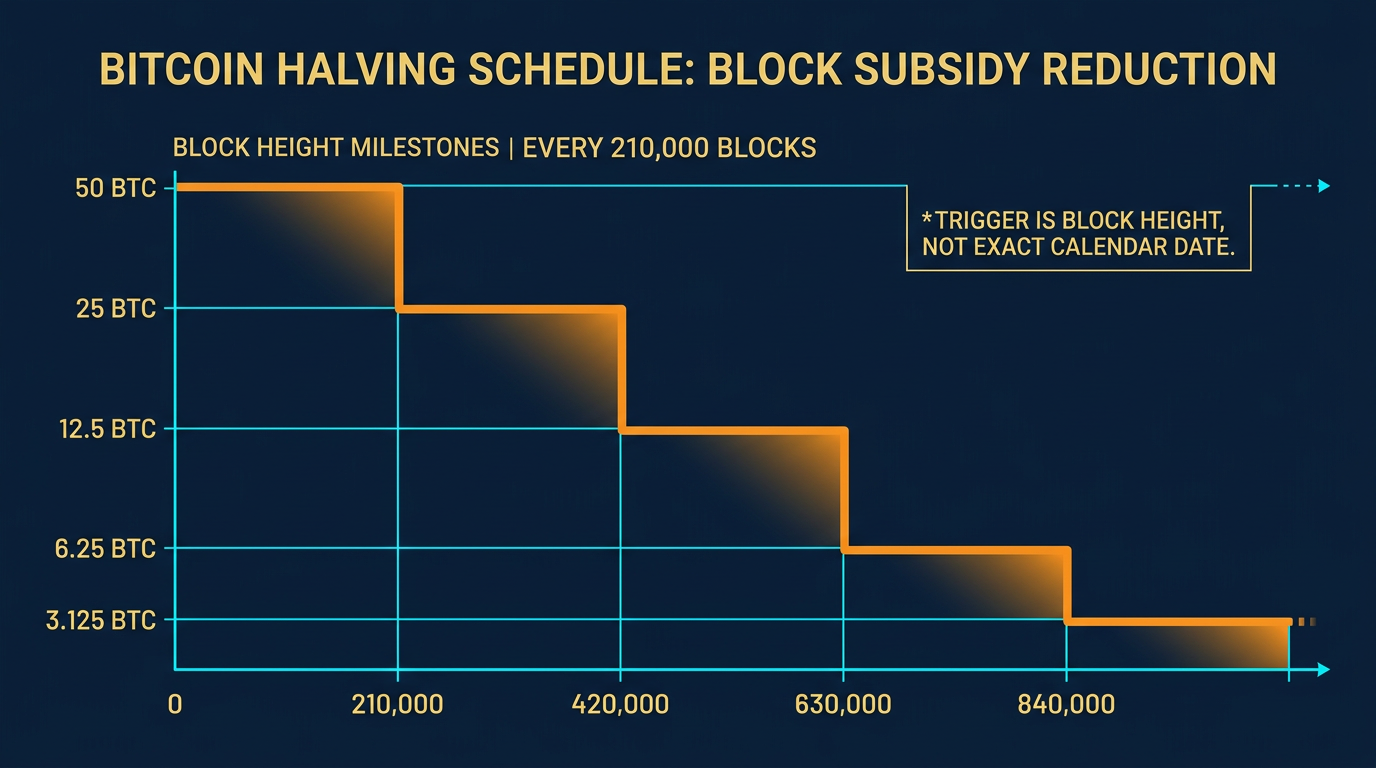
For the infrastructure behind that timing, the most relevant follow-ups are Bitcoin Network Hashrate and Bitcoin Mining Difficulty Explained. Hashrate changes block timing in the short run, and difficulty pushes the network back toward the ten-minute average over longer windows.
What the Halving Changes for Miners
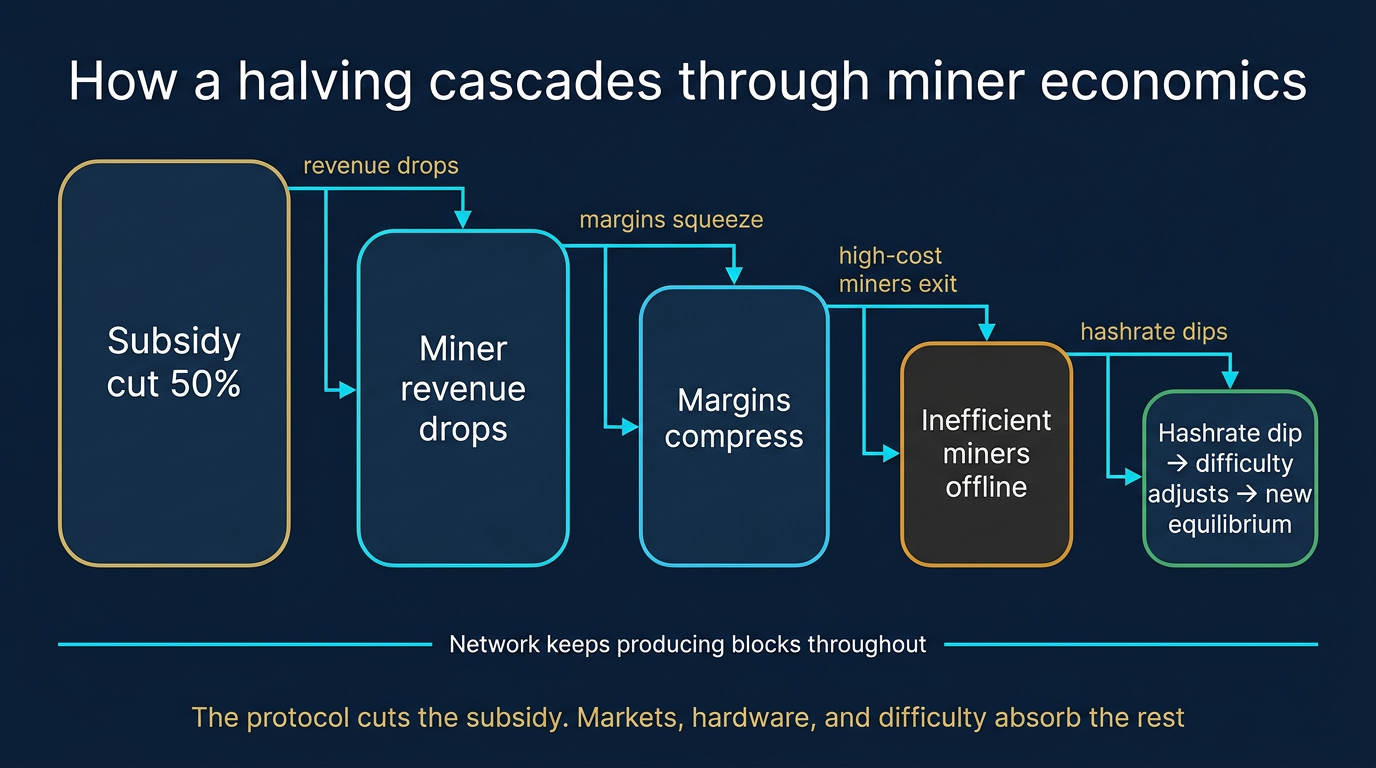
The immediate effect is that miners earn half as much newly issued BTC per block as they did before, assuming the same fee environment. That puts pressure on mining economics overnight. Operators with inefficient hardware or expensive electricity can become less profitable or even unprofitable, while more efficient miners are better positioned to stay online.
One operator insight is that the halving does not hit all miners equally. The protocol cuts everyone’s subsidy, but the business effect depends on energy contracts, hardware age, financing structure, treasury strategy, and access to lower-cost power. That is why the post-halving environment often favors larger or more efficient operators.
Another operator insight is that miner pressure does not always show up as an immediate network crisis. Some miners hedge, some upgrade hardware ahead of time, and some rely more heavily on fees or treasury management. The visible effect is often a gradual reshuffling of who can mine profitably rather than a dramatic single-day collapse.
What Happens to Hashrate and Difficulty After a Halving
If the subsidy reduction makes some mining operations uneconomic, part of the network hash rate may shut down. If enough miners leave, blocks can arrive more slowly for a period because the current difficulty was calibrated for a higher level of mining power. That slowdown is temporary rather than permanent.
Bitcoin’s difficulty adjustment then recalibrates the mining target, usually every 2,016 blocks, so the remaining miners can again find blocks close to the intended schedule. This is one reason halvings are important economically but not fatal operationally. The protocol has a built-in mechanism for absorbing changes in mining participation.
The practical point is that a halving does not mean blocks suddenly stop. It means the miner revenue mix becomes tighter, and the network may go through a period of adjustment before a new equilibrium emerges.
What the Halving Does Not Change
| Common misunderstanding | What is actually true |
|---|---|
| The halving cuts user balances | Only the block subsidy is halved. Your BTC holdings are unchanged. |
| Transaction fees are halved by rule | Fees are set by block space demand, not the subsidy schedule. |
| The halving happens on a fixed date | The trigger is block height. Calendar estimates are always approximate. |
| The 21 million supply cap changes | The cap remains fixed. The halving only slows how quickly new coins are issued. |
| A price increase is guaranteed | Issuance changes mechanically. Market outcomes depend on demand and broader conditions. |
This last point matters because halving discussions often slide into price prediction. The protocol event is real and mechanical. Market reactions are separate questions involving demand, speculation, miner behavior, and broader macro conditions.
Practical Usage: How to Interpret a Halving
For most users, the halving is best understood as part of Bitcoin’s long-term monetary design rather than as a trading signal. It tells you how new issuance slows over time and why the network’s inflation rate declines across eras. If you are evaluating Bitcoin as a system, the important question is how the subsidy schedule interacts with miner incentives, fee markets, and security over the long run.
If you want the foundational definition behind this concept, read Bitcoin Transaction Fees Explained: Why They Change.
For a closely related follow-up, see UTXO Consolidation Explained: What It Is and When to Do It.
For the risk side of this topic, see Wallet Address Reuse Risks: What It Exposes On-Chain.
- Read it as a supply-schedule event: The main protocol change is slower issuance of new BTC.
- Watch miner adjustment, not just headlines: Hashrate, difficulty, and fee conditions show how the network is absorbing the revenue change.
- Separate protocol facts from market narratives: The halving is deterministic even when price commentary around it is noisy.
- Connect it to other Bitcoin mechanics: Difficulty, hashrate, and fee markets explain the operational side better than scarcity slogans do.
- Use it to understand eras of issuance: Each halving period marks a new stage in how quickly fresh supply enters circulation.
A simple practical framing is this: the halving matters because it changes miner revenue and future issuance, not because it magically changes every other Bitcoin variable at once. If you want to judge the real effect, watch how miners adapt and how the network settles after the event rather than relying on one-day narratives.
Risks and Common Mistakes
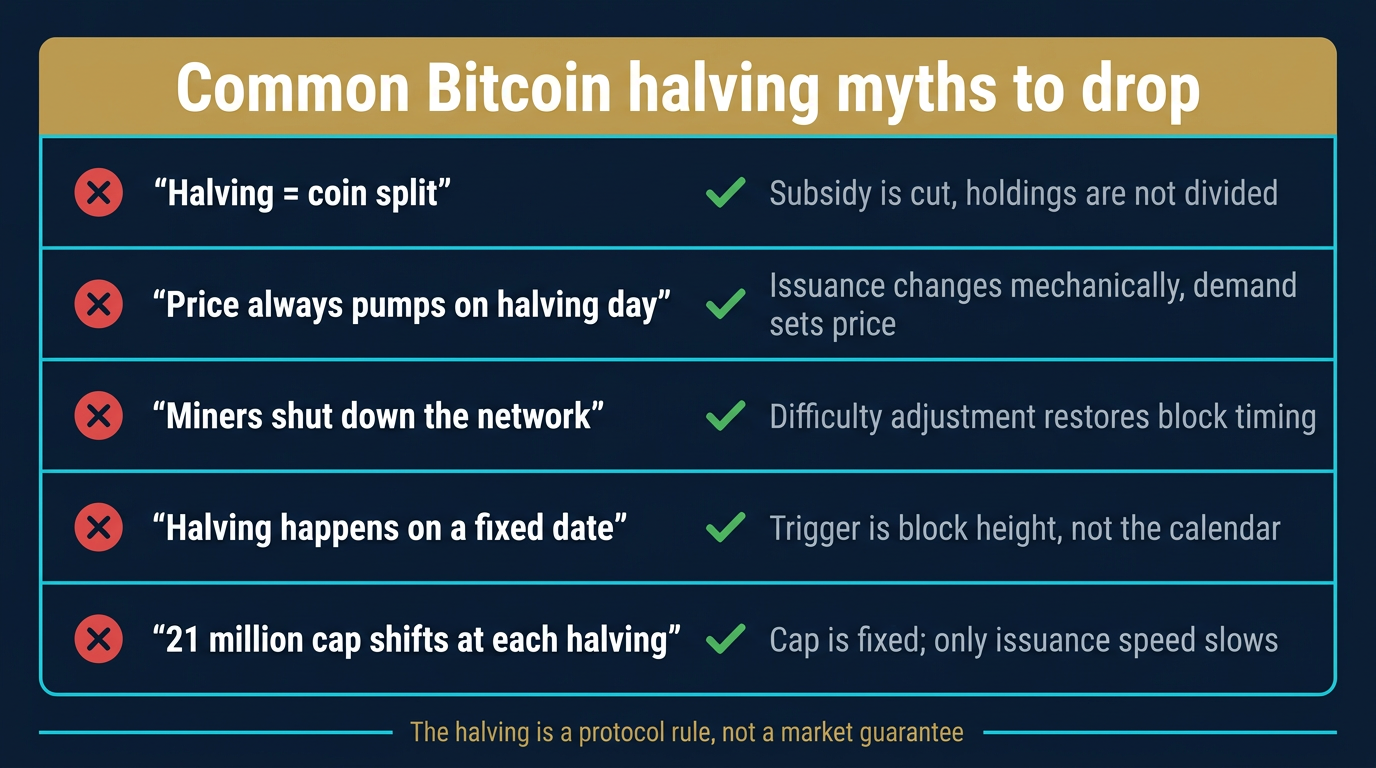
- Confusing the halving with a coin split: The event reduces the subsidy; it does not divide existing holdings.
- Assuming price effects are automatic: Supply issuance changes mechanically, but market outcomes still depend on demand and broader conditions.
- Ignoring miner economics: The main immediate stress falls on mining profitability, not on the basic ability of users to hold BTC.
- Forgetting the role of difficulty: If some miners leave, the network has a built-in adjustment process that helps restore normal block timing.
- Treating the calendar date as exact: The trigger is the next relevant block height, so timing estimates are always approximate.
Sources
- Bitcoin Developer Reference: Block Chain
- Blockstream Glossary: Halving
- Fidelity Digital Assets: The Economics of a Bitcoin Halving
Frequently Asked Questions
What is the halving in Bitcoin?
It is the programmed event that cuts the block subsidy paid to miners in half every 210,000 blocks. It slows the rate at which new bitcoin enters circulation while keeping the network’s consensus rules intact.
How often does a halving happen?
About every four years, but the exact timing depends on block production. The protocol triggers it by block height rather than by calendar date.
Does the halving reduce transaction fees?
No. The subsidy is what gets reduced. Transaction fees are determined by demand for block space and the current fee market, not by the halving rule itself.
What happens to miners after a halving?
Miner revenue from newly issued BTC is cut in half per block. Less efficient miners may come under pressure, some hash rate may leave, and difficulty may later adjust if network mining power changes enough.
Does the halving guarantee the price will rise?
No. The event changes issuance, but market price still depends on demand, liquidity, macro conditions, miner selling behavior, and investor expectations. The protocol itself does not encode a price reaction.