

Last Updated on April 14, 2026 by Snout0x
Metal vs paper seed storage is a practical security decision because your backup is the only recovery mechanism for a self-custody wallet. If it is destroyed or lost, your funds are gone. Paper is the default for most users; metal backups add physical resilience but require a larger investment. The right choice depends on how long you plan to store funds and what physical threats are realistic in your situation.
If you want the foundational definition behind this concept, read What Is a Hardware Wallet? Key Storage Explained.
For the risk side of this topic, see Crypto Wallet Phishing Attacks: How Attackers Target Your Wallet.
For a closely related follow-up, see Exchange Withdrawals Will Pause Again.
The practical decision framework is this: use paper only when balances are modest, storage time is short, and the backup lives inside a genuinely protective environment such as a quality safe. Choose metal when the funds are meaningful, the time horizon is measured in years, or a single fire or flood event would be unacceptable. The comparison is really about durability margin, not just material preference.
This content is for educational purposes only and should not be considered financial or investment advice.
Key Takeaways
- Paper seed backups are simple and free but degrade in fire, flood, and humidity.
- Metal backups are fire-resistant (typically to 1,400 degrees Celsius or higher) and waterproof.
- Both formats are only as secure as where you store them: physical location matters more than material.
- Never store the seed phrase digitally, regardless of format.
- Redundant copies in different locations reduce the risk of total loss.
Metal vs Paper Seed Storage: Paper Backups
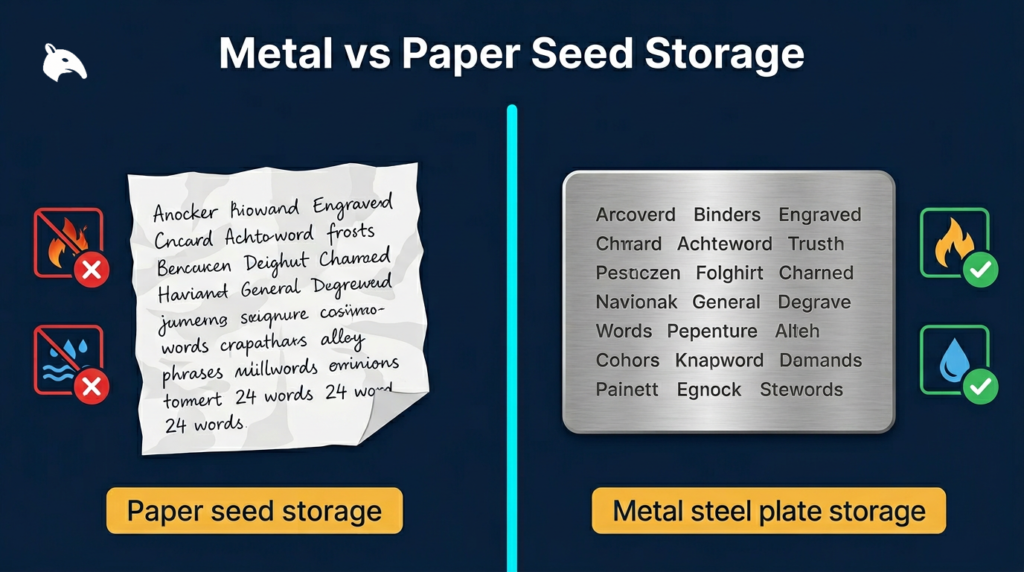
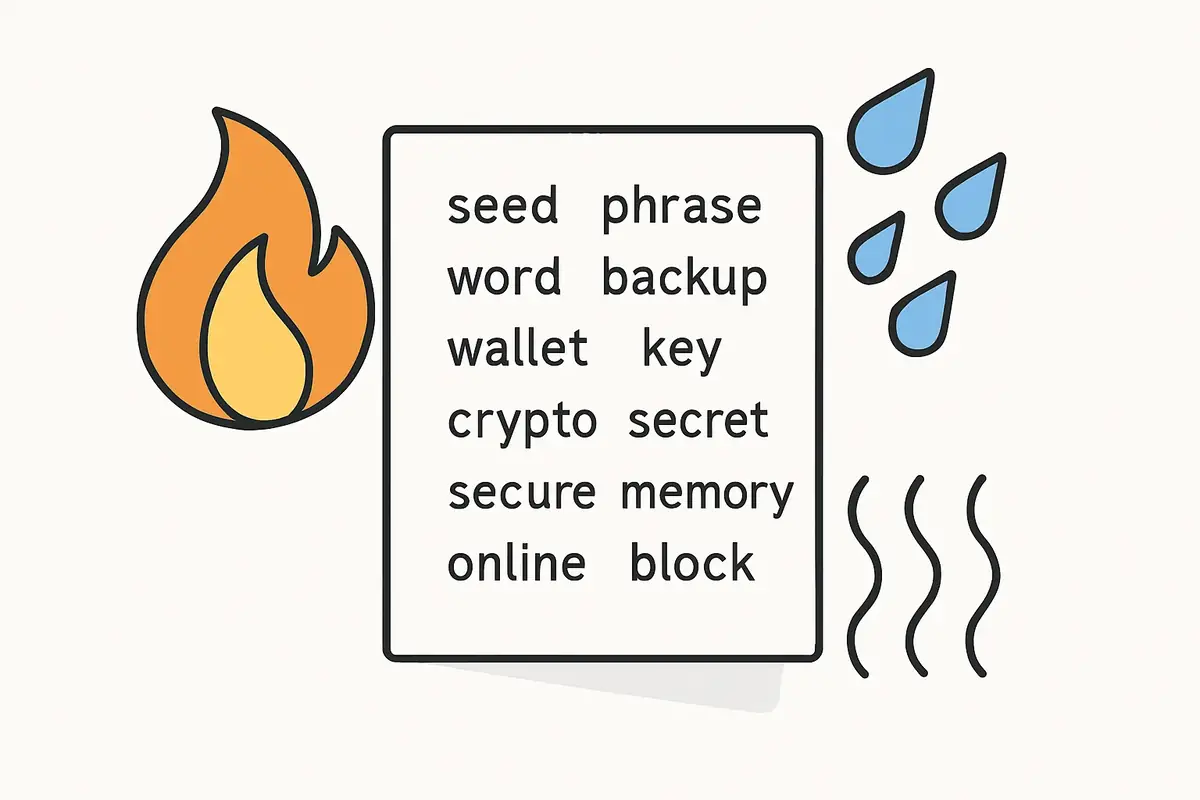
Most hardware wallets ship with paper cards for recording the recovery phrase. Paper is accessible, inexpensive, and works immediately. The limitation is physical fragility.
- Fire: Paper burns at approximately 230 degrees Celsius. A house fire easily reaches temperatures that destroy paper backups.
- Water: Paper degrades when wet. A flood or burst pipe can render a paper backup unreadable.
- Ink fading: Over years, ink on certain paper types fades or smears, particularly in humid environments.
- Physical damage: Tearing, folding repeatedly, or general wear reduces readability over time.
Paper backups stored inside a fireproof safe in a dry location significantly reduce these risks. For most users holding modest amounts, a high-quality fireproof safe plus a paper backup is adequate.
Metal Seed Storage
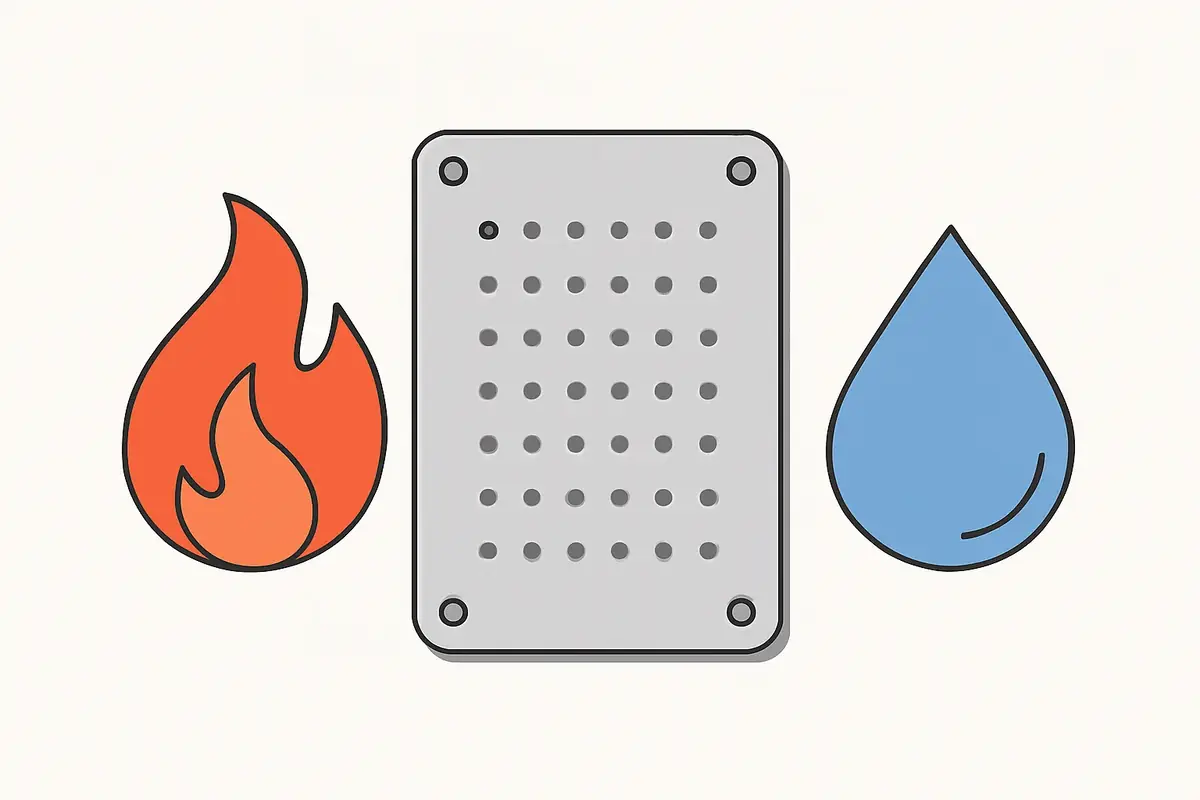
Metal seed backup devices use stainless steel, titanium, or similar alloys to store seed words by stamping, engraving, or tile-based lettering. They are designed to survive conditions that destroy paper.
- Fire resistance: Stainless steel plates survive temperatures well above standard house fire peaks.
- Waterproof: Metal is unaffected by flooding, humidity, or liquid exposure.
- Corrosion resistance: Quality alloys (316L stainless steel, Grade 5 titanium) resist rust over decades.
- Impact resistance: Metal withstands physical damage that would destroy paper.
The trade-off is cost. Metal seed backup solutions range from around $30 for basic stamping kits to over $100 for purpose-built tile-based systems. Setup requires more time and care to ensure every word is correctly recorded without transcription errors.
Practical Usage: Choose Based on Your Threat Model
- Cost: Paper is effectively free. Metal costs $30 to $150 depending on the product.
- Setup time: Paper takes 2 minutes. Metal requires careful stamping or tiling, typically 10 to 30 minutes.
- Fire resistance: Paper burns at about 230 degrees Celsius. Stainless steel withstands over 1,400 degrees Celsius.
- Water resistance: Paper degrades. Metal is unaffected.
- Long-term durability: Paper degrades over years. Quality metal lasts decades or longer.
- Risk of transcription error: Similar for both; both require careful word-by-word verification after creation.
The verdict is straightforward. Paper is a reasonable starting point for smaller balances or temporary storage when it is protected inside a dry, fire-resistant location. Metal is the better long-term answer for serious self-custody because it preserves recovery through the kinds of household disasters that destroy paper. If you expect the backup to matter years from now rather than weeks from now, metal is usually the stronger choice.
Risks and Common Mistakes
The medium matters less than the location and access controls. A metal backup left in an obvious place is no more secure than paper in a safe. Storing the backup in the same location as the hardware wallet itself means a single theft event captures both. Use physically separate, secure locations for the backup and the device.
Never create a digital copy of the seed phrase. Photographs, cloud documents, password managers, or notes apps are all higher-risk than any physical format. Digital copies can be accessed remotely; physical ones cannot.
For a comparison of backup devices on the market, see Best Seed Phrase Backup Devices. If you want the device and backup sides of the setup to work together, Hardware Wallet Setup Best Practices is the most relevant next step.
Frequently Asked Questions
Is laminated paper as durable as metal?
No. Lamination adds modest water resistance and reduces surface wear, but it does not meaningfully improve fire resistance. The laminating plastic itself melts well below house fire temperatures.
Should I make multiple copies?
Yes. Having two or three copies stored in different physical locations (a home safe, a secure location away from home, a trusted third-party vault) protects against any single location being destroyed or compromised.
Which metal is best for seed storage?
316L stainless steel and Grade 5 titanium are the most commonly used materials. Both offer excellent corrosion and heat resistance. Titanium is lighter; stainless steel is more common and typically less expensive.
Can I use a QR code backup instead of written words?
Some systems allow QR or encoded backups, but most standard recovery processes require entering the BIP-39 mnemonic words. Storing only a QR code may lock you out if the software needed to decode it is unavailable in the future. Plain word backups are the most portable and recoverable format.
Is it worth using metal for a small amount of crypto?
That depends on your time horizon. If you plan to hold for years, even modest amounts benefit from durable backups. If you expect to access or move funds within months, paper in a safe is a reasonable starting point.