

Last Updated on April 16, 2026 by Snout0x
If you want to choose a crypto wallet well, start by ignoring the app-store rankings and hardware-wallet marketing pages for a moment. A wallet is really a key-management system plus a transaction-signing interface. The right choice depends on who controls the keys, where signing happens, how recovery works, and how much money or risk you expect that wallet to carry. Once those pieces are clear, the wallet category usually becomes obvious.
For most people, the practical answer is straightforward: use an exchange for trading access, a hot wallet for small active balances, and a hardware wallet for larger or longer-term holdings. The decision gets easier when you stop asking which wallet is “best” in general and start asking which wallet should handle this specific balance, this specific activity, and this specific recovery burden.
This content is for educational purposes only and should not be considered financial or investment advice.
Key Takeaways: How to Choose a Crypto Wallet
- Start with custody, not branding: The first decision is whether you want an exchange account, a self-custody hot wallet, or a hardware wallet that isolates keys from internet-connected devices.
- Match the wallet to its job: A trading balance, a daily-use DeFi wallet, and a long-term savings wallet usually should not live in the same place.
- Recovery design matters: A wallet is only as strong as its backup process, seed phrase storage, and ability to recover safely onto a new device.
- Threat model beats feature lists: The best wallet for crypto depends on your balance size, on-chain activity, device hygiene, and tolerance for operational complexity.
- Do not optimize for convenience alone: Many wallet failures come from using one highly exposed wallet for every transaction, every dApp, and every long-term holding.
Wallet Types Compared
You should compare wallet types by job and failure mode, not by branding alone.
| Type | Best For | Risk Level | Key Control |
|---|---|---|---|
| Exchange | Buying, selling, short-term liquidity | High for long-term storage | Platform controls keys |
| Hot wallet | Daily use, DeFi, active on-chain activity | Medium to high | You control keys on an internet-connected device |
| Hardware wallet | Long-term storage, larger balances | Lowest of the three when used properly | You control keys on a dedicated device |
A Simple Safe Wallet Setup (Most Users)
Most people do not need a complicated wallet stack. They need a structure that separates convenience from storage. The practical default is simple: use the exchange only for buying or selling, keep a small hot-wallet balance for activity, and move long-term holdings to a hardware wallet. If your balance is meaningful, you should not rely on a hot wallet alone.
- Exchange: buying, selling, deposits, withdrawals in progress
- Hot wallet: small active balance for apps, swaps, and daily transfers
- Hardware wallet: long-term storage and larger balances you do not need to move often
The point is not complexity. The point is making sure one compromised app session or one exchange problem cannot touch everything you own.
How to Choose a Crypto Wallet Starts With Key Control
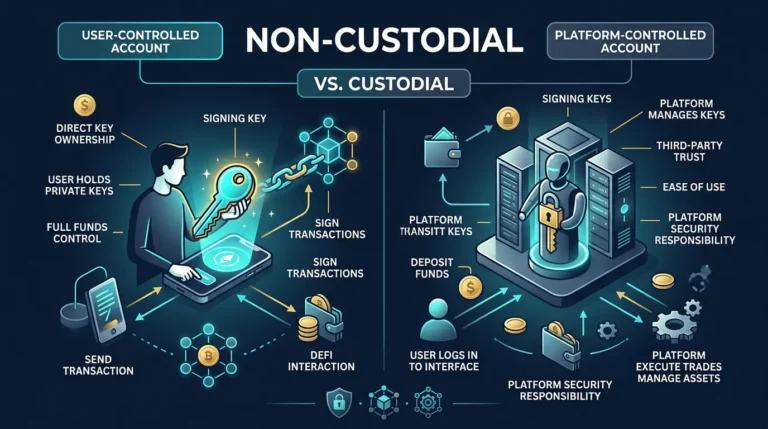
Before comparing devices or apps, separate custodial access from real wallet control.
Exchange accounts and self-custody solve different problems
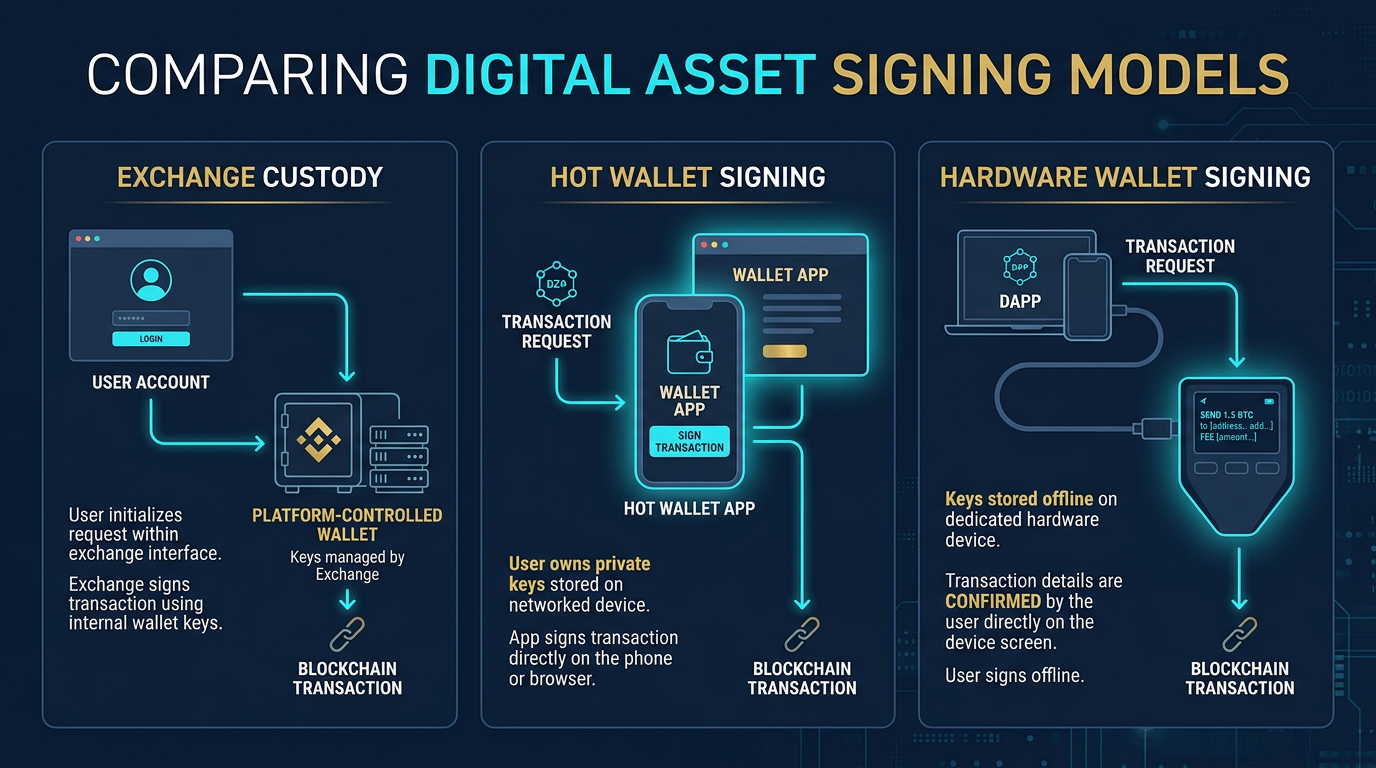
An exchange account is optimized for trading, conversion, and fiat ramps. In that model, the platform usually controls the private keys and records your balance in an internal ledger. That can be useful when speed and market access matter, but it is not the same thing as holding coins in a wallet you control. If that distinction is still fuzzy, the most relevant next step is how to store crypto safely, because the custody model determines where each balance should live.
A self-custody wallet changes the trust model. Instead of depending on a company to process withdrawals, your wallet controls the credentials needed to authorize transactions on-chain. That also means mistakes become your responsibility. Losing a recovery phrase, exposing a device, or signing a malicious approval request can all lead to loss without any help desk undo button. When you choose a crypto wallet, you are choosing which failures you are willing to manage yourself. If you are not ready to protect recovery material, you are not ready to self-custody a meaningful balance.
Where signing happens determines a large part of the attack surface
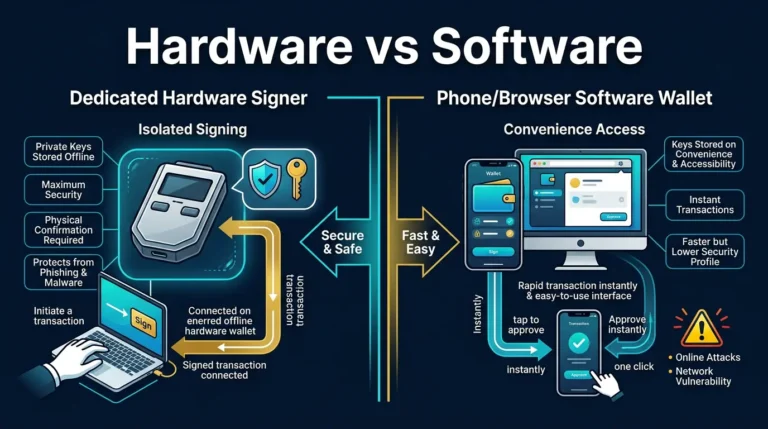
Wallets differ most meaningfully in where transaction signing takes place. In a browser or mobile hot wallet, signing happens on a general-purpose device that is connected to the internet and constantly interacting with websites, extensions, apps, and QR flows. That makes hot wallets convenient, but it also means malware, fake prompts, and malicious dApps have more chances to influence what you approve.
Hardware wallets narrow that attack surface by moving key operations into a dedicated device. The computer or phone still prepares the transaction, but the signing step happens inside the wallet after you confirm details on the device itself. That extra boundary matters because it forces an attacker to compromise more than a browser session. It also makes clear why topics like transaction signing and screen verification are central to wallet selection, not optional technical trivia.
Match the Wallet to the Job It Performs
Wallet choice becomes easier when you stop looking for one perfect wallet and start assigning roles.
Trading and on-ramp activity favor access, not deep storage
If the balance exists mainly for active orders, fiat deposits, or near-term swaps, the main requirement is operational access. That often means an exchange account or a simple hot wallet connected to a trusted service. The mistake is assuming that because a setup is good for movement, it is also good for storage. Fast access and long-term safety usually pull in different directions. Money with an immediate trading job can stay accessible. Money without a job should move out.
A wallet should be sized to the role it performs, not to your total portfolio.
Hot wallets make sense for frequent on-chain interaction
Hot wallets are useful when you regularly connect to DeFi apps, mint NFTs, bridge funds, or send payments from a phone. Their strength is speed. Their weakness is exposure. If you are going to use a hot wallet, pick one whose recovery flow you understand, whose chain support matches what you actually use, and whose interface makes approvals readable instead of hiding transaction details behind vague buttons.
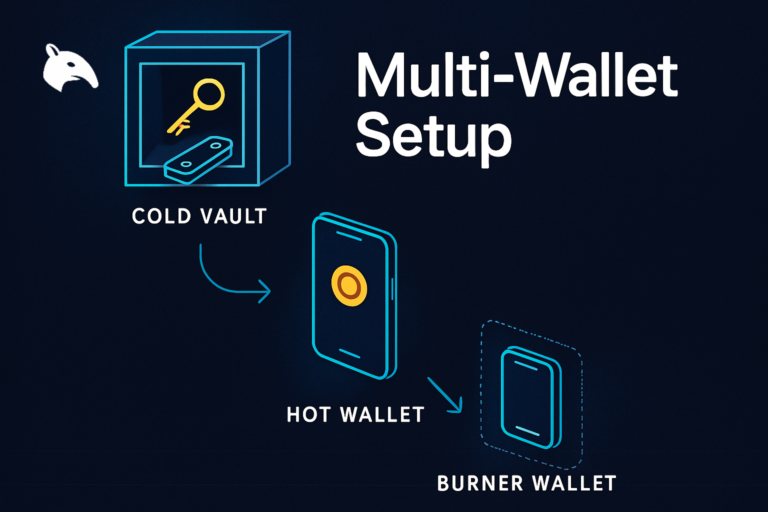
A good hot-wallet setup is usually limited in balance and purpose. Many users are better served by one wallet for routine on-chain activity and another wallet for higher-value assets that should not be exposed to every dApp session. If you want the threat pattern that turns hot wallets into liabilities, study crypto wallet phishing attacks. Using one hot wallet for every app and every balance is a preventable mistake.
Hardware wallets fit long-term balances and slower decisions
If funds are meant to sit for months or years, a hardware wallet is often the most practical answer because it separates key storage from the laptop or phone you use every day. That does not make every hardware wallet equally good. Some prioritize secure-element designs, some emphasize open-source transparency, and some focus on air-gapped transaction flow. Your choice should reflect whether you value broad compatibility, clearer device verification, or maximum isolation from internet-connected hardware.
For most non-technical users, the sweet spot is not the most exotic cold-storage setup. It is a reputable hardware wallet with a recovery process you have documented and tested. If you have decided that category fits your situation, review what a hardware wallet is before getting lost in model comparisons. Do not solve a storage problem with a convenience wallet.
Recovery Design Matters More Than Extra Features
Most wallet comparisons overemphasize supported coins, app polish, or companion software. Recovery quality is usually more important.
Seed phrases and backup standards affect long-term portability
Many wallets rely on BIP-39 seed phrases to derive keys and restore access on another device. That matters because a wallet with portable backup standards gives you options if a company disappears, a device breaks, or you need to migrate to a more appropriate setup later. A wallet that looks elegant but traps you in a proprietary recovery flow may feel simple today and become a problem later. Recovery portability is not a nice extra. It is part of the safety model.
When you choose a crypto wallet, ask a basic question: if this app or hardware vendor vanished tomorrow, could you still restore my funds safely? The answer depends on seed format, derivation support, export options, and whether the wallet clearly documents recovery steps. A wallet is not just the interface you use when everything works. It is the recovery process you rely on when things go wrong.
Device replacement and backup testing are part of wallet selection
A good wallet should make replacement manageable without encouraging sloppy backup habits. That means you should understand how to restore to a new device, how passphrases interact with seed recovery if you use them, and whether address display on the new device is easy to verify before sending real funds. These are not advanced edge cases. Phones break, laptops get wiped, and hardware gets lost. If you have never tested the recovery path, you do not yet know whether the wallet setup is safe.
Backup design also interacts with your physical security plan. Someone choosing a wallet for a larger balance should already be thinking about durable seed storage, device separation, and whether an advanced setup like an air-gapped wallet is genuinely necessary or just adding complexity. In many cases, a simpler wallet with disciplined backups beats a more sophisticated wallet used carelessly.
Threat Model Questions That Narrow the Right Wallet
You do not need a perfect threat model document, but you do need a realistic picture of what could go wrong for you.
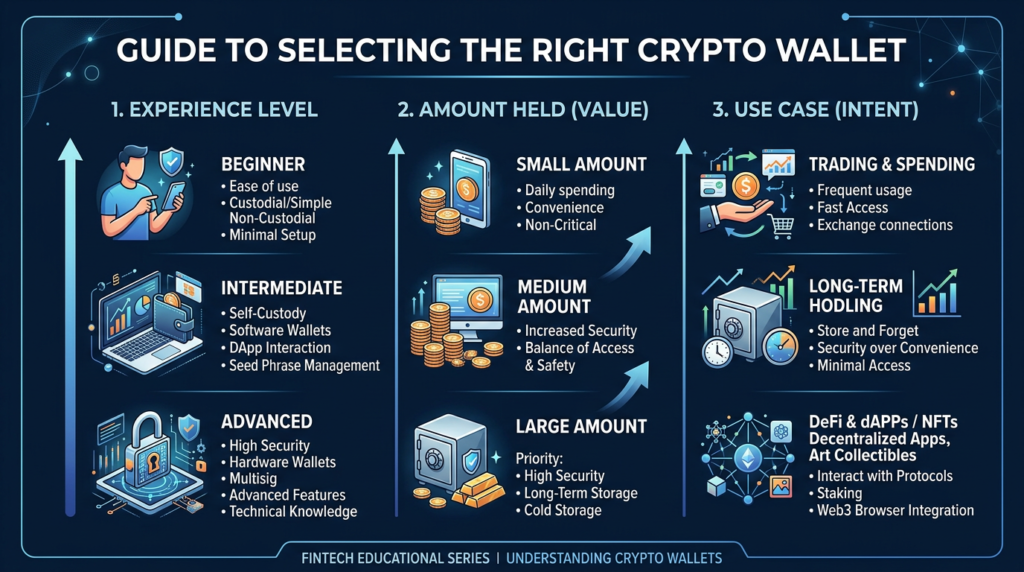
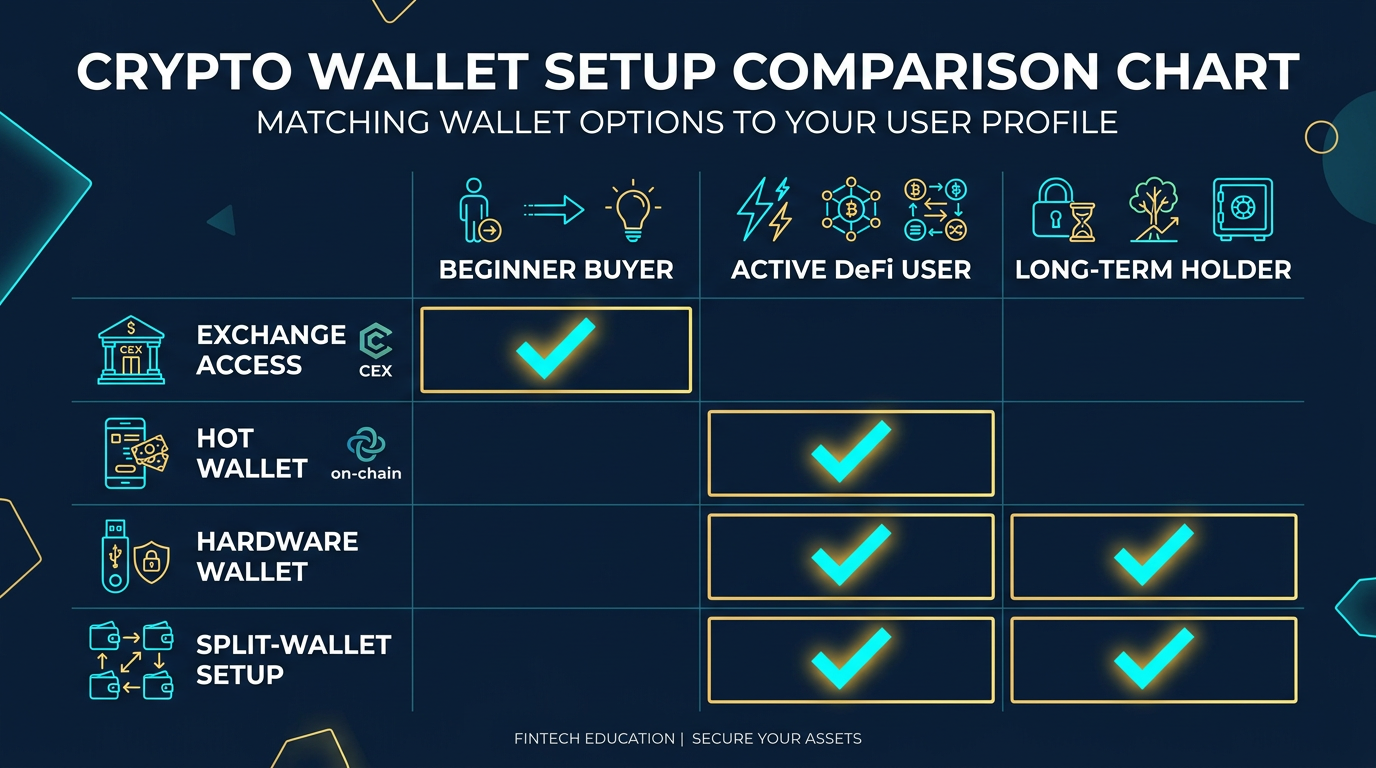
The beginner buyer needs clarity and recoverability
A beginner usually does not need the most advanced wallet. They need one that makes addresses readable, backup instructions explicit, and chain support hard to misunderstand. The biggest beginner risks are often sending to the wrong network, losing recovery words, or being pushed into bad habits by confusing UX. If the wallet roles still feel abstract, start with what a crypto wallet is. Beginners should optimize for clarity before they optimize for features.
For smaller balances, a software wallet may be enough if the user understands that convenience comes with exposure. If holdings grow, the wallet ecosystem should let them graduate to better security later without starting over.
The active on-chain user needs separation and readable approvals
A DeFi-heavy user lives in a different risk environment. They connect wallets frequently, approve token allowances, sign messages, and interact with new contracts. For them, the best wallet for crypto is rarely a single wallet. It is usually a layered setup: one hot wallet for experimentation, another for more serious on-chain activity, and a colder wallet that does not directly touch every protocol. Active on-chain users should assume one approval mistake can happen and structure around that reality.
In this case, wallet selection should emphasize transaction clarity, connection hygiene, and easy blast-radius control. If a wallet makes it hard to tell what a signature does, or encourages constant reuse of one highly funded address, it may be the wrong tool even if it supports every chain you want. Strong wallet selection is really strong exposure management.
The long-term holder needs isolation and process discipline
A long-term holder usually cares less about app polish and more about key isolation, backup durability, and calm transaction flow. They do not need to sign five transactions per day. They need a wallet that makes rare but important actions deliberate. That often means a hardware wallet, a well-planned seed backup, and a smaller everyday wallet for any funds that actually need to move. Long-term storage should be inconvenient compared with spending, because that friction is part of the protection.
The common failure is a convenient mobile wallet that slowly becomes a vault. Convenience drift turns a spending wallet into a savings wallet without any corresponding security upgrade. Decide in advance how much value each wallet holds and when assets move between tiers.
Common Mistakes When People Choose a Crypto Wallet
A useful wallet is not the same thing as a safe wallet for every job. Several selection errors show up repeatedly.
Choosing by coin count or interface polish alone
Wallet marketing often highlights the number of supported assets, sleek design, or fast setup. Those things matter only after the security and recovery model is acceptable. A wallet can support hundreds of assets and still be a poor fit if it encourages weak backup practices or exposes a large balance to daily browsing activity. Asset coverage is useful, but it should not outrank control of keys, clarity of signing, and portability of recovery.
Using one wallet for every chain, app, and savings goal
Another common error is collapsing every role into one wallet because managing multiple wallets feels annoying. That creates a large blast radius. A single compromised browser session, malicious contract approval, or stolen device then affects every asset you own. In practice, strong wallet selection often means deciding where not to use a wallet just as much as deciding where to use it.
Ignoring device verification and supply-chain trust
People often spend hours comparing wallet features and almost no time thinking about how they buy, initialize, and verify the device or app itself. That is backwards. A hardware wallet with a strong security model still needs to come from a trusted source and be verified properly before use. A software wallet downloaded from the wrong site or app listing can fail before key generation even begins.
Practical Usage: A Simple Framework to Choose a Crypto Wallet
Work through this sequence in order. Each step narrows the right choice before you compare specific devices or apps.
If the answers point toward convenience and a modest balance, a well-chosen hot wallet may be enough. If they point toward infrequent movement and meaningful savings, a hardware wallet usually makes more sense. If they point toward constant trading, you are choosing market access and accepting custodial risk for a limited balance. The right answer is the structure that matches the job, not the wallet with the loudest reputation.
A practical decision sequence: assign the funds a job, decide whether the balance belongs under your own key control or under an exchange account, choose the signing environment that matches that role, and test the recovery path before scaling the balance. Set a maximum amount for any hot wallet, define when funds must sweep into a colder wallet, and review that rule whenever your balance or activity changes. If you cannot explain where the recovery phrase is stored and how you would restore it, the setup is not ready.
Sources
- BIP-39 Specification – Reference for mnemonic seed phrases and wallet recovery portability.
- Bitcoin Developer Documentation – Background on wallet models, keys, and transaction behavior in Bitcoin systems.
- Ethereum Developer Documentation – Overview of accounts, wallets, signing, and common interaction patterns on Ethereum.
FAQ: How to Choose a Crypto Wallet
What type of crypto wallet is best for beginners?
For beginners, the best wallet type is usually one that makes backups, addresses, and network selection easy to understand rather than one with the most advanced features. A simple software wallet can work for smaller balances, while a hardware wallet becomes more attractive once holdings are meaningful enough that better key isolation is worth the extra setup.
Should I use one crypto wallet or several?
Using several wallets is often safer because it lets you separate roles. Many people benefit from one wallet for active on-chain use, another for routine storage, and a colder wallet for larger long-term holdings. That way one bad approval, compromised browser, or stolen phone does not expose everything.
When does a hardware wallet make sense?
A hardware wallet makes sense when the balance is large enough, long-term enough, or important enough that you want signing to happen outside the phone or computer you use daily. It is especially useful for holders who move funds infrequently and care more about controlled, verified transactions than about instant convenience.
What matters most when comparing crypto wallets?
The most important comparison points are who controls the keys, where signing happens, how recovery works, and whether the wallet fits the role you want it to play. Supported assets and interface design matter, but they come after the custody and recovery model is acceptable.
Can I change wallets later without moving to a worse setup?
Usually yes, if your wallet uses standard recovery methods and you understand the migration path. Good wallet selection includes thinking ahead about portability. A setup based on well-documented seed recovery and clear backup procedures gives you more flexibility to upgrade security later without losing access or creating confusion.