

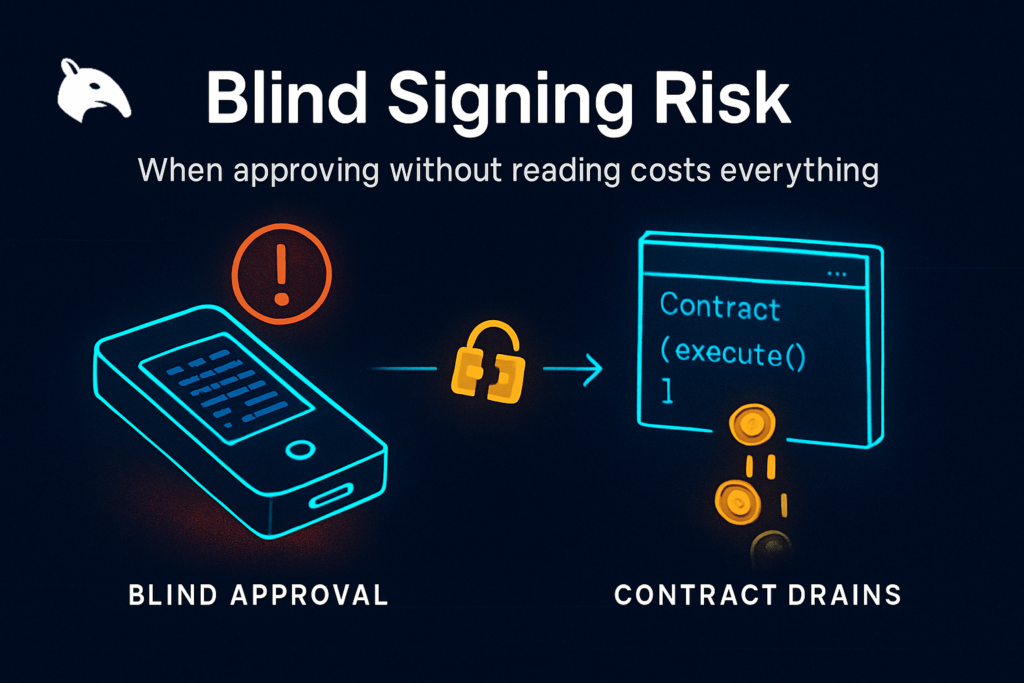
Blind signing is dangerous because it turns the most important security step in a crypto workflow into a guess. When a wallet cannot show what a transaction or message actually does in a human-readable way, the user may still produce a valid signature that authorizes something harmful. The blockchain does not care whether the user understood the prompt. It only checks whether the signature is valid.
That is why unreadable approvals, vague contract warnings, and raw data prompts create real loss paths. A user can unknowingly approve token spending, authorize a malicious contract interaction, or confirm a fake claim flow while believing they are just clicking through routine wallet friction. The danger is not abstract. It is that an unreadable prompt can still become a real on-chain permission.
This content is for educational purposes only and should not be considered financial or investment advice.
Quick Answer
Blind signing is dangerous because it allows malicious or misunderstood actions to be approved without meaningful verification. If you cannot read what the wallet prompt will do, you can still authorize a valid transaction that drains tokens, grants permissions, or triggers other harmful outcomes.
Key Takeaways
- Unreadable prompts can still create valid permissions: A blockchain only checks signature validity, not user understanding.
- Blind signing often hides approval risk: Users may authorize token spenders or malicious contract calls without realizing it.
- Hardware wallets reduce key exposure, not judgment risk: If the device cannot show the action clearly, the human can still approve a bad transaction.
- Attackers rely on speed and routine: The danger increases when users click through prompts as if they are harmless friction.
- The right default is refusal: If the action is unreadable, incomplete, or unclear, do not sign it.
Why This Risk Matters So Much
In crypto, the signature is the permission. That means the moment you sign, the system treats the action as authorized. If the prompt was misleading, truncated, or unreadable, the chain does not pause and ask whether you were rushed, confused, or shown vague data. It simply executes what the signed payload allows.
How Users End Up Signing Blind
Most users do not decide to take reckless risk on purpose. They sign blind because the workflow feels familiar, the site looks polished, and the wallet prompt appears to be a routine step. In other cases, the device or wallet simply fails to decode the action into clear language, leaving the user with a warning, a hex blob, or vague labels like “data” and “set approval.”
Operator insight: blind signing rarely feels like a dramatic security event while it is happening. It feels like impatience. It feels like one extra click to get through a staking flow, a bridge flow, or a claim flow. That is exactly why it is so exploitable. The user is being asked to replace verification with momentum.
What Can Go Wrong After One Blind Signature
- Malicious token approvals: You may authorize a spender contract that can pull tokens later.
- Bad contract interactions: A fake mint, bridge, or claim flow can trigger a harmful call that looks routine from the frontend.
- Persistent permission exposure: The danger can remain after you close the tab because the approval lives on-chain.
- False safety assumptions: Users may believe a hardware wallet or familiar app automatically made the action safe.
The automated theft path behind this often overlaps with What Is a Crypto Drainer?. The drainer does not need your seed phrase if you already signed the wrong permission.
Why Approval Scams Fit This Pattern Perfectly
Approval scams are one of the clearest examples of blind-signing danger. The wallet prompt may look like a normal approval step, but if the spender address, limit, and purpose are not readable or not checked, the user may grant a malicious contract the ability to pull tokens later. Nothing about the blockchain marks that approval as suspicious if the user signed it willingly.
That is why Crypto Approval Scams is the most relevant companion attack page. A lot of “wallet drains” are really signing failures first and theft events second.
Why Hardware Wallets Help, But Do Not Eliminate This
Hardware wallets help by isolating the private key and keeping signing away from an infected phone or computer. But they do not remove the need for human verification. If the trusted screen shows only fragments, an “unverified contract” warning, or undecoded data, then the user is still making a security decision without enough usable information.
That is the core point behind Hardware Wallet Screen Security. A hardware wallet is safer than a hot wallet for key storage, but it is not magic if the device cannot explain the action clearly enough for you to verify it.
Where This Shows Up Most Often
- DeFi wallet connections: Users connect wallets and move through approval flows too quickly.
- Fake airdrop or reward claims: The prompt looks routine even when the action is not.
- Complex swap or bridge routes: Extra contract layers make the prompt harder to verify.
- NFT and “verify wallet” pages: Social pressure and urgency make vague prompts easier to accept.
For the front-end workflow behind many of these interactions, DeFi Wallet Connection: How It Works is the best local mechanism explainer.
Practical Usage: How to Reduce This Risk
- Reject unreadable prompts: If the wallet cannot show what the action does, stop.
- Check spender, amount, and destination: Those details matter more than the site’s marketing language.
- Use devices and wallets with strong transaction parsing: Clearer prompts reduce guesswork.
- Slow down whenever the workflow feels unfamiliar: Urgency is often the attacker’s advantage.
- Review and revoke permissions: If you suspect a bad approval, treat it like an active risk until removed.
A useful rule is this: if you would struggle to explain the prompt out loud before approving it, you should not sign it yet.
Risks and Common Mistakes
- Assuming the wallet would stop a bad action automatically: Wallets can display warnings, but they still execute what you approve.
- Treating unreadable prompts as normal Web3 friction: Repeated exposure can make dangerous behavior feel routine.
- Trusting the website more than the signing prompt: A polished interface can hide a harmful contract action.
- Ignoring permissions that remain after the session ends: A malicious approval can be used later, not just immediately.
- Using a device beyond what its screen can verify: Small or poorly decoded prompts create false confidence.
Sources
- Ledger Support: Enable Blind Signing in the Ethereum App
- MetaMask Support: What Is a Token Approval?
- Revoke.cash: What Are Token Approvals?
Frequently Asked Questions
Why is blind signing dangerous in crypto?
It is dangerous because a valid signature can approve a harmful action even if the user could not read what the prompt really meant.
Can a hardware wallet still be risky if I sign blind?
Yes. A hardware wallet protects the private key, but it does not make an unreadable or undecoded transaction safe to approve.
Can one blind signature drain a wallet?
Yes, especially if the signature grants a malicious contract the ability to spend tokens or triggers a harmful contract call.
What should I do when a wallet shows an unverified contract warning?
The safest default is to stop and verify the action independently. If the wallet cannot explain the prompt clearly, refusing to sign is safer than guessing.
What habit reduces this risk the most?
The most useful habit is refusing to sign anything you cannot explain in plain language before approval.