

Last Updated on April 17, 2026 by Snout0x
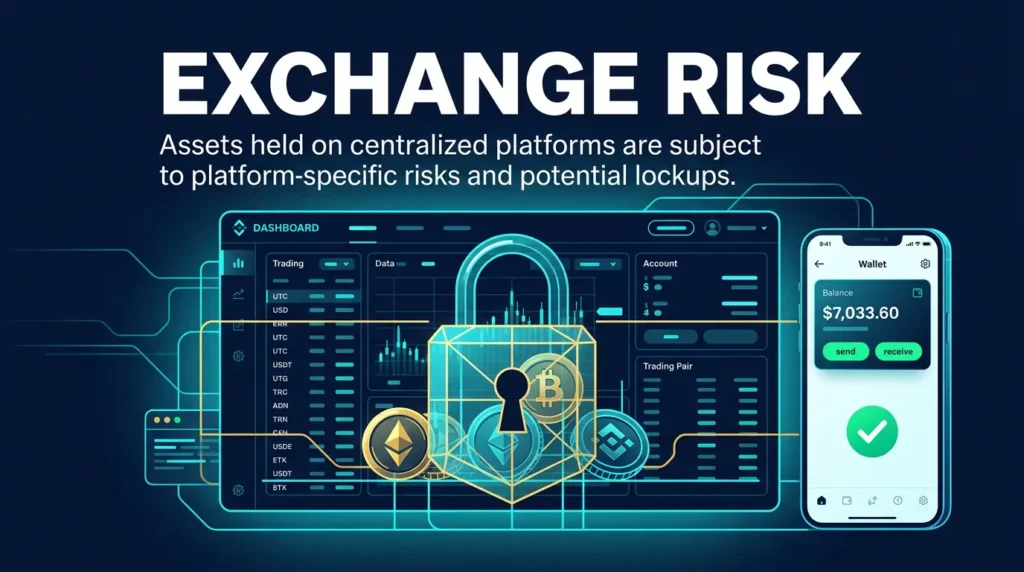
The biggest risk of keeping crypto on an exchange is not price volatility. It is custodial dependence. Once a platform controls the keys, your access to funds depends on the exchange’s operations, policies, liquidity, and legal structure rather than on your direct ability to sign a transaction. That difference can feel minor in normal times and become decisive under stress.
This article is the practical risk-control layer for users who already understand that an exchange is convenient but want to think more clearly about what can go wrong when balances stay on-platform too long.
This content is for educational purposes only and should not be considered financial or investment advice.
Key Takeaways
- An exchange balance is a counterparty relationship: You may own the value economically, but the platform controls movement operationally.
- Risk is wider than “the exchange got hacked”: Freezes, insolvency, account restrictions, and withdrawal delays matter too.
- Convenience can hide exposure: Funds often stay on-platform by habit long after they stopped needing exchange access.
- Long-term holdings usually fit poorly on exchanges: The longer funds sit idle there, the more you are accepting custodial risk without gaining real utility.
- The best defense is role-based storage: Keep operational balances on-platform and move reserves into wallets you control.
Why Exchange Risk Exists at All
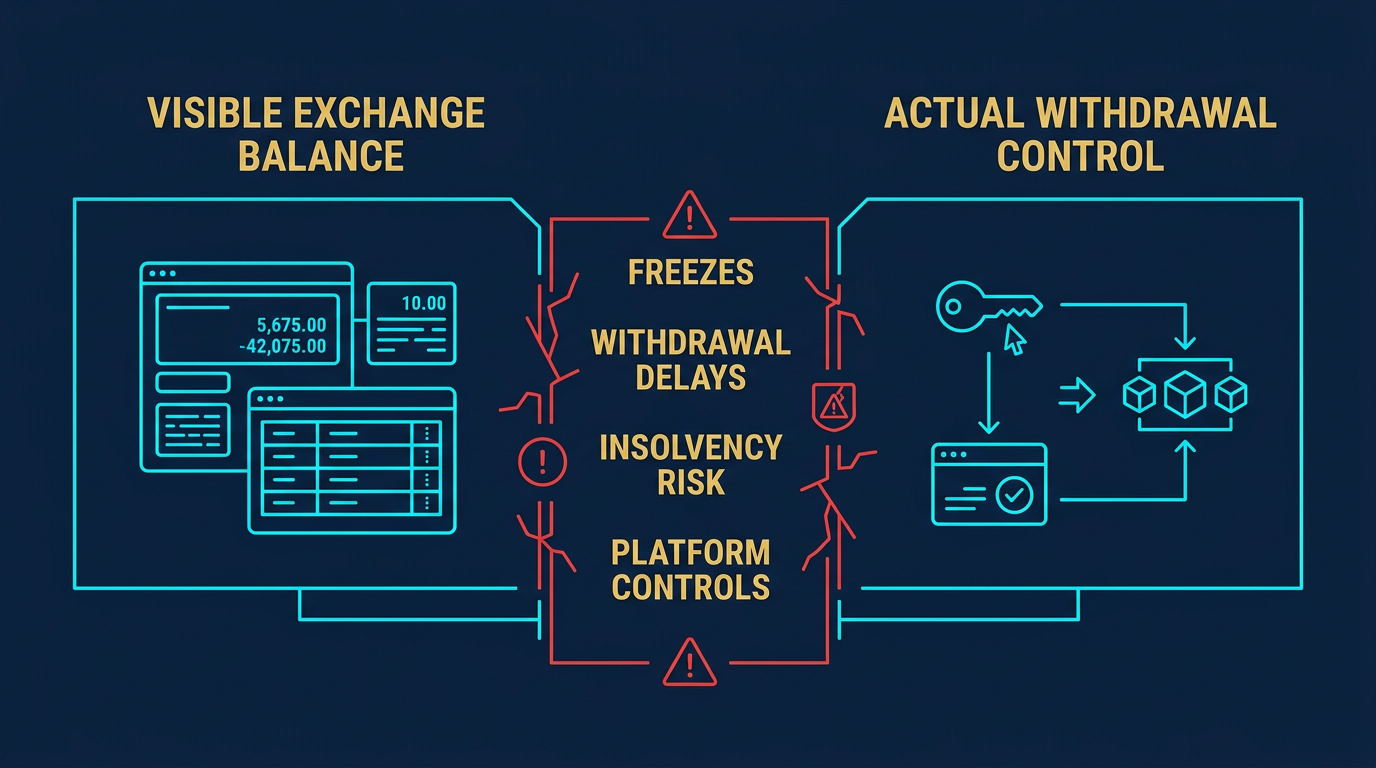
When crypto sits on an exchange, the platform usually holds the wallet infrastructure and the keys behind it. Your account shows a balance, but that balance is an internal claim inside the exchange’s system, not direct blockchain control. In calm conditions, the distinction can feel invisible. In stressed conditions, it becomes the whole story.
A useful mental model is this: coins on an exchange are easy to view and trade, but they are not independent from the platform’s operational health. If the exchange slows withdrawals, changes access rules, or fails outright, the balance on screen may remain visible while your control over it weakens sharply.
Counterparty Risk Is the Core Problem
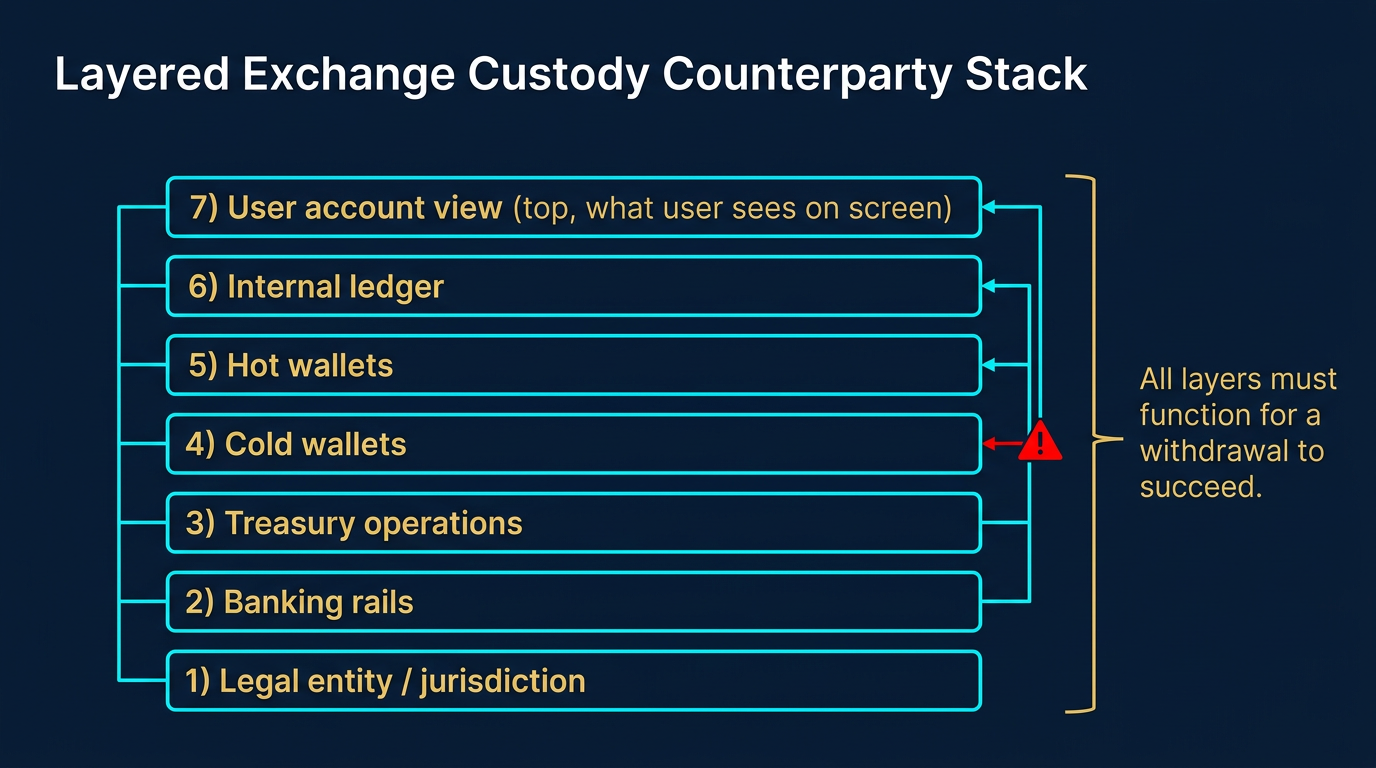
Counterparty risk means your outcome depends on another entity doing what it is supposed to do. With exchange custody, that entity is the platform. It must remain solvent, process withdrawals honestly, manage treasury operations correctly, maintain working banking rails, keep records accurately, and defend accounts against abuse. If any of those layers break, your funds may become harder to reach even if the underlying blockchain is functioning normally.
This is why exchange risk is fundamentally different from holding assets in self-custody. The chain may be healthy while the access layer around your account is not. For the definition side of that distinction, the most relevant local explainer is What Is Crypto Custody.
Withdrawal Freezes and Delays
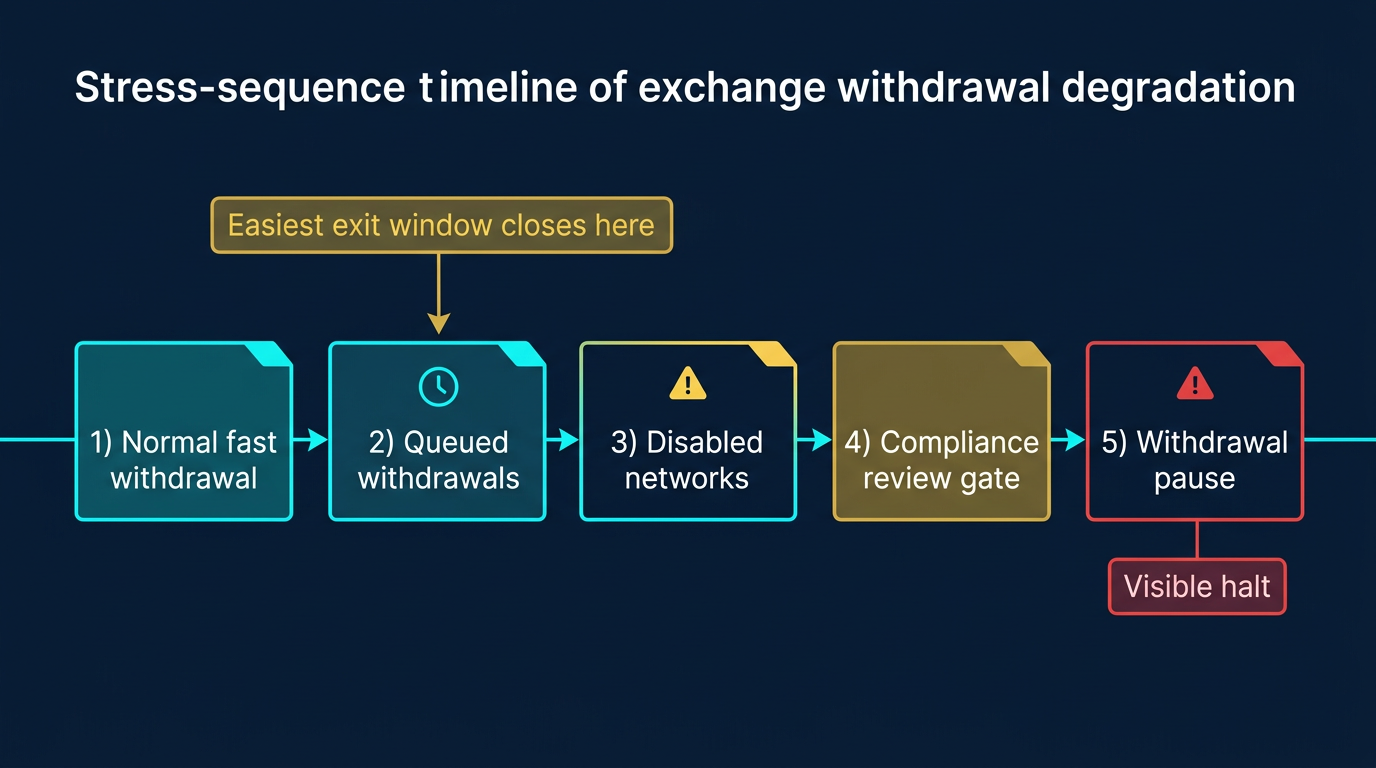
Many users think funds are safe as long as they can still log in and see a balance. That is not the right test. The real test is whether you can withdraw when you choose on a reasonable timeline. Exchanges can pause transfers because of maintenance, compliance reviews, internal risk flags, banking issues, liquidity pressure, or stress events during volatile markets.
Real-world scenario: a user wants to move funds off an exchange during a sudden market scare. The platform still shows the balance, but withdrawals are queued, some networks are disabled, and support responses slow down. The user has not “lost” the funds in the obvious sense, but control has already deteriorated at the worst possible time.
For the more extreme version of that problem, see What Happens During the Collapse of a Crypto Exchange?.
Insolvency and Failure Risk
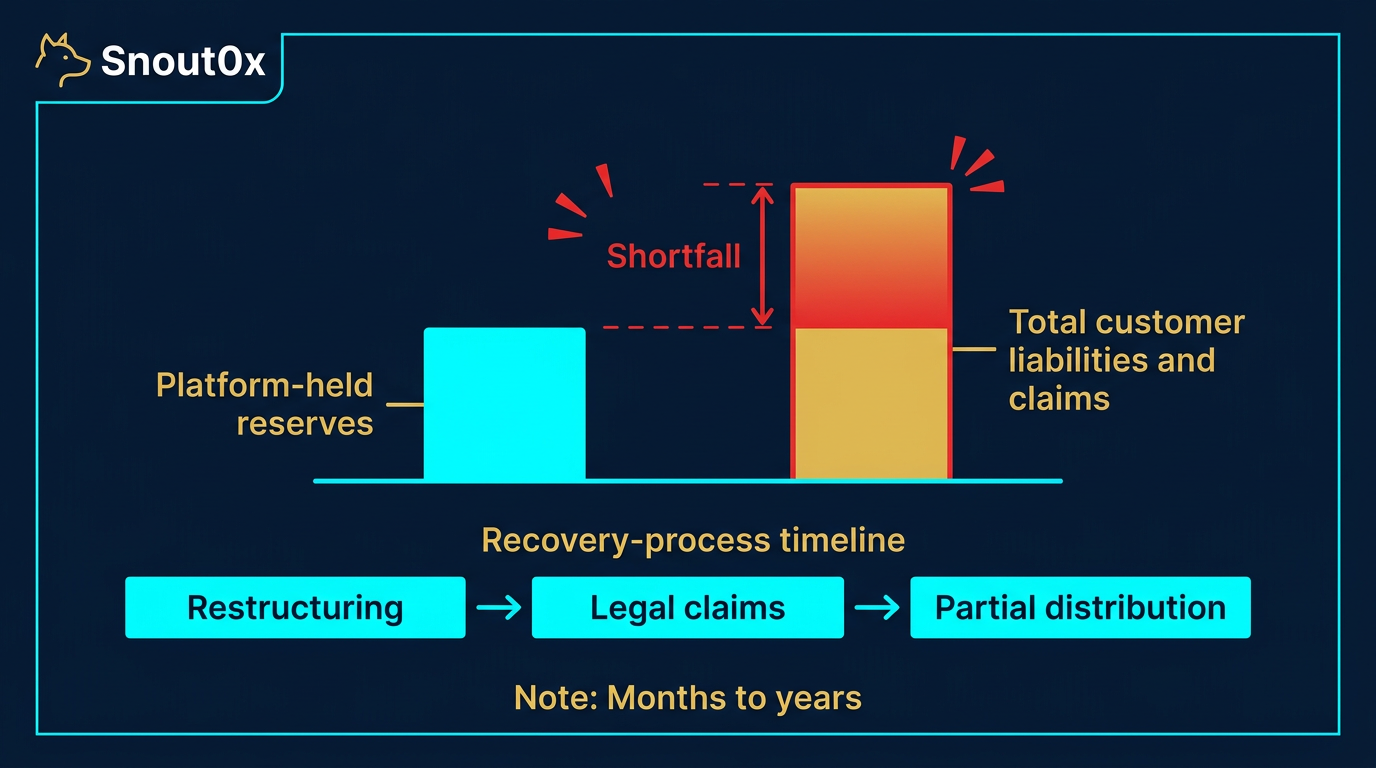
If an exchange becomes insolvent, the user’s problem shifts from access inconvenience to legal recovery risk. At that point, balances may become claims in a restructuring or bankruptcy process rather than assets the user can simply withdraw. Recoveries can take months or years, and they may depend on the platform’s custody structure, records, and terms of service.
Operator insight: people often imagine exchange failure as a dramatic headline, but the operational risk starts earlier. By the time insolvency is undeniable, the easiest exit window is often already closed.
Account Restriction and Compliance Risk
Exchange accounts also carry identity and compliance dependencies. Withdrawal limits, enhanced verification requests, source-of-funds questions, travel-rule requirements, and account reviews can affect access even when the platform itself is healthy. This is one reason custodial accounts behave differently from self-custody wallets.
Real-world scenario: a user needs to move funds quickly but the exchange requests additional verification before allowing the transfer. The issue is not solvency. It is that the account relationship includes compliance controls that can matter suddenly when timing is important.
Account Takeover Is Still Part of Exchange Risk
Even if the platform itself is sound, an exchange account can still be compromised through email takeover, weak passwords, SMS-based recovery abuse, phishing, or social engineering. In that case, the risk is not exchange insolvency but the fact that your account security depends on identity systems and recovery channels rather than just key control.
That makes exchange security feel closer to online banking risk than to pure wallet risk. It is a different threat model with different weak points.
Why Idle Balances Are the Worst Fit
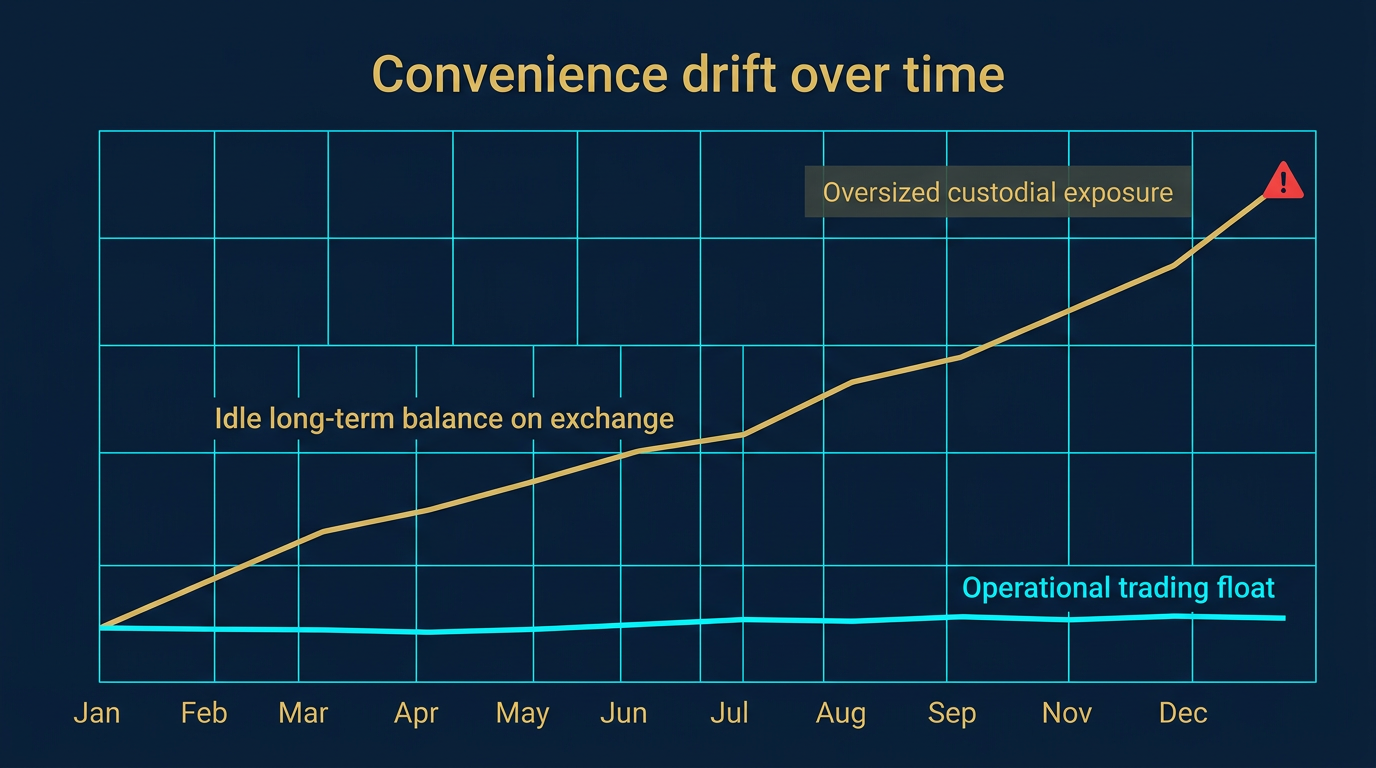
The weakest reason to keep funds on an exchange is simple inertia. Money intended for long-term holding often remains on-platform because the app is already open, the account is familiar, and moving funds feels like a task for later. That convenience drift is dangerous because it increases custodial exposure without adding much actual benefit.
Real-world scenario: a user buys BTC and stablecoins for long-term holding, leaves them on the exchange for convenience, and checks the app occasionally without trading. Months later, the funds are still sitting in a high-access custodial environment even though their real job was long-term storage all along.
How to Think About the Right Exchange Balance
The best way to manage exchange risk is to think in functions, not percentages. Funds that are actively being traded, converted to fiat, or withdrawn soon may need to remain on-platform temporarily. Long-term reserves usually do not. The right question is not “How much do I own?” but “What amount still has an immediate exchange job?”
The full decision framework for that is How Much Crypto Should You Keep on an Exchange?, which is the best follow-up if you want a role-based sizing model rather than just a risk list.
Practical Usage: How to Reduce Exchange Custody Risk
A useful operator rule is this: the less often funds need exchange functions, the less justified exchange custody becomes. Convenience is valuable for money in motion. It is weak justification for money at rest.
Risks and Common Mistakes
- Treating the dashboard as proof of control: A visible balance is not the same as immediate, independent withdrawal ability.
- Leaving long-term holdings on-platform by habit: Convenience drift often creates the largest custodial exposure.
- Ignoring identity-layer dependence: Exchange access can fail through account, email, recovery, or compliance problems without any blockchain failure.
- Waiting for certainty before reducing exposure: Users often want perfect proof of a problem when repeated access stress is already enough warning.
- Using one exchange account for every role: Trading capital, cash-out funds, and long-term reserves usually should not share the same custody stack.
Sources
Frequently Asked Questions
What is crypto exchange risk?
It is the risk that funds held on an exchange become harder to access or recover because of counterparty failure, withdrawal restrictions, account issues, or insolvency.
Is keeping crypto on an exchange risky?
It can be, especially for long-term holdings. Exchanges are useful for trading and conversion, but funds left there remain exposed to custodial and account-access risk.
What happens if an exchange freezes withdrawals?
You may still see a balance on-screen while losing the ability to move the funds on your own timeline. That is one of the clearest signs of custodial dependence.
Does KYC remove exchange risk?
No. Identity verification changes the account model, but it does not remove custody risk, solvency risk, or withdrawal dependence on the platform.
How can investors reduce exchange custody risk?
They can reduce it by keeping only operational balances on-platform, hardening account security, testing withdrawal routes early, and moving reserves into self-custody.