

Last Updated on April 3, 2026 by Snout0x
The Bitcoin mempool is the temporary holding area for valid transactions that have been broadcast to the network but not yet confirmed in a block. The key idea is simple: transactions do not go straight from your wallet into the blockchain. They first wait in node memory, compete on fee rate, and only then get chosen by miners. That waiting room is what users mean when they talk about “the mempool.”
For a closely related follow-up, see UTXO Consolidation Explained: What It Is and When to Do It.
For the broader overview around this topic, see What Is Blockchain?.
A simple way to think about the mempool is as Bitcoin’s temporary checkout line for block space. Transactions that meet the rules can enter the line, but they do not all move forward equally. The line is reordered constantly by fee rate, which is why some payments clear quickly while others wait.
This content is for educational purposes only and should not be considered financial or investment advice.
Key Takeaways
- The Bitcoin mempool is a queue of valid but unconfirmed transactions held by full nodes.
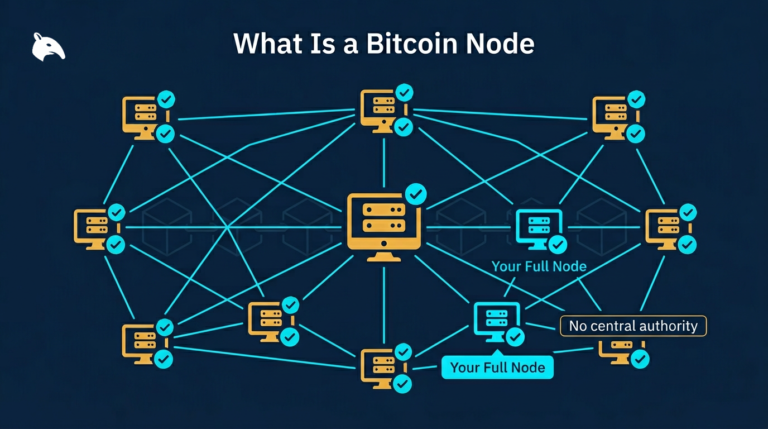
- There is no single global mempool; each node maintains its own local version based on the transactions it has seen and accepted.
- Miners choose transactions primarily by fee rate, which is why higher sat/vB payments usually confirm faster.
- Transactions leave the mempool when they are confirmed, replaced, or eventually dropped after waiting too long.
- Understanding the mempool helps you estimate fees, time transactions better, and diagnose why a payment is delayed.
The Basic Mechanism Behind the Bitcoin Mempool
When a wallet broadcasts a Bitcoin transaction, nearby nodes validate it before accepting it into memory. They check signatures, confirm that the inputs are unspent, and make sure the transaction follows the consensus and policy rules they enforce. If it passes those checks, the node stores it in its mempool and forwards it to peers, which repeat the same process.
That means the mempool is not the blockchain itself. It is a staging area that sits in front of block confirmation. A transaction can be valid, visible across the network, and still remain unconfirmed because miners have not chosen it yet. If you want the user-facing effect of that competition under pressure, see Bitcoin Mempool Congestion.
How Transactions Enter and Leave the Queue
Transactions enter the queue through wallet broadcasts, exchange withdrawals, payment processors, and any other application that submits raw Bitcoin transactions to the peer-to-peer network. Once widely propagated, they sit in node mempools until one of three things happens: a miner includes them in a block, a replacement transaction overrides them, or nodes eventually drop them to free memory.
That final outcome matters because a stuck transaction is not always permanently broken. If a low-fee payment waits too long and disappears from node memory, the wallet can often create a new version with a higher fee. This is easier when the wallet supports Replace-By-Fee. It is also why users should distinguish between “unconfirmed” and “lost.” Those are not the same state.
How Miners Decide What Gets Confirmed First
Miners build blocks from the mempool, but they do not choose randomly. They are economically motivated to maximize fee revenue from limited block space, so they sort candidates by fee rate. A transaction paying 50 sat/vB generally outranks one paying 10 sat/vB, even if the lower-fee transaction was broadcast earlier. That is why the mempool behaves like an auction for confirmation priority.
If you want the foundational definition behind this concept, read Bitcoin Transaction Fees Explained: Why They Change.
For a closely related follow-up, see How to Read a Blockchain Transaction Step by Step.
For a closely related follow-up, see Bitcoin vs Ethereum Transaction Model: Two Different Ways Blockchains Track Value.
The intuitive point is that confirmation priority is an auction, not a timestamp guarantee. Getting into the mempool means your transaction is valid enough to wait. It does not mean miners owe it an immediate spot in the next block.
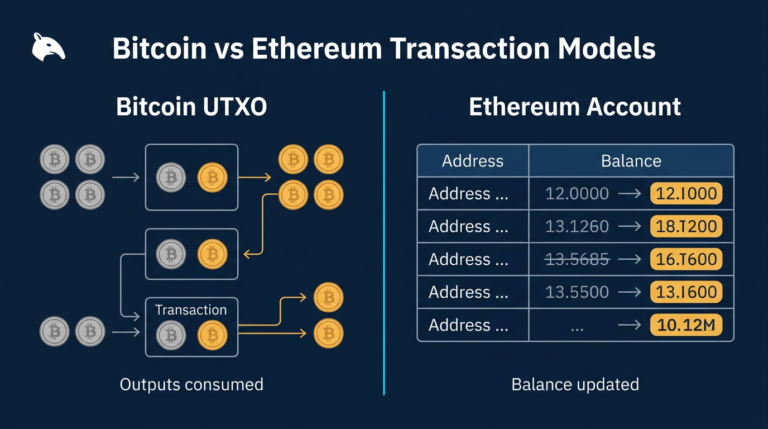
Transaction structure matters here. A payment with many inputs takes more virtual bytes than a simple one, which is why fee estimation depends on UTXO shape, not just the BTC amount being sent. If you need the underlying model behind those inputs and outputs, see What Is UTXO. The mempool is where those differently sized transactions compete against one another.
Why Different Nodes Can Show Slightly Different Pending Sets
Because every Bitcoin full node maintains its own mempool, there is no perfectly synchronized universal queue. Propagation takes time, nodes can have different memory limits, and local policy settings can vary. In normal conditions those differences are small, but they become more visible during high traffic or after a fresh transaction is first broadcast.
This is also why two explorers can briefly disagree about whether a transaction is visible or what fee rate seems necessary. They may be sampling different nodes at slightly different moments. The important point is not whether every node sees the exact same pending set instantly. It is that valid transactions spread widely enough for miners to consider them for inclusion.
Practical Usage
A practical use of mempool knowledge is fee timing. Before sending a non-urgent payment, check a live mempool viewer and compare the current fee bands for next block, within a few blocks, and economy confirmation. If the backlog is deep and the payment can wait, delay it instead of blindly accepting an expensive estimate. If the payment is urgent, choose a wallet that lets you set the fee manually and supports Replace-By-Fee.
The mempool is also useful for troubleshooting. If a transaction shows as unconfirmed for longer than expected, look at the fee rate it paid relative to the current market, not just the elapsed time. That tells you whether the issue is normal queue pressure or something else. For the user-facing effects of fee spikes and stalled transactions, Bitcoin Mempool Congestion is the most relevant local follow-up.
Risks and Common Mistakes
The biggest mistake is assuming the mempool is a guarantee of fast confirmation. Being accepted into the queue only means the transaction is valid enough to wait. It does not mean miners will include it quickly. Users often misread that distinction, especially when a wallet says “broadcast successfully” and they assume settlement is effectively complete.
Another common mistake is assuming the mempool is identical everywhere. Each node has its own local pending set, so explorers and wallets can briefly disagree during propagation spikes. That is normal network behavior, not proof that the transaction has failed.
Another mistake is relying on a wallet that hides fee control and transaction details. During a busy period, that can leave you paying too much or too little without understanding why. The consequence is usually either unnecessary overpayment or a stuck transaction that could have been avoided with a quick check of current mempool conditions.
Sources
Frequently Asked Questions
Is there one global Bitcoin mempool?
No. Each full node keeps its own local mempool. Valid transactions usually propagate widely, so the pending sets become similar, but they are not one shared central database.
Why can two explorers show different mempool views?
They may be observing different nodes or data snapshots. Small differences in propagation timing, node policy, and memory pressure can produce slightly different pending transaction views.
Does a transaction leave the mempool only when it confirms?
No. A transaction can also leave because it was replaced or because nodes eventually dropped it after it sat unconfirmed for too long.
What does sat/vB mean?
Sat/vB means satoshis per virtual byte. It is the fee-rate unit miners use to compare transactions competing for limited block space.
Can a valid transaction still stay unconfirmed for a long time?
Yes. A transaction can be fully valid and still wait a long time if its fee rate is below the current market for confirmation priority.