

Last Updated on April 19, 2026 by Snout0x
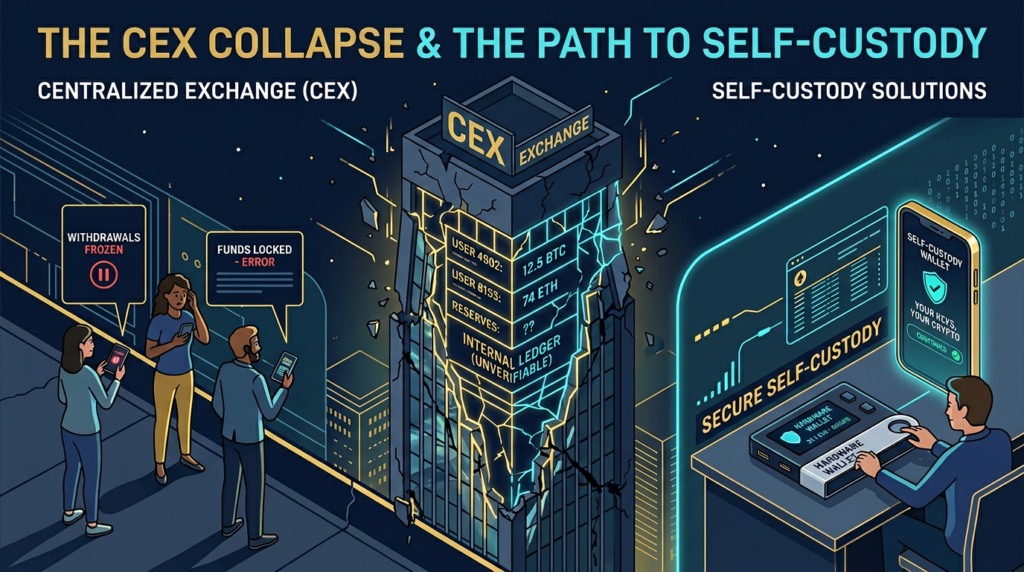
An exchange failure is not just a price event or a bad headline. It is a custody event. Once an exchange stops processing withdrawals, your account balance becomes a claim on a troubled company rather than assets you can move directly on-chain. That is why exchange failures feel so different from normal market losses. The problem is no longer volatility. The problem is access, legal priority, and time.
In practice, users usually do not experience a collapse as one clean announcement. It often starts with delayed withdrawals, vague maintenance notices, banking issues, liquidity rumors, or abrupt policy changes. If the situation worsens, the exchange may freeze activity entirely and enter restructuring or bankruptcy. At that point, what you recover, when you recover it, and whether you recover all of it depends on the exchange’s custody structure, records, jurisdiction, and terms of service.
This content is for educational purposes only and should not be considered financial or investment advice.
Key Takeaways
- An exchange balance is not the same as self-custody: If the platform controls the keys, your access depends on the company’s solvency, operations, and legal process.
- Failure usually starts with access problems: Withdrawal delays, banking friction, and sudden rule changes often appear before a formal bankruptcy filing.
- Recovery is a legal process, not a support ticket: Once an exchange fails, users may become creditors or claimants and wait months or years for distribution.
- Records matter more than opinions during a crisis: Statements, transaction IDs, and official notices become more useful than social media speculation.
- The best defense happens before stress appears: Keep only necessary working capital on-platform and move long-term holdings into wallets you control.
What Actually Breaks When an Exchange Fails
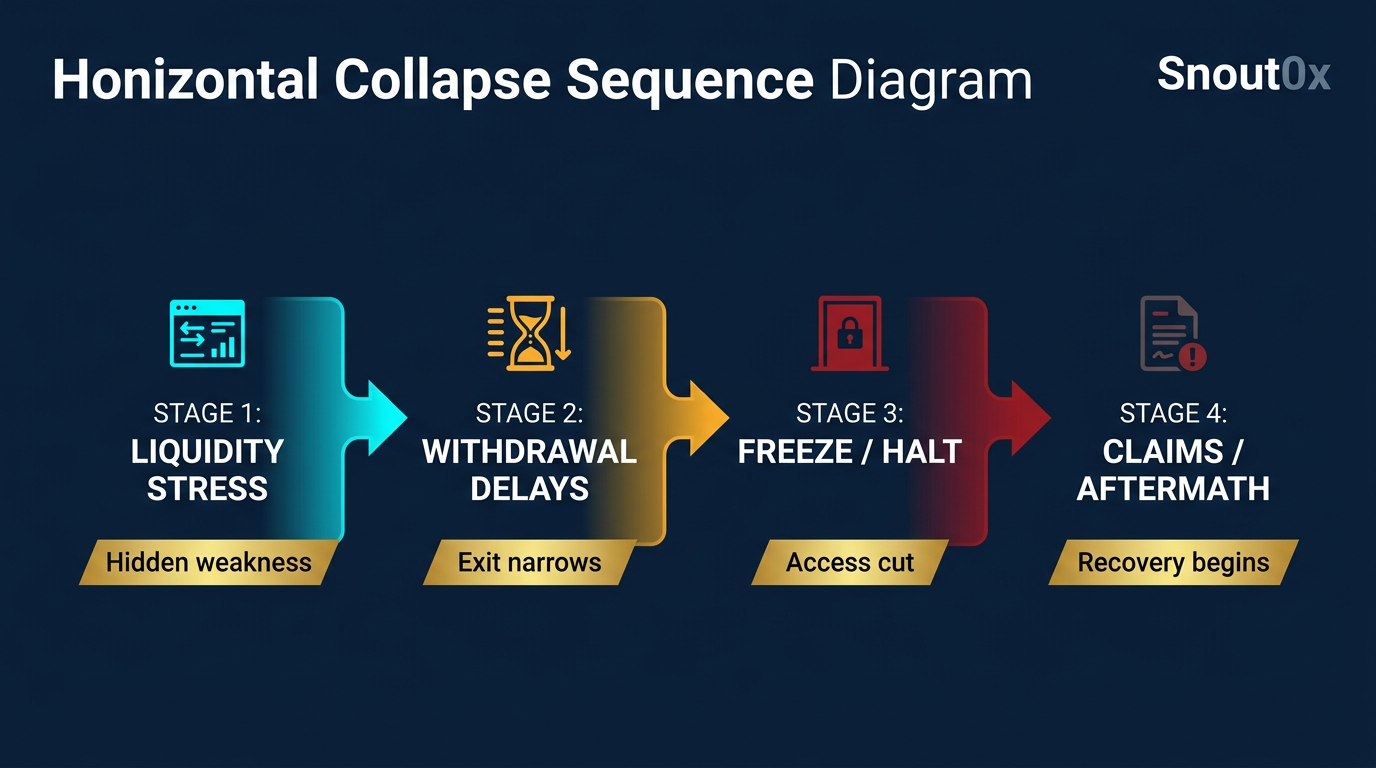
Most users imagine an exchange collapse as a single moment, but operationally it is usually a chain reaction. Liquidity gets tight, withdrawals slow down, counterparties pull away, banks become cautious, or internal treasury mismatches become impossible to hide. A platform can still display account balances long after its ability to honor withdrawals has weakened. That gap between visible balances and real transferability is what turns a normal exchange account into a risk event.
Not every failure starts with bankruptcy
Some exchanges fail through outright insolvency, where liabilities exceed available assets. Others fail through a hack, a regulatory freeze, a banking disruption, or a rush of withdrawal demand they cannot meet. From the user’s perspective, the path matters less than the outcome: the platform stops functioning as a reliable bridge between your dashboard balance and your actual coins. A company can be operationally broken before it is legally declared bankrupt.
This is why early warning signs often look mundane. An exchange may increase withdrawal review times, disable certain networks, reduce limits, or cite “temporary maintenance” during volatile periods. None of those messages prove fraud on their own, but they matter because the first promise an exchange must keep is simple: when you request your own assets, the platform should be able to deliver them predictably.
The first broken promise is usually liquidity
A healthy exchange can process withdrawals because it has liquid access to customer assets, functioning banking rails, and treasury controls that match customer obligations. A failing exchange starts breaking that link. You may still be able to log in, view balances, and even trade internally while the exit door narrows. That is one reason many users do not appreciate the severity of a collapse until withdrawals stop or become selective.
A useful mental model is to treat the exchange dashboard like a hotel reservation system. The booking confirmation proves the company owes you a room, but it does not prove the room is available right now if the building has a major operational problem. Likewise, an exchange balance shows what the platform says it owes you. It does not prove immediate, independent control of coins on the blockchain.
Why Your Account Balance Is Not the Same as Coins You Control
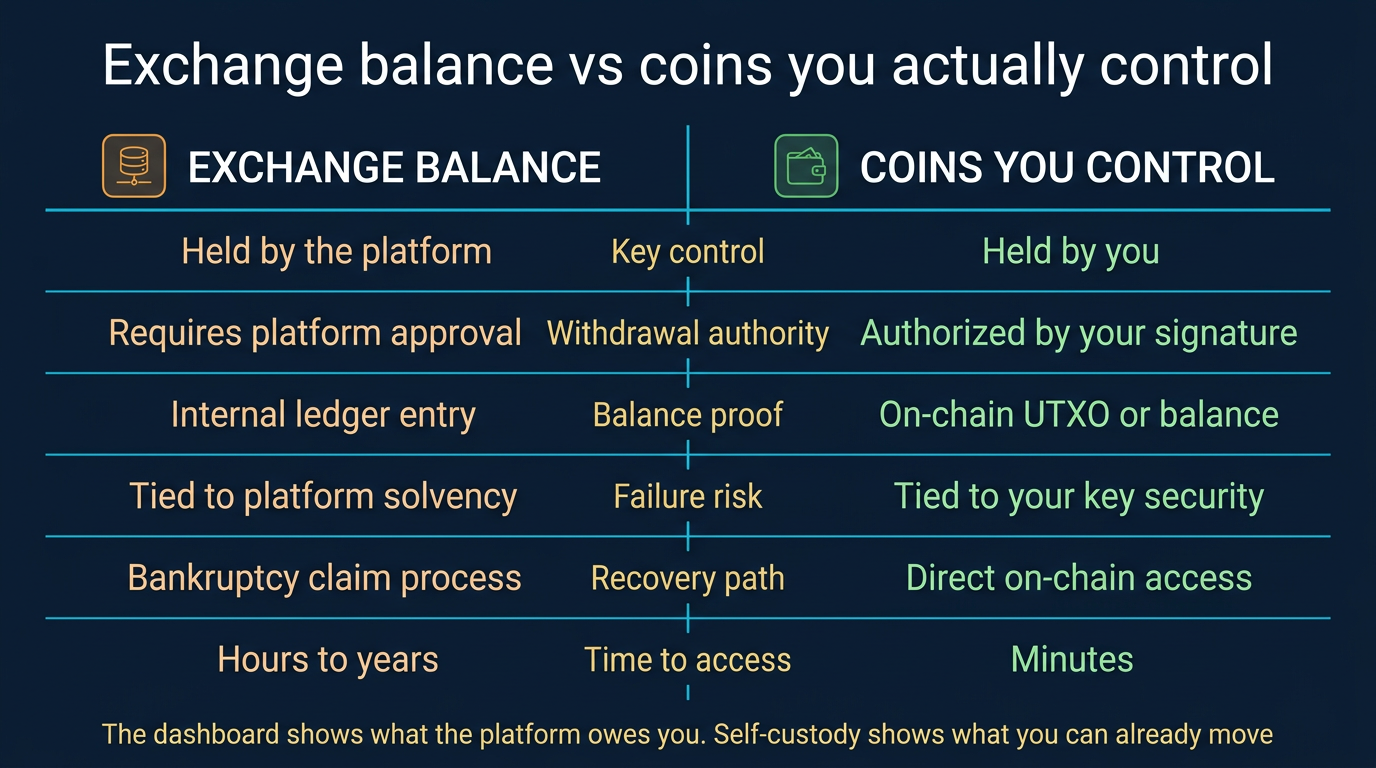
To understand why exchange failures are so painful, you need to separate ownership in theory from control in practice. When you hold assets in self-custody, your wallet signs transactions directly and no exchange approval is required to move funds. When assets stay on an exchange, the platform usually controls the wallets, keeps internal ledgers, and decides when withdrawals are processed. That difference defines the entire recovery problem.
Custody structure decides who controls movement
A crypto wallet lets the holder authorize movement with private keys. An exchange account is different. It gives you a contractual claim inside a company-controlled system. The company may use pooled wallets, omnibus custody, internal accounting layers, and outside custodians. That can work efficiently in normal times, but it means your ability to move assets depends on the exchange’s systems being solvent, liquid, and honest.
One operator insight is that users often mistake interface clarity for custody clarity. A polished app can make balances feel as concrete as coins in a wallet you control. But the real question is not whether the interface looks stable. It is whether you can independently withdraw when you choose. In a collapse, the gap between those two realities becomes obvious very quickly.
Segregation matters, but most users cannot verify it directly
Some platforms claim to segregate customer assets, use third-party custodians, or avoid rehypothecation. Those distinctions matter, but retail users rarely have full visibility into whether the assets are truly ring-fenced, how liabilities are matched, or what legal rights apply in bankruptcy. Even honest companies can become difficult to unwind if records are incomplete, assets are pooled across entities, or customer agreements blur the line between custody and lending.
That is why exchange collapse recovery often feels slower than users expect. The question becomes not just “Where are the coins?” but “Which entity controls them, who has priority, are balances reconciled correctly, and what do the customer agreements actually say?” Until those answers are sorted, the existence of blockchain assets somewhere in the system does not automatically translate into fast customer withdrawals.
The Legal Reality: Bankruptcy, Claims, and Recoveries
Once an exchange formally fails, the story usually shifts from operations to legal process. Bankruptcy courts, administrators, liquidators, and restructuring advisers may step in. Users stop dealing with a customer-service problem and start dealing with a claims process. That shift matters because support language like “your funds are safe” becomes much less important than the legal classification of customer assets and the company’s actual books.
Customer claims do not always mean immediate return of assets
If the exchange truly held customer assets in segregated custody and records are clean, customers may have a stronger path to asset return. But many failures are messier. Assets may be commingled, lent out, pledged, frozen across jurisdictions, or tied up in disputes about ownership. In those cases, customers may find themselves waiting as claimants while the estate determines what exists, what is missing, and who ranks ahead of whom.
This is where “not your keys, not your coins” stops sounding like a slogan and starts sounding like legal reality. In a collapse, you are no longer testing whether crypto works. You are testing whether your contract with a centralized company gives you fast, senior, and well-documented rights. Sometimes it does not. Sometimes it gives you a long line, a form to file, and a haircut on value or timing.
Why recoveries take months or years
Recoveries are slow because administrators must reconcile customer liabilities, trace wallets, review transfers, freeze suspect outflows, coordinate across legal entities, and sometimes litigate against insiders or counterparties. Even if some assets remain, distribution takes time. Courts may need to decide valuation dates, token treatment, and whether distributions happen in kind or in cash equivalents. Users often underestimate how many moving parts sit between “the exchange had assets” and “I received my share.”
A second operator insight is that the most valuable thing a user can control during this phase is documentation. Statement exports, transaction IDs, deposit addresses, confirmation emails, tax records, and screenshots of balances often become part of proving or reconciling a claim. By the time a portal opens for claim submissions, memory is weak and timelines are blurry. Good records are far more useful than confident guesses.
What Users Usually Experience First
Exchange collapses usually feel confusing before they feel final. Most users see an unstable transition rather than a clean off-switch. That confusion creates two layers of risk at once: the original custody risk and a second wave of bad decisions made under stress.
Withdrawal pauses and communication fog
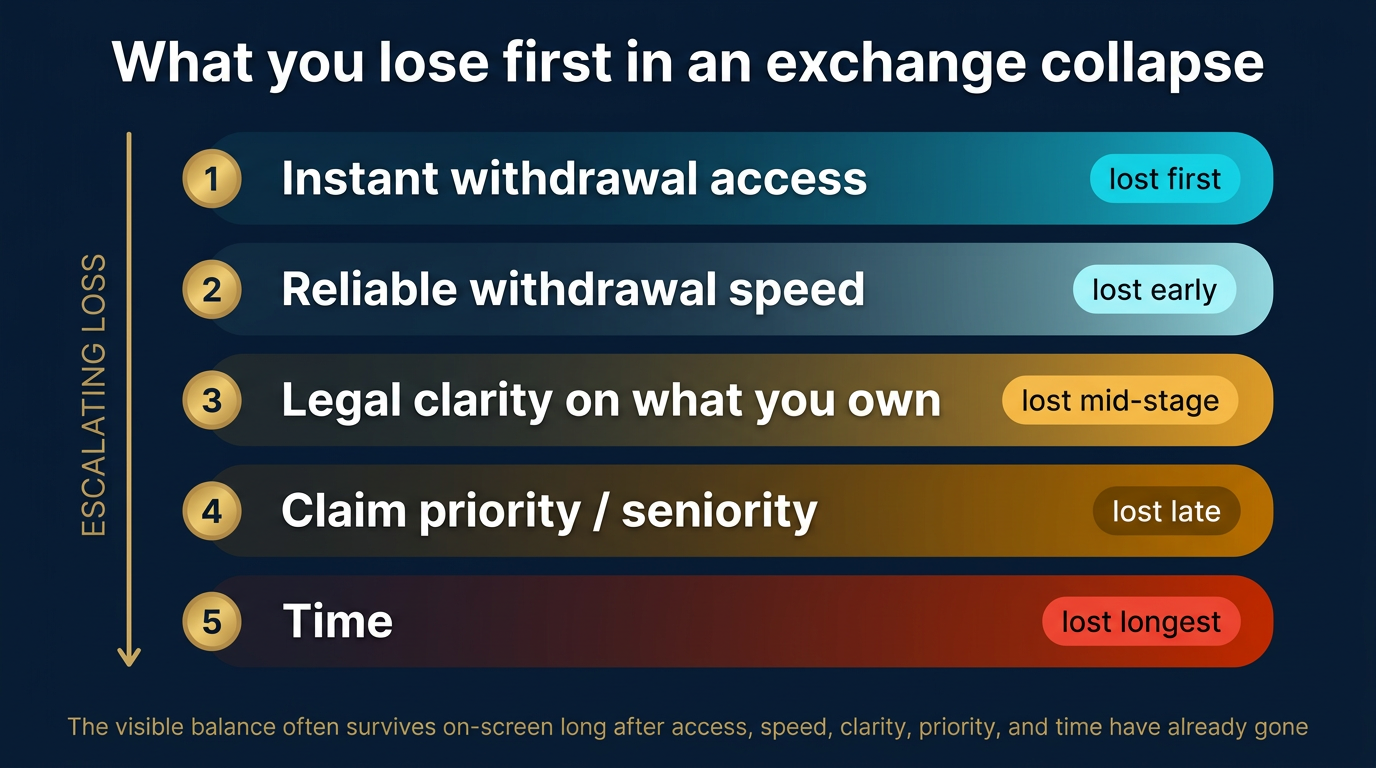
The first user-facing symptom is often a change in withdrawal behavior. Requests may queue longer than usual, certain assets may be temporarily disabled, and support responses may become slower or more scripted. When stress builds, rumors spread faster than verified information. That is exactly why a crisis playbook like Exchange Withdrawals Will Pause Again matters. The right time to think about withdrawal routes is before every other user is trying to escape at the same moment.
One of the hardest parts for users is that the app can remain mostly functional while the exit path is degraded. Internal trading may continue. Prices may still update. Customer balances may still appear normal. That can create false reassurance. If you cannot remove funds on a reasonable timeline, the platform is no longer functioning in the only way that matters for custody safety.
Secondary scams usually arrive immediately
When a high-profile exchange fails, attackers move fast. Fake support accounts, “recovery agents,” phishing portals, and fake claim sites appear almost immediately. Panicked users click links they would normally ignore because they are desperate to get funds back. This makes exchange failures fertile ground for follow-on theft. If you do not already understand how crypto phishing works, a collapse can become a second loss event, not just the original one.
The practical rule is simple: never trust claim instructions from DMs, search ads, Telegram groups, or unofficial email domains. In a collapse, attackers know that urgency lowers skepticism. The more dramatic the news cycle becomes, the more valuable calm verification becomes. Official court filings, verified company channels, and bookmarked domains matter more than social replies promising fast recovery.
Practical Usage: What to Do Before and During an Exchange Failure
The most useful response to exchange-failure risk is not trying to predict which platform will fail next. It is reducing how much damage any one failure can do to you. That means choosing the right wallet, designing your custody system before stress arrives, and switching into evidence-preservation mode if an exchange begins showing trouble.
Before there is any sign of trouble
- Limit the exchange bucket: Use the framework in how much crypto to keep on an exchange so only active trading inventory, near-term conversions, or withdrawals in progress stay on-platform.
- Build the destination first: If funds are meant to leave the exchange, decide where they belong using how to store crypto safely. A withdrawal plan is incomplete if you do not trust the receiving wallet.
- Test the route with small amounts: Verify destination addresses, memo requirements, and network selection before you need to move meaningful balances under pressure.
- Keep records locally: Save statement exports, deposit and withdrawal history, transaction hashes, and screenshots of balances on a secure local system you control.
- Separate operating security: Use a strong unique password, app-based two-factor authentication, and a dedicated email account for exchange access instead of reusing your normal inbox.
If the exchange starts showing stress
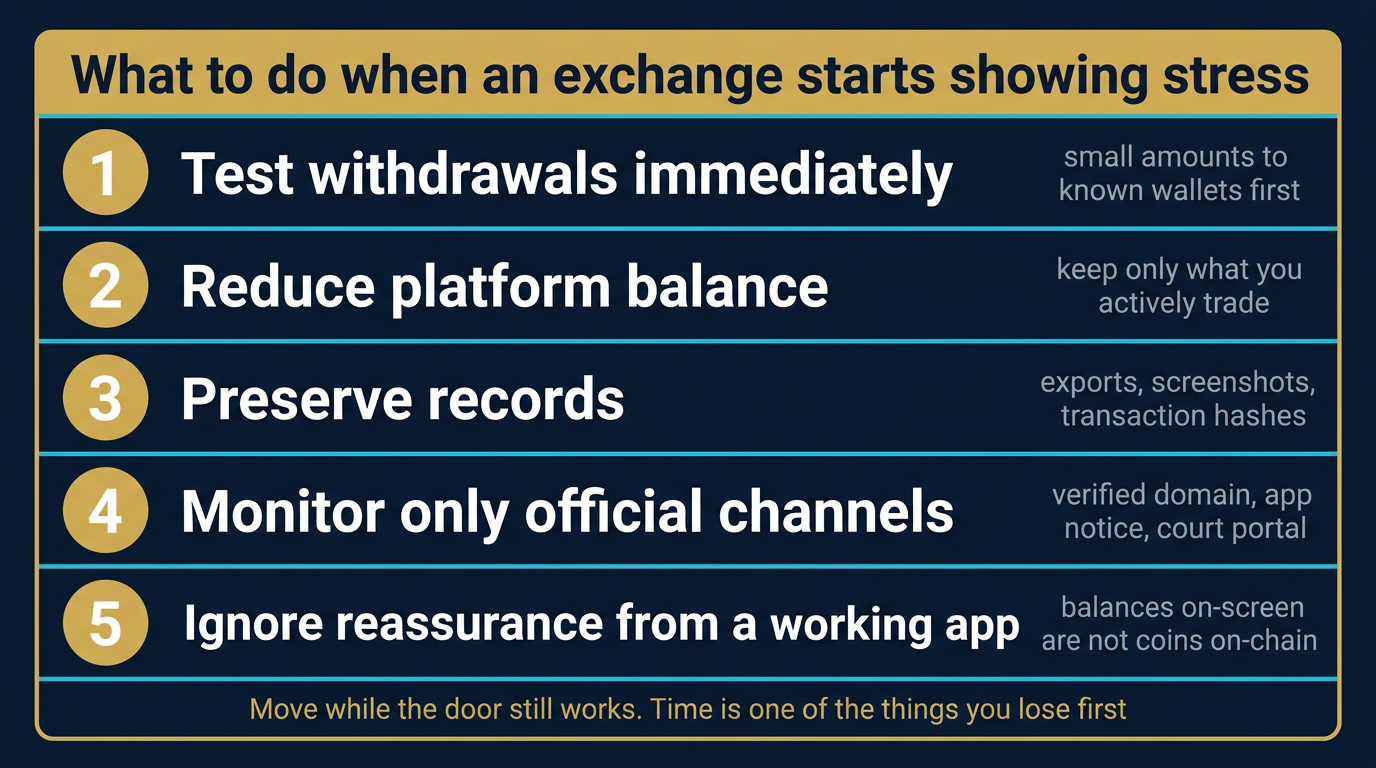
- Stop adding funds: Do not deposit more capital just because the platform offers incentives, high yields, or temporary assurances during a rumor cycle.
- Preserve evidence immediately: Export account history, save screenshots, copy wallet addresses, and keep records of pending withdrawal attempts or support tickets.
- Verify communication sources: Use only official app notices, verified domains, or court-appointed claim portals once they exist. Ignore DMs and “recovery specialist” pitches.
- Attempt withdrawals methodically: Prioritize larger idle balances, verify networks carefully, and do not improvise under time pressure by sending assets to wallets you have not already tested.
- Assume time will expand: If the platform is genuinely failing, support will not resolve the issue like a routine ticket. Shift your mindset from convenience recovery to legal and operational containment.
A final operator habit is to decide in advance what would make you leave an exchange entirely. That threshold might be repeated withdrawal delays, banking instability, sudden changes in terms, or a refusal to explain custody arrangements clearly. The point is to avoid waiting for certainty. By the time an exchange problem becomes obvious to everyone, the easiest exit window is usually gone.
Risks and Common Mistakes
- Confusing app access with coin control: A visible dashboard balance can create false confidence even when withdrawals are slowing or failing.
- Waiting for perfect proof: Many users delay action because they want certainty that a platform is insolvent. In practice, repeated access stress is often enough reason to reduce exposure.
- Leaving long-term savings on a trading venue: Funds with no near-term job are the weakest candidates for custodial storage and the strongest candidates for self-custody.
- Ignoring secondary scam risk: Fake claim forms, fake support, and fake legal-assistance offers often appear immediately after a platform failure becomes public.
- Keeping poor records: Users who never export statements or transaction history often discover too late that reconstructing claims from memory is slow and error-prone.
Sources
- U.S. SEC Investor Bulletin: Crypto Asset Spot Market Platforms
- U.S. CFTC: Understand the Risks of Virtual Currency Trading
- FDIC: Crypto Companies and Deposit Insurance
FAQ: What Happens When a Crypto Exchange Fails?
What happens to your crypto when an exchange collapses?
Your crypto usually becomes part of a custody and legal process rather than something you can move immediately. Withdrawals may pause, balances may remain visible but inaccessible, and recovery may depend on how the exchange held assets, what its terms said, and whether a bankruptcy or restructuring process begins.
Can you still withdraw during an exchange bankruptcy?
Usually not freely. Some users manage to withdraw during the early stress phase before a full freeze, but once bankruptcy or formal restructuring begins, withdrawals are often halted and replaced by a claims process. At that point, customer support is no longer the main path to recovery.
Are customer funds protected if a crypto exchange fails?
Sometimes partly, sometimes poorly, and sometimes only after a long delay. The answer depends on whether customer assets were segregated, how the exchange documented custody, whether assets were lent or commingled, and what legal rights customers have under the applicable jurisdiction and terms of service.
How long do recoveries take after an exchange collapse?
They can take months or years. Administrators may need to reconcile records, recover assets, resolve disputes, trace transfers, and determine how claims are valued and ranked before distributions happen.
What should you do first if your exchange looks unstable?
Stop adding funds, preserve records immediately, verify only official communications, and attempt withdrawals methodically if the route still works. Do not click rushed claim links from social media or trust unofficial recovery services.