

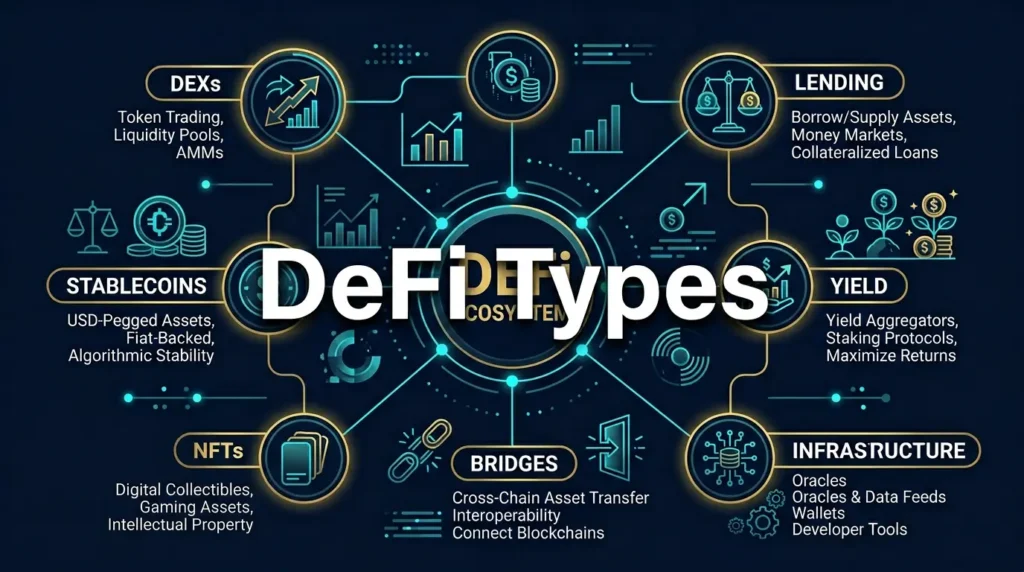
DeFi is not one product. It is a stack of protocol categories that each solve a different financial problem on-chain. Some protocols let users swap assets. Some let users borrow against collateral. Some manage stablecoins. Some route capital into yield strategies. Others provide infrastructure, such as bridges or oracles, that make the rest of the system possible.
The easiest mistake is to talk about “DeFi” as if every protocol has the same job or the same risk model. It does not. A decentralized exchange, a lending market, and a yield vault are all DeFi systems, but they expose users to very different mechanics and failure modes. Understanding the major categories is how you stop treating every on-chain app as interchangeable.
This content is for educational purposes only and should not be considered financial or investment advice.
Key Takeaways
If you want the foundational definition behind this concept, read What Is a DeFi Protocol? How It Works Without a Bank.
- DeFi is a category of categories: Different protocols handle trading, lending, stablecoins, yield, or infrastructure.
- Each protocol type solves a different problem: Swapping, borrowing, collateral management, and reward distribution are not the same function.
- The user experience can look similar while the risk is different: A dashboard may feel familiar even when the underlying mechanics change completely.
- Infrastructure protocols matter as much as user-facing apps: Oracles, bridges, and routing systems shape how the visible layer works.
- Knowing the protocol type improves risk judgment: You can evaluate what can break only after you understand what the system is trying to do.
1. Decentralized Exchanges
DEX protocols let users swap tokens directly on-chain through liquidity pools or related market mechanisms. Their core job is price discovery and execution without relying on a centralized exchange to custody funds and match orders manually. In AMM-based designs, users trade against shared liquidity rather than against a visible order book.
The closest local mechanism explainer here is What Is a Liquidity Pool. That article explains why DEX trading depends so heavily on pool structure and liquidity depth.
2. Lending and Borrowing Markets
Lending protocols let users supply assets to earn yield and let other users borrow those assets by posting collateral. The system continuously checks collateral ratios and can trigger liquidation if a borrower becomes undercollateralized. This makes lending markets some of the clearest examples of rule-driven on-chain finance.
A useful mental model is to think of these systems as collateral engines rather than as banks. They do not make judgment calls about your income or creditworthiness. They enforce collateral rules and liquidation thresholds automatically through code.
3. Stablecoin Protocols
Stablecoin protocols are built to maintain or manage a token that aims to track a reference value, usually one US dollar. Some do this with fiat-backed reserves outside the chain. Others do it with on-chain collateral, redemption logic, or hybrid designs. The core function is price stability, but the actual trust model varies a lot between implementations.
That is why two “stablecoin protocols” can look similar on the surface while carrying very different peg, reserve, and governance risks. For the direct failure angle, the closest local piece is Stablecoin Depeg Risk.
4. Yield and Vault Protocols
Yield protocols route capital into strategies intended to produce return through fees, lending demand, token incentives, or auto-compounding. Some are simple pool wrappers. Others are multi-layer vaults that move funds between different venues according to a strategy. Their job is not basic trading or borrowing. Their job is return optimization.
For the direct mechanism and risk pair, the best local references are What Is Yield Farming in Crypto and Yield Farming Risks Explained.
5. Derivatives and Synthetic-Exposure Protocols
Some DeFi systems create exposure to prices, funding rates, or leverage without requiring spot ownership of the underlying asset in the usual way. These can include perpetuals, synthetic assets, options-like products, and structured leverage systems. The core job is exposure engineering rather than basic asset exchange.
One operator insight is that these protocols often look familiar because the interface resembles a trading app, but the actual risk stack is usually much denser. Oracle dependence, liquidation mechanics, and funding design matter heavily in these systems.
6. Bridge Protocols
Bridge protocols help users move assets or representations of assets across different blockchains. They are not mainly about exchange, lending, or yield by themselves. Their job is interoperability. That makes them foundational infrastructure for multi-chain DeFi, but also a unique trust and security layer on top of the chains being connected.
For the direct mechanism explainer, see What Is a Crypto Bridge.
7. Oracle and Infrastructure Layers
Many DeFi protocols depend on infrastructure systems that ordinary users barely notice. Oracles deliver external price data. Routers optimize trade paths. Liquidation networks execute collateral enforcement. Analytics and keeper systems help protocols react to conditions on-chain. These systems may not look like “apps,” but they are part of the operational backbone.
A second operator insight is that infrastructure layers can be the hidden point of failure in otherwise well-designed systems. A protocol can have sound lending logic and still behave badly if its oracle inputs are manipulated or delayed.
How These Categories Connect
DeFi protocols often feed each other. A stablecoin may be used in a lending market. Borrowed assets may be routed into a yield strategy. Yield farms may depend on DEX liquidity. Bridges may move assets into another chain’s vault or lending protocol. That is why DeFi should be understood as a connected system rather than as isolated apps.
One practical way to think about the stack is this: user-facing finance sits on top of protocol logic, and protocol logic sits on top of infrastructure and blockchain execution. The more layers you use at once, the more dependencies you are really accepting.
Practical Usage: How to Classify a DeFi Protocol Fast
- Ask what financial job it performs: Is it mainly for trading, borrowing, issuing a stable asset, generating yield, or moving assets across chains?
- Ask what contract state it depends on most: Pool balances, collateral ratios, peg rules, oracle prices, or cross-chain proofs?
- Ask where the user return or fee flow comes from: Trading fees, interest spreads, liquidations, subsidies, or some combination?
- Ask what breaks the system fastest: Slippage, depegs, oracle failure, smart-contract bugs, or mercenary capital exit?
- Ask what other protocols it depends on: The more external dependencies, the more the risk stack broadens.
A practical frame is to stop asking “Is this DeFi?” and start asking “What kind of DeFi system is this, and what exact job is my capital or my wallet interaction serving here?” That makes the protocol easier to place and the risks easier to reason about.
Risks and Common Mistakes
- Treating every protocol like a DEX: Many users understand swaps first and then misread lending, vault, or stablecoin systems through the wrong lens.
- Ignoring hidden infrastructure dependence: A visible app may depend heavily on bridges, oracles, routers, or keeper systems in the background.
- Using yield as a category label: Yield can be an output of many different protocol types, not a complete description of what the system is.
- Confusing the frontend with the protocol: A polished interface can hide weak contracts, fragile incentives, or strong admin powers.
- Skipping the “what job does this do?” question: If you cannot answer that clearly, you are not yet evaluating the protocol on the right level.
Sources
Frequently Asked Questions
What are the main types of DeFi protocols?
The main categories include DEXs, lending markets, stablecoin systems, yield or vault protocols, derivatives systems, bridges, and infrastructure layers such as oracle networks.
Is a DEX the same as a lending protocol?
No. A DEX focuses on asset exchange and liquidity, while a lending protocol focuses on collateralized borrowing and supplying capital for loans.
Are yield platforms their own protocol category?
Yes. Yield platforms and vault systems often deserve their own category because their main job is return optimization rather than simple trading or lending.
Why do DeFi protocols depend on oracles and bridges?
They depend on them because many systems need external price data, cross-chain asset movement, or supporting execution infrastructure to function correctly.
How should users compare one DeFi protocol type with another?
Users should compare them by function first: what problem they solve, what contract state they depend on, what breaks them, and where fees or yield actually come from.