

People often use “coin” and “token” as if they mean the same thing, but they point to different layers of blockchain systems. A coin is usually the native asset of its own blockchain. A token is usually an asset created on top of an existing blockchain through smart-contract logic. Both can be traded, stored in wallets, and priced in markets, but they do not play the same architectural role.
The easiest way to think about it is this: if the asset belongs to the base network itself, it is usually a coin. If the asset depends on another network’s infrastructure and contract system, it is usually a token. That distinction matters because it affects how the asset works, what it depends on, and what its role is inside the broader crypto system.
This content is for educational purposes only and should not be considered financial or investment advice.
Quick Answer
A coin is usually the native asset of a blockchain, such as BTC on Bitcoin or ETH on Ethereum. A token is usually created on top of an existing blockchain through a smart contract, such as many ERC-20 assets issued on Ethereum.
Key Takeaways
- Coins belong to base blockchains: They are native assets such as BTC, ETH, or SOL.
- Tokens are built on top of blockchains: They usually rely on smart contracts running on a host chain.
- Both can look similar in a wallet: The user experience can hide the architectural difference.
- The distinction is about system role: Native network assets and contract-issued assets serve different functions.
- Examples make it clearer: BTC is a coin, while many Ethereum-based assets such as USDT on ERC-20 are tokens.
What Makes Something a Coin?
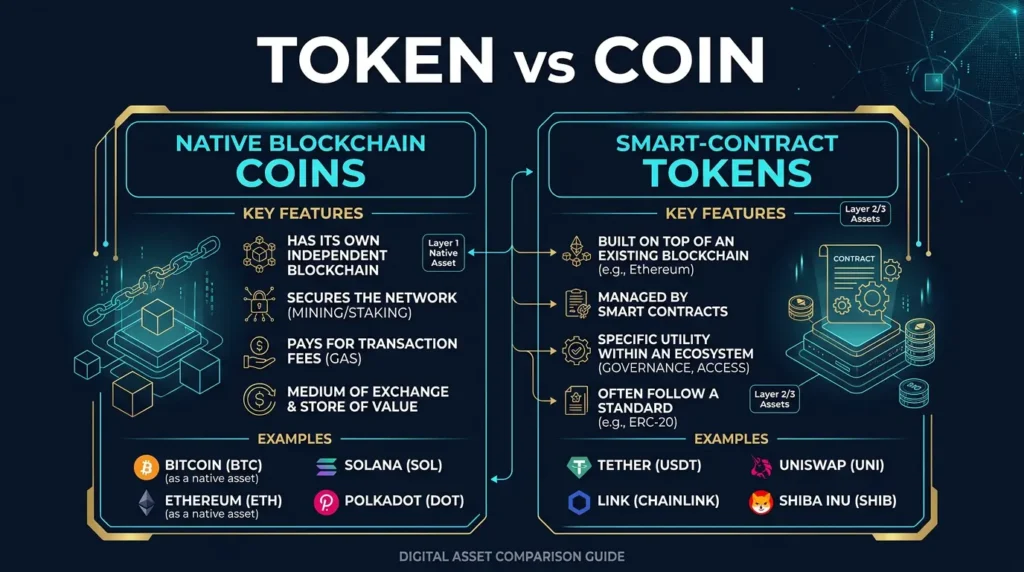
A coin is usually the asset that belongs to a blockchain’s own ledger and consensus system. It is the native unit of that network. On Bitcoin, that native asset is BTC. On Ethereum, it is ETH. On Solana, it is SOL. These assets are not issued by a separate application contract living on the chain. They are part of the base system itself.
Native assets often help power the network directly. They may be used for transaction fees, validator incentives, staking, or base settlement. That does not mean every coin has identical economics, but it does mean the asset is more tightly connected to the chain’s core operation than a typical token is.
What Makes Something a Token?
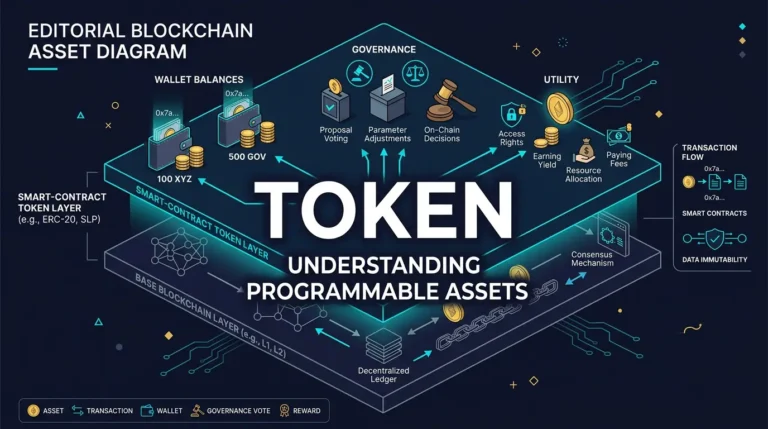
A token is usually created through smart-contract code on an existing blockchain. It depends on the host chain for security, final settlement, and execution. The token contract defines balances, transfers, and any extra rules such as minting, burning, rewards, governance rights, or access permissions.
That is why tokens are common in DeFi, apps, gaming ecosystems, stablecoin systems, and governance structures. A team can issue an asset and build an economy around it without having to launch a brand-new blockchain from scratch.
If you want the token side explained cleanly on its own, the local definition page is What Is a Crypto Token?. For the underlying execution layer, use What Is a Smart Contract?.
Simple Examples: BTC, ETH, and USDT
BTC is a coin because it is native to the Bitcoin blockchain. ETH is a coin because it is native to Ethereum. USDT can exist in multiple forms depending on the network, but USDT issued as an ERC-20 asset on Ethereum is a token because it depends on Ethereum’s smart-contract and account system rather than being Ethereum’s own base asset.
Real-world example: if you hold ETH in an Ethereum wallet, you hold the network’s native coin. If you hold an ERC-20 stablecoin or governance asset in that same wallet, you hold a token that lives on top of Ethereum. The wallet may display both side by side, but they are not the same kind of asset under the hood.
Why the Difference Matters
The distinction matters because coins and tokens depend on different layers of the system. A token inherits the environment of its host chain, including its fees, contract standards, wallet support, and smart-contract risks. A coin is more directly tied to the blockchain’s own operation and consensus model.
Operator insight: users often think in tickers and prices, but architecture matters too. If you understand whether an asset is native to the chain or issued on top of it, you immediately understand more about how it moves, what risks it inherits, and what infrastructure it depends on.
Why Tokens Are So Common
Launching a token is much easier than launching a whole blockchain. Projects can use an existing ecosystem’s wallets, liquidity, developer tooling, and users. That is why so many app-specific assets, stablecoins, governance assets, and reward systems are implemented as tokens rather than as standalone coins.
For a distribution example, many projects introduce these assets through airdrops instead of through a base-network launch.
How to Tell Whether an Asset Is a Coin or Token
- Ask what chain it belongs to: If it is the native unit of that blockchain, it is usually a coin.
- Ask whether it has a contract address: If it is issued through a smart-contract standard on another chain, it is usually a token.
- Ask what it is used for: Fees, staking, and validator incentives often point toward native-asset roles, while app utility and governance often point toward token roles.
- Check how wallets and explorers label it: Contract-address references are a strong clue that you are looking at a token.
- Do not rely on branding alone: Names and tickers can sound official even when the asset is just a copycat token.
Why Wallets Can Make Them Look the Same
Modern wallets are designed to simplify the interface, so users often see native assets and contract-issued assets in one account view. That is convenient, but it can hide the difference between the blockchain’s own asset and an application-layer asset. The front-end feels unified even when the underlying systems are not.
This is also why token approvals, claim flows, and fake contract interactions confuse users so easily. The wallet experience is often smooth, but the architectural details still matter when you are deciding what to trust or sign.
For that interaction-risk layer, see Crypto Approval Scams and What Is Crypto Phishing?.
Practical Usage: A Simple Rule of Thumb
- If it is the base asset of the chain, treat it as a coin: Examples include BTC, ETH, and SOL.
- If it is issued on top of another chain, treat it as a token: Many stablecoins, governance assets, and DeFi assets fit here.
- If you are unsure, check the contract address: Native assets do not usually rely on a token-contract address in the same way.
- Use architecture to guide trust: Knowing which layer the asset belongs to helps you understand its dependencies and risks.
A practical shortcut is this: coins are usually the chain’s own money, while tokens are usually assets built on the chain.
Risks and Common Mistakes
- Using the words interchangeably: A user may think every asset in an Ethereum wallet works like ETH, then miss the fact that an ERC-20 asset can involve separate contract risks, approvals, and fake contract copies.
- Assuming wallet display means architectural equivalence: Wallets often show ETH and ERC-20 balances in one clean view, but sending a token on the wrong network or treating it like the chain’s native gas asset can create failed transfers and confusion.
- Ignoring contract-address verification: A scammer can issue a copycat token with the same ticker and logo style as a real asset. If the user checks only the name and not the official contract address, they can buy or approve the wrong asset.
- Confusing native-network value with app-layer utility: A base coin may be needed for fees and staking, while a token may only matter inside one app. Buying one while expecting the function of the other is a common category mistake.
- Thinking every token is weak or every coin is superior: Some tokens sit at the center of large ecosystems, while some coins mainly serve base-network functions. The distinction explains structure, not automatic quality, so evaluation still needs demand, liquidity, and use-case analysis.
A concrete example helps. A user may buy ETH expecting gas for Ethereum transactions, then later buy a token on Ethereum and assume it can pay gas the same way. It cannot. The user still needs ETH for transaction fees because the token is not the chain’s native asset. That kind of confusion is minor in theory but expensive in practice when transfers, approvals, or bridge actions are involved.
Sources
- Ethereum.org: ERC-20 Token Standard
- Bitcoin Developer Documentation
- OpenZeppelin Contracts Documentation
Frequently Asked Questions
Is Bitcoin a coin or a token?
Bitcoin is a coin because BTC is the native asset of the Bitcoin blockchain.
Is ETH a coin or a token?
ETH is a coin because it is native to Ethereum, even though many tokens also run on Ethereum.
Is USDT a coin or a token?
USDT is usually a token when issued on networks such as Ethereum as an ERC-20 asset, because it depends on the host chain rather than being that chain’s native asset.
Can a token be more useful than a coin?
Yes. Usefulness depends on the role the asset plays, not just whether it is native to a chain. Some tokens are central to major applications, while some coins mainly serve network-level functions.
What is the easiest way to tell the difference?
The easiest way is to ask whether the asset is the blockchain’s own native unit or whether it is issued by a smart contract on top of another chain.