

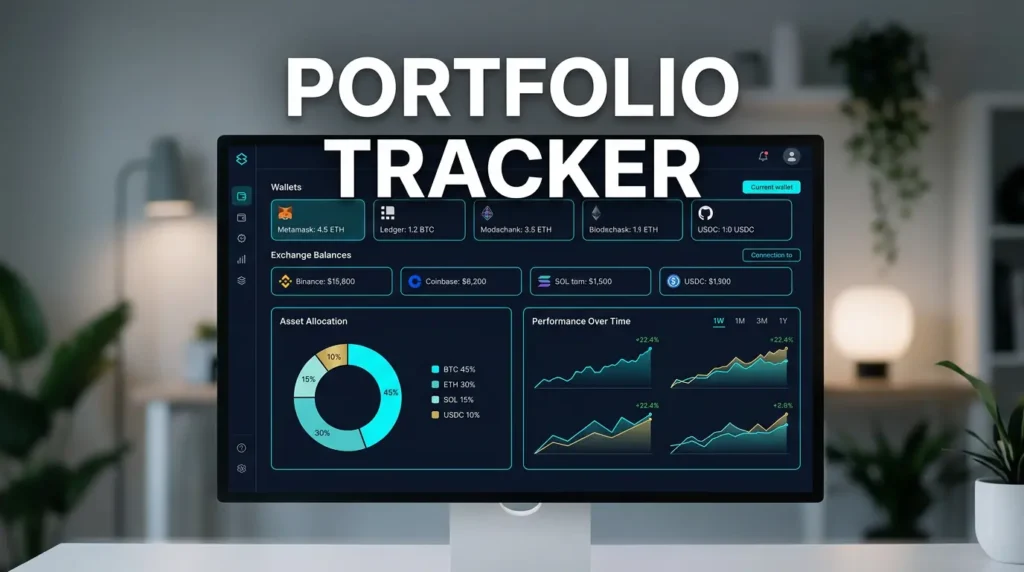
A portfolio tracker for crypto is a tool that pulls together your balances, transactions, and performance data from wallets, exchanges, and sometimes DeFi protocols into one view. Instead of checking five different apps and block explorers, a tracker tries to show the whole portfolio in a single dashboard. Its main job is visibility: what you hold, where it sits, how it changed, and how the portfolio is distributed across assets and accounts.
A simple mental model is to think of a tracker as a read-only control panel for your crypto. It is not supposed to be the vault. It is the screen that helps you understand what is inside the vaults, wallets, and exchange accounts you already use.
This content is for educational purposes only and should not be considered financial or investment advice.
Key Takeaways
If you want the foundational definition behind this concept, read self-custody.
- A tracker is mainly a visibility tool: It helps investors see holdings, allocations, and performance in one place.
- Good trackers are usually read-only: They should monitor wallets and exchanges without needing private keys or seed phrases.
- Trackers are useful because crypto is fragmented: Assets often sit across multiple wallets, exchanges, chains, and protocols.
- Not all trackers cover the same complexity: Spot balances are easier to track than DeFi positions, LP tokens, and rewards.
- A tracker should support decisions, not replace verification: The source wallet, exchange, or protocol still matters when accuracy is important.
Why People Use a Tracker
Crypto portfolios become messy quickly. One user may hold bitcoin in a hardware wallet, stablecoins on an exchange, altcoins in a mobile wallet, and DeFi positions on multiple chains. Each location shows only part of the story. A portfolio tracker exists because the portfolio itself is fragmented.
The tool becomes useful when it answers practical questions fast: How much do I own in total? Which wallet holds what? How much is in BTC versus stablecoins? What changed this week? Which account is carrying most of the exposure? Without a tracker, those answers often require manual checking across multiple interfaces.
How These Tools Usually Work
Most trackers work by connecting to data sources rather than controlling funds directly. They may read public wallet addresses on-chain, sync exchange balances through API keys, or let users enter transactions manually. The goal is to aggregate information, not to hold the assets themselves.
For the risk side of this topic, see Wallet Address Reuse Risks: What It Exposes On-Chain.
- Wallet address tracking: The tracker reads public wallet data from supported blockchains.
- Exchange sync: The tracker imports balances and trade history from exchange APIs, ideally with read-only permissions.
- Manual transaction entry: Some users add balances or trades manually when automated support is limited.
This is why the safest mental model is “observe, do not control.” A legitimate tracker should help you see portfolio data without becoming a signing device or a place to store recovery secrets.
What a Tracker Should Never Need
A portfolio tracker should not need your seed phrase or private key. Those credentials are for controlling funds, not for monitoring them. If a tracker asks for direct key material just to show balances, that is a major security red flag.
Operator insight: the safest tracker relationship is usually read-only. It should look at your portfolio, not become part of the mechanism that can move it.
For adjacent wallet structure background, the most relevant local explainer is How to Choose a Crypto Wallet. A tracker is supposed to sit on top of your wallet structure, not replace it.
What Information These Tools Usually Show
- Total portfolio value: A combined estimate across wallets, exchanges, and supported chains.
- Asset allocation: How much of the portfolio is in BTC, ETH, stablecoins, altcoins, or other categories.
- Wallet and exchange breakdown: Which balances live in which accounts or addresses.
- Performance history: Changes in value over time, sometimes including profit-and-loss estimates.
- Transaction history: Imports of trades, transfers, and selected on-chain activity.
More advanced tools may also show staking rewards, lending positions, liquidity-pool balances, NFT holdings, or token approvals, but not every tracker handles those areas well.
Why Some Portfolios Are Harder to Track Than Others
A simple buy-and-hold portfolio is usually easy to track because balances sit in obvious places and move infrequently. A DeFi-heavy portfolio is much harder because value may be wrapped inside lending protocols, LP tokens, bridges, staking contracts, and reward systems. The more layers between the user and the underlying assets, the harder it becomes for any dashboard to interpret everything perfectly.
That is why a portfolio tracker is most accurate when the portfolio is straightforward and most approximate when the portfolio is highly experimental. The tool still helps, but the user should expect more spot-checking as complexity rises.
Why Investors Use Them Even When They Are Not Perfect
Even imperfect aggregation is often better than no aggregation at all. A tracker saves time, reduces blind spots, and makes it easier to notice concentration risk, idle balances, duplicated exposure, or forgotten wallets. Investors use them because manual portfolio awareness becomes too costly once holdings spread across multiple environments.
The value is not that the tracker becomes the final authority. The value is that it gives you a usable dashboard for decisions that would otherwise require constant switching between apps, wallets, and explorers.
Privacy and Trust Still Matter
Every time you connect a wallet address or exchange account to a tracker, you reveal portfolio information to that service. Even if the connection is read-only, the tool may still learn which addresses belong together, which exchanges you use, and how your portfolio is distributed. That matters for privacy as much as security.
Real-world scenario: a user links a cold-storage wallet, a trading exchange account, and a DeFi wallet to one tracker profile. The service may now understand the whole portfolio more clearly than any one wallet or exchange ever did. That may be acceptable, but it is still a trust decision the user should make consciously.
When a Tracker Is Most Useful
- When assets are spread across many places: Multiple wallets and exchanges create the clearest need.
- When allocation matters: Investors who rebalance or monitor exposure benefit from one portfolio view.
- When performance is hard to judge manually: A dashboard makes drift, concentration, and growth easier to spot.
- When DeFi or staking adds complexity: Even partial visibility is often helpful when positions become layered.
If the next question is which tools are best for that job, the local money-page follow-up is Best Crypto Portfolio Trackers. This page is the definition layer, not the product ranking.
Practical Usage: How to Think About One Safely
- Treat it as a dashboard, not a vault: The tool should monitor holdings, not store the secrets that control them.
- Prefer read-only connections: Public addresses and read-only exchange APIs are usually the right model.
- Expect some blind spots: Complex DeFi positions, obscure chains, and newer protocols may not display perfectly.
- Verify important balances at the source: For large moves or reporting decisions, check the wallet, exchange, or protocol directly.
- Be deliberate about privacy: Connecting many wallets into one profile improves visibility but also increases how much the service knows about you.
A practical rule is simple: if a tracker helps you see more clearly without needing power over your funds, it is doing its job correctly.
Risks and Common Mistakes
- Trusting the dashboard as the only truth: A lending position, LP token, or bridged asset can display late or incorrectly, so relying only on the dashboard can lead to bad allocation or tax assumptions.
- Giving a tracker too much access: If a service asks for a seed phrase, private key, or exchange API permissions beyond read-only, the user may be turning a monitoring tool into a direct attack surface.
- Ignoring privacy trade-offs: Linking a cold wallet, exchange account, and DeFi wallet into one profile can let the service cluster the entire portfolio under one identity.
- Expecting every chain and protocol to display perfectly: Newer protocols, obscure chains, and non-standard tokens may be missing or misclassified, which is why important balances should still be checked against the source wallet or protocol.
Sources
Frequently Asked Questions
What is a portfolio tracker for crypto?
It is a tool that aggregates holdings, balances, and performance data from wallets, exchanges, and sometimes DeFi positions into one dashboard.
How do these tracking tools work?
They usually read public wallet addresses, sync exchange balances through APIs, or import transactions manually so the portfolio can be viewed in one place.
Do portfolio trackers need private keys?
No. A legitimate tracker should not need a private key or seed phrase just to monitor balances and transactions.
Why do investors use them?
They use them to see total holdings, asset allocation, wallet distribution, and performance more easily across multiple accounts and chains.
Are they always accurate?
Not always. Simple portfolios are easier to display accurately than complex DeFi, bridge, staking, or LP positions, so important balances should still be checked at the source.