

Last Updated on April 19, 2026 by Snout0x
Bitcoin fees are the payments users attach to transactions so miners have an incentive to include them in a block. They are not based on how much bitcoin you are sending. They are based on how much block space your transaction consumes and how much competition currently exists for that limited space. That is why a small payment can sometimes cost more to send than a larger payment, and why the same wallet action can be cheap one day and expensive the next.
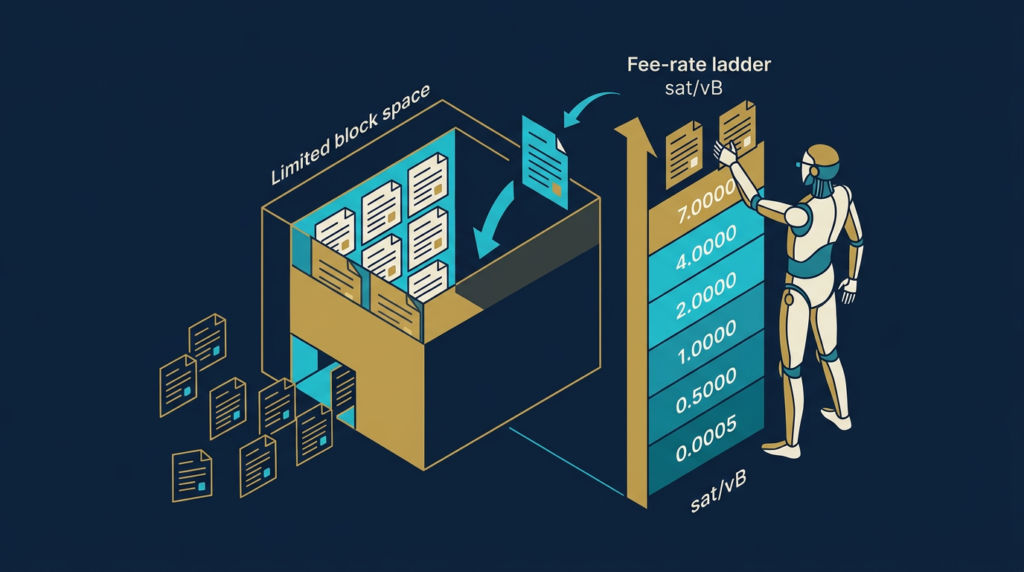
The simplest way to understand fees is to treat Bitcoin block space like a limited auction. Every roughly ten minutes, a new block opens with finite room. Users who want faster confirmation bid for that room by paying a higher fee rate. When demand is low, even modest bids get through quickly. When demand spikes, lower-fee transactions wait and higher-fee transactions move first.
This content is for educational purposes only and should not be considered financial or investment advice.
Key Takeaways
- Bitcoin fees are priced by transaction size and demand: They depend on virtual bytes and current competition for block space, not on the amount of BTC being sent.
- Fee rate matters more than total fee: Miners compare transactions by satoshis per virtual byte, usually written as
sat/vB. - Mempool congestion drives fee spikes: When more transactions are waiting than blocks can clear, users bid against each other for faster confirmation.
- Wallet structure affects cost: Transactions with many inputs are larger and usually more expensive than simple transactions with fewer inputs.
- Timing and tools can reduce costs: Better fee estimation, low-congestion timing, and UTXO maintenance can lower what you pay over time.
What a Bitcoin Transaction Fee Actually Is
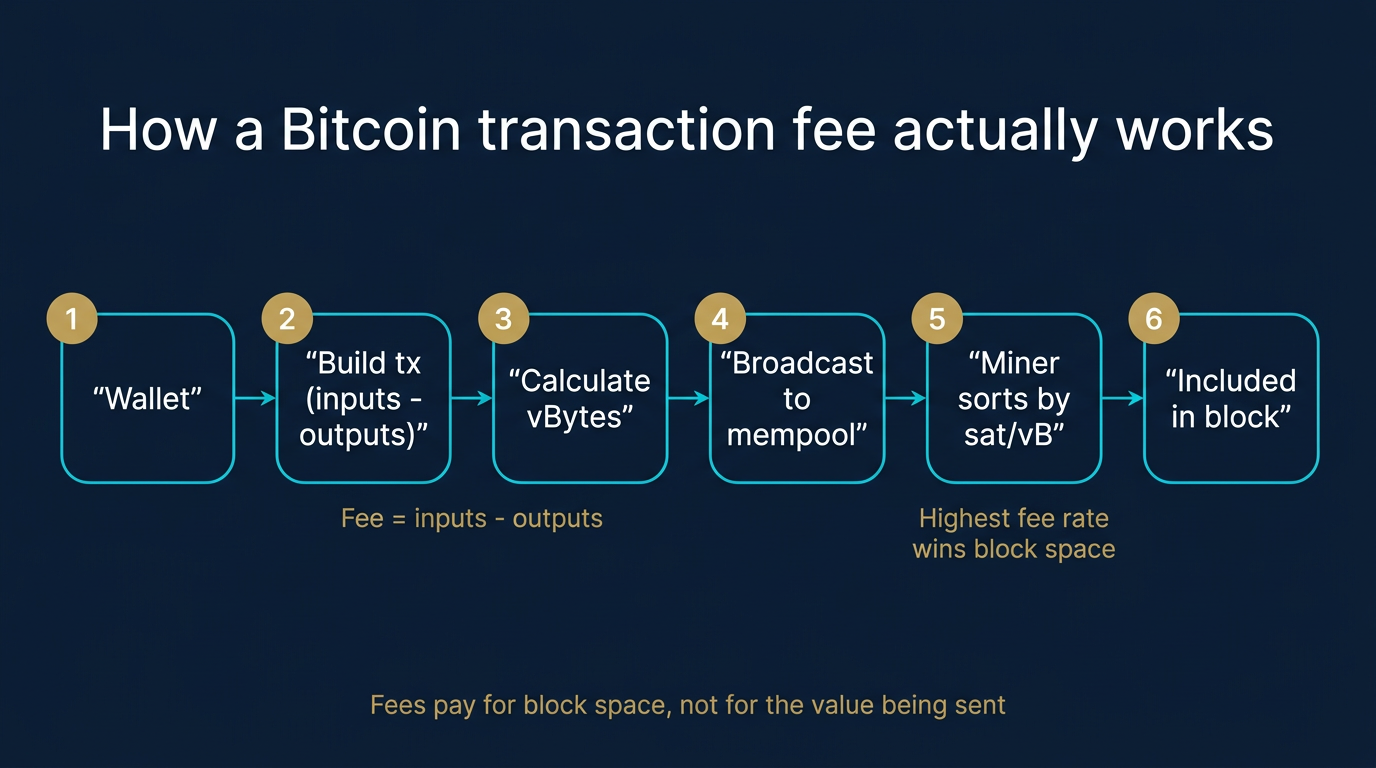
A Bitcoin transaction fee is the difference between the total value of the inputs you spend and the total value of the outputs you create. In practice, wallets calculate this automatically. What matters for users is that the fee is the price paid to get transaction data into a block. Miners earn that fee in addition to the block subsidy, so they have an economic reason to prefer transactions that pay more for the space they occupy.
A useful mental model is to think of the fee as postage, but for block space rather than envelope weight. You are not paying more because the value inside the envelope is large. You are paying for the amount of room your transaction takes up and how urgently you want it handled relative to everyone else trying to mail something at the same time.
Why Bitcoin Fees Are Based on Size, Not Value
Bitcoin transactions consume space according to their structure. A transaction with many inputs and outputs takes more data to describe than a simple transaction with one input and two outputs. Since each block has limited capacity, larger transactions take up more of that scarce resource and therefore cost more to include.
This surprises beginners because traditional payment systems often price transfers as a percentage of the value being moved. Bitcoin does not work that way. Sending 0.01 BTC and sending 10 BTC can cost the same if the underlying transaction structure is the same. The network only sees bytes, signatures, and outputs. It does not care whether the payment value feels big or small to the user.
For the structure behind this, the most relevant definition is What Is UTXO?. The number of UTXOs your wallet spends is one of the main reasons fees differ from one transaction to the next.
What sat/vB Means
Sat/vB is the price you pay per unit of block space, not per dollar of bitcoin. One satoshi is the smallest unit of BTC. One virtual byte is the standard way to measure how much room your transaction takes up after SegWit’s witness-data discount. The total fee is simply your chosen sat/vB rate multiplied by your transaction’s size in vBytes.
Bitcoin fee rates are usually quoted in satoshis per virtual byte, or sat/vB. A satoshi is the smallest unit of bitcoin. A virtual byte is a standardized way of measuring how much block space a transaction effectively uses, especially after SegWit changed how witness data is weighted.
The practical formula is simple: fee = fee rate × transaction size in vbytes. If your transaction is 140 vB and you choose 20 sat/vB, the fee is 2,800 satoshis. If the same transaction must compete during heavy congestion and the market moves to 120 sat/vB, the fee becomes 16,800 satoshis. The transaction itself did not change. The market for block space did.
One operator insight is that users often look at the absolute fee and miss the more important variable: transaction shape. If your wallet has become fragmented into many small inputs, even a moderate fee market can feel expensive because you are paying that market rate on a larger transaction than you expected.
How the Bitcoin Fee Market Works
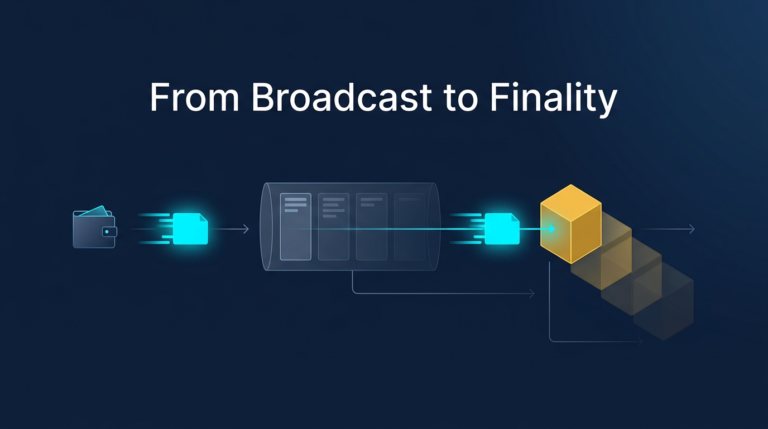
When you broadcast a transaction, it enters the mempool, which is the set of valid but unconfirmed transactions waiting on nodes across the network. Miners generally fill blocks with the transactions offering the strongest fee rates first, because that maximizes block revenue. If demand for inclusion is light, many transactions clear quickly at low rates. If demand exceeds available block space, transactions start competing more aggressively.
If you want the foundational definition behind this concept, read Bitcoin Mempool Explained: How the Transaction Queue Works.
A second mental model helps here: the mempool is like a queue with dynamic pricing. The queue order is not first-come, first-served in a simple sense. It is more like an airline upgrade list where price and priority matter. A later transaction can jump ahead of an earlier one if it bids more for scarce space.
For the direct explanation of that queue, see What Is the Bitcoin Mempool?. For the extreme version of the same process, mempool congestion explained shows why fees can spike so sharply during busy periods.
Why Bitcoin Fees Fluctuate
Fees change because demand for block space changes while supply stays relatively fixed. Blocks arrive on average every ten minutes, and each can only carry so much transaction data. When user activity surges, fees rise. When activity cools, fees usually fall.
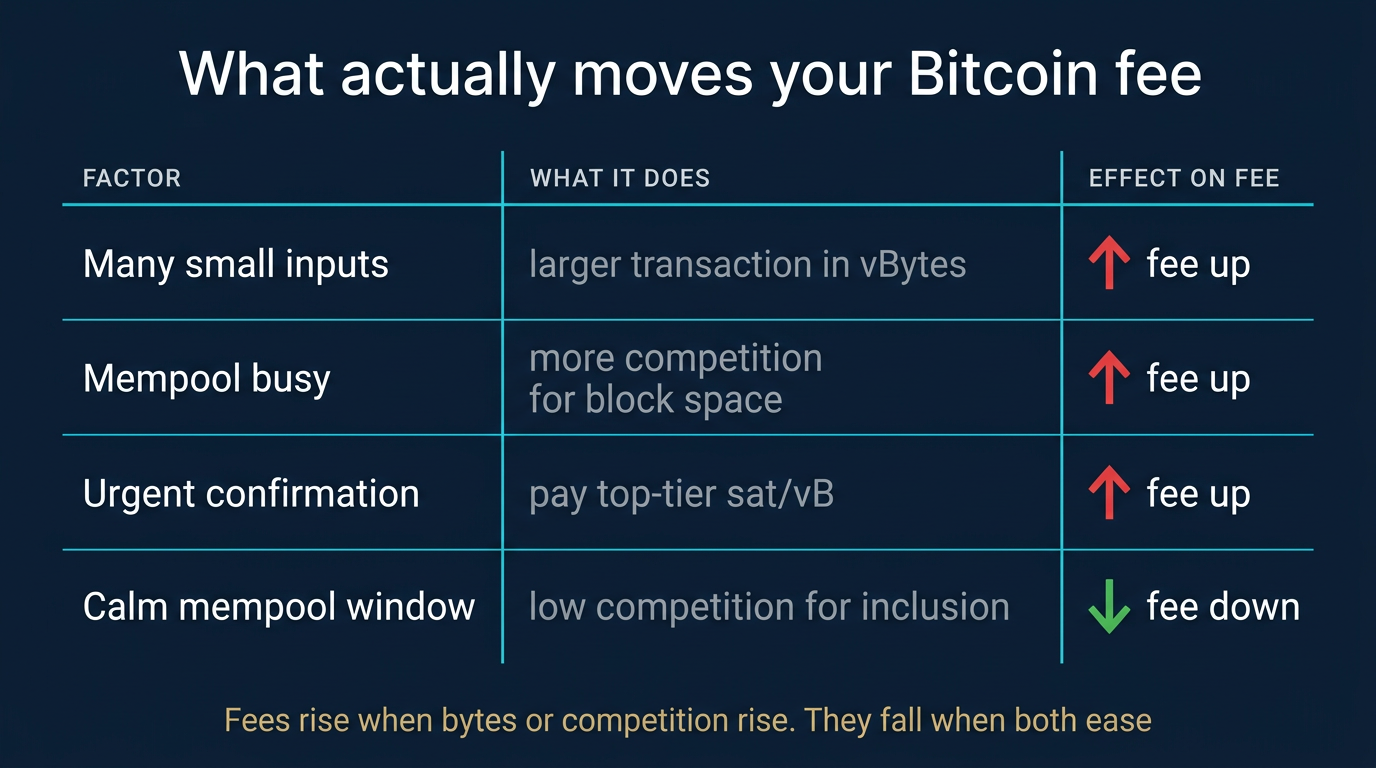
- Market volatility: Sharp price moves often trigger exchange withdrawals, self-custody transfers, and trader repositioning.
- Inscription or data-heavy activity: New categories of transactions can suddenly compete for the same space.
- Exchange batch waves: Large custodians sometimes push many withdrawals around the same time.
- User urgency: During busy moments, more users pay up for near-immediate confirmation.
One operator insight is that fee spikes often feel random to casual users because they only notice the price at send time. In reality, the wallet is reflecting a live market. The surprising part is not that fees moved. The surprising part is that many users assume a static fee environment on a network designed around a dynamic auction.
Why Some Wallets Pay More Than Others
Two users can send the same amount of bitcoin at the same time and still pay different fees. The difference usually comes from wallet design and transaction composition. A wallet using many small UTXOs will build a larger transaction than a wallet using one or two larger UTXOs. Different address types also affect effective size, and some wallets estimate fees more conservatively than others.
This is why maintenance matters. If your wallet receives lots of small inputs over time, future spending can become more expensive than expected. That is exactly where UTXO consolidation becomes useful: you pay a small maintenance fee during quiet periods to reduce later costs when urgency is higher.
Practical Usage: How to Think About Fees Before You Send
The practical goal is not to predict the exact lowest possible fee every time. The goal is to match the fee to the urgency of the transaction. If the payment is routine and not time-sensitive, waiting for lower congestion can save money. If timing matters, paying more for faster confirmation is often the right trade-off.
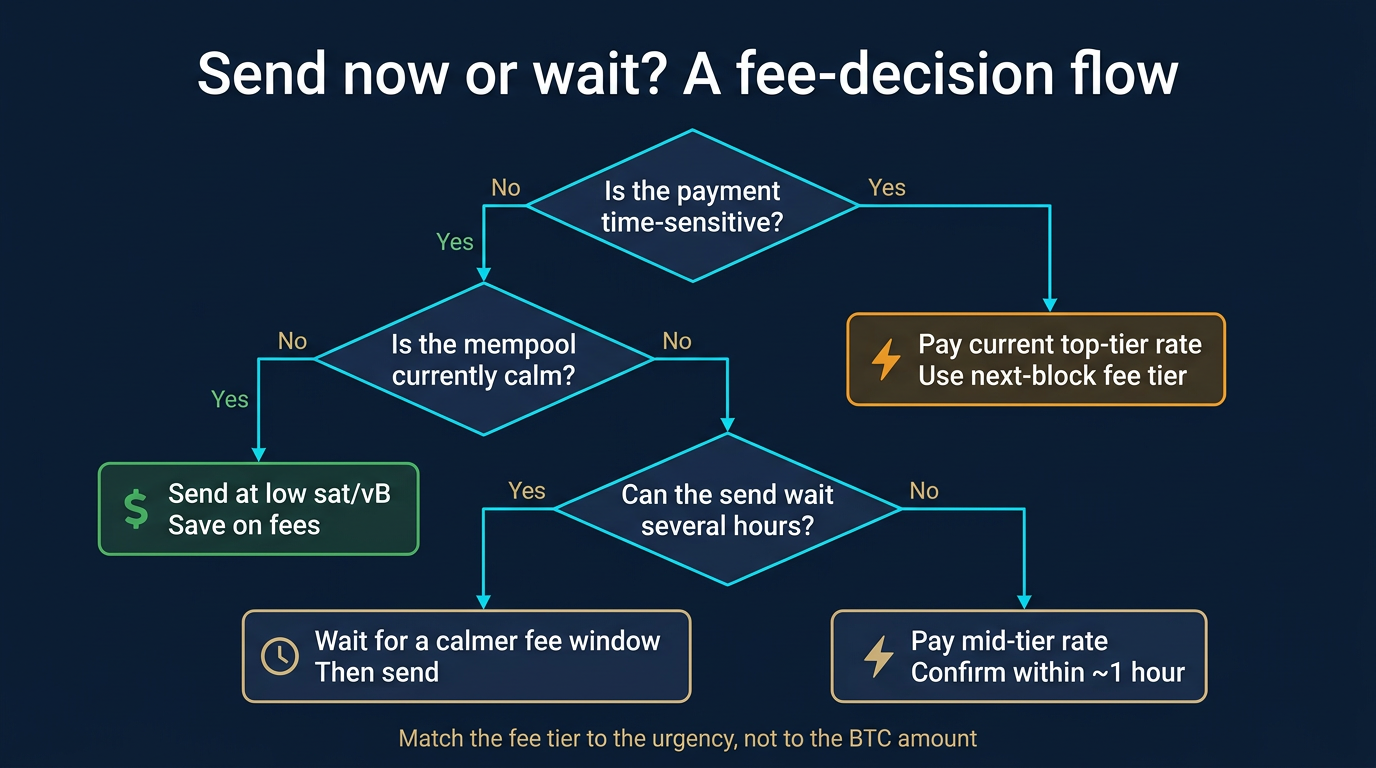
- Check current fee estimates first: Look at live mempool conditions before broadcasting, especially for larger or time-sensitive payments.
- Use wallet fee tiers intentionally: “Next block” is for urgency; lower tiers are for patience.
- Know your wallet’s input count: A heavily fragmented wallet usually needs more fee budget than a simple one.
- Do maintenance in quiet periods: Consolidating small UTXOs during low-fee windows can reduce later spending costs.
- Prefer flexibility when available: Wallets that support fee bumping give you more control if the market changes after broadcast.
A concrete way to think about it is this: if you are moving funds to cold storage and the timing is flexible, save money and wait for a calmer fee market. If you are sending to an exchange deposit before a deadline, underpaying can be more expensive than simply choosing a higher fee rate from the start.
Risks and Common Mistakes
For a closely related follow-up, see Bitcoin vs Ethereum Transaction Model: Two Different Ways Blockchains Track Value.
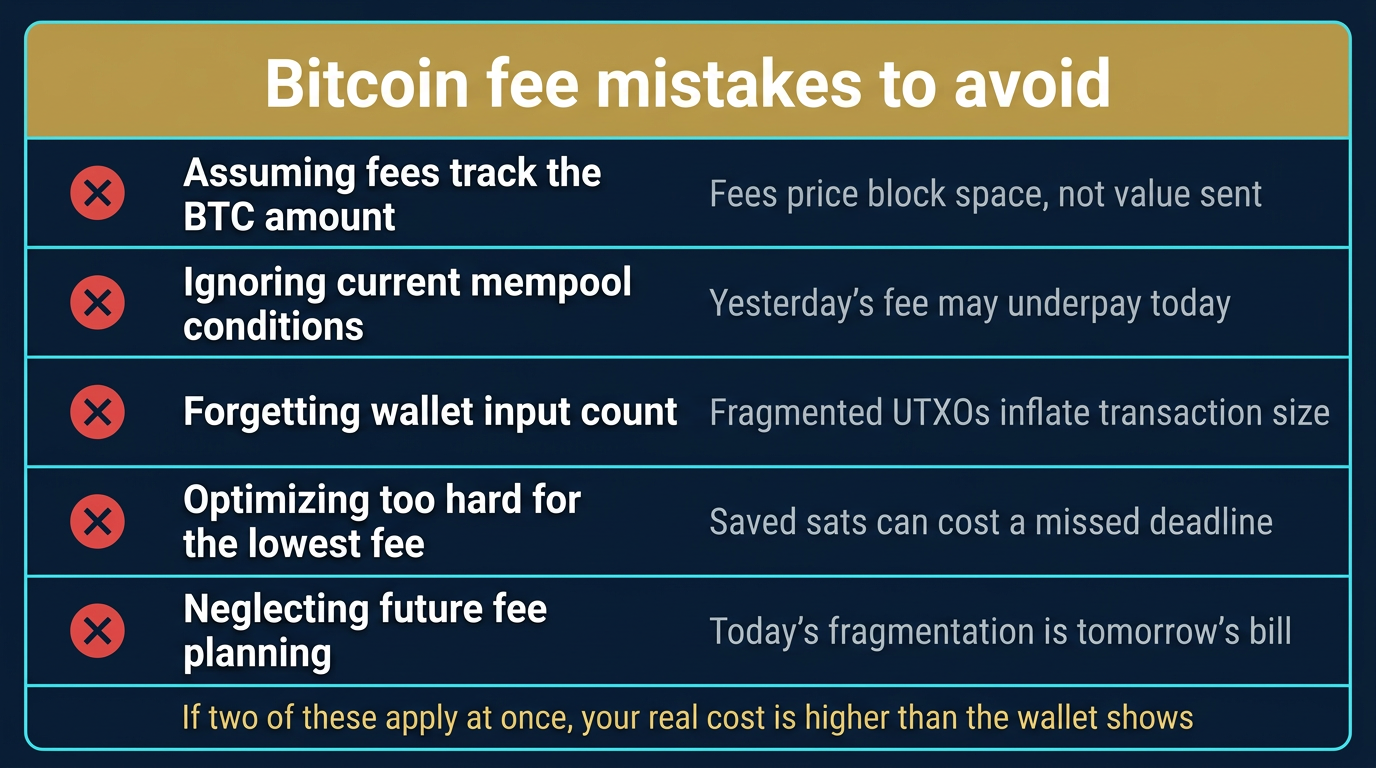
- Assuming fees track payment size: The amount of bitcoin sent is not what determines the fee.
- Ignoring current mempool conditions: A fee that worked yesterday may be too low today.
- Forgetting wallet structure: Many small inputs can make a transaction much more expensive than expected.
- Optimizing too hard for the lowest fee: Saving a little on fees can be costly if the payment is time-sensitive.
- Neglecting future fee planning: Poor UTXO management can turn routine future transactions into costly ones.
Sources
- Bitcoin Developer Guide: Transactions
- Bitcoin Developer Reference: estimatesmartfee
- Bitcoin Core: SegWit Wallet Development Guide
Frequently Asked Questions
Why do fees on Bitcoin change so much?
They change because block space is limited while transaction demand changes constantly. When the mempool is busy, users compete by paying higher fee rates for faster confirmation. When demand falls, lower fee rates are often enough.
Are Bitcoin fees based on how much BTC I send?
No. Bitcoin fees are mainly based on transaction size in virtual bytes and the current fee market, not on the value being transferred. A large-value transfer can cost the same as a smaller one if the transaction structure is similar.
What does sat/vB mean in Bitcoin?
It means satoshis per virtual byte. It is the standard unit for Bitcoin fee rates and tells you how much you are paying for each unit of transaction space. Wallets use that rate and your transaction size to estimate the final fee.
Why can two users pay different fees for the same payment amount?
Because their transactions may have different sizes. One wallet might use one or two inputs, while another uses many small inputs. Since fees depend on size, the second user usually pays more even if the BTC amount sent is the same.
How can I lower fees over time when sending bitcoin?
Use live fee estimates, avoid urgent sends during congestion when possible, and maintain a cleaner UTXO set through low-fee consolidation if your wallet becomes fragmented. Lowering future fees is often about planning, not just choosing a cheaper number at send time.