

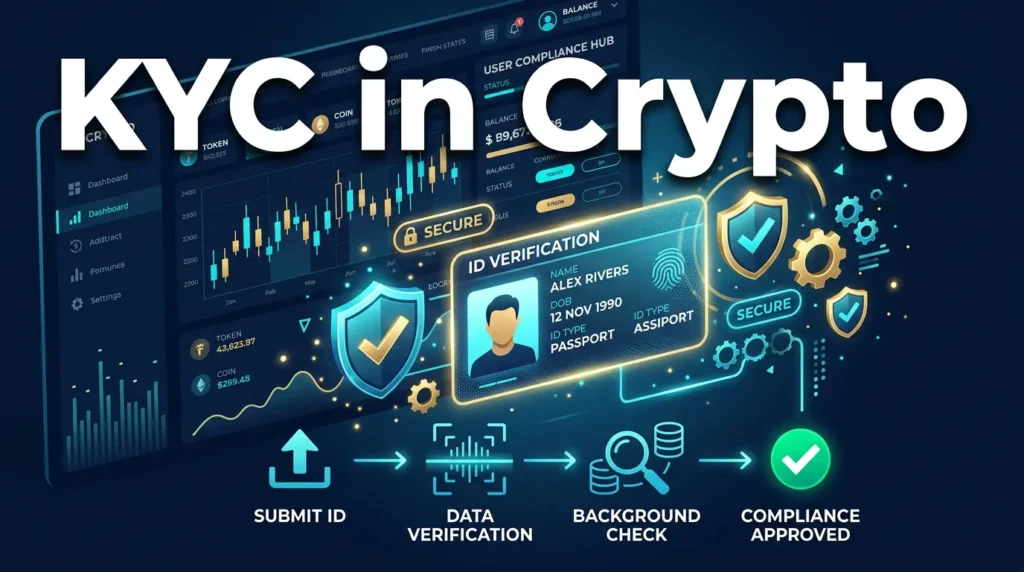
KYC in crypto means Know Your Customer. It refers to the identity-verification process that exchanges and other custodial crypto services use to confirm who a customer is before allowing certain account functions. In practice, that often means collecting personal information, checking government-issued ID, and sometimes verifying address, source of funds, or account activity depending on the service and jurisdiction.
For the broader overview around this topic, see What Is Blockchain?.
A simple mental model is to think of KYC as the identity layer attached to a financial account. In traditional banking, that layer is familiar. In crypto, it becomes most visible when you use centralized exchanges, custodians, fiat on-ramps, or other regulated services that sit between you and the blockchain.
This content is for educational purposes only and should not be considered financial or investment advice.
Key Takeaways
- KYC is identity verification: It is the process regulated services use to confirm who their customers are.
- It is tied to AML compliance: Exchanges use KYC as part of anti-money laundering and broader compliance controls.
- KYC is mainly a custodial-service issue: It usually matters most when a company holds accounts, processes fiat, or mediates transfers.
- Verification can affect account limits and withdrawals: Unverified or partially verified users may face restrictions.
- KYC does not define the whole crypto ecosystem: It is most relevant to regulated service providers, not to every direct blockchain interaction.
What KYC Actually Means
KYC is the process of identifying and verifying a customer before or during their use of a financial service. In crypto, that typically appears when you open an account on a centralized exchange, use a custodial platform, connect fiat banking rails, or trigger risk reviews tied to withdrawals and compliance monitoring.
The point of the process is not just collecting identity documents for their own sake. It is to help the service understand who is using the platform, reduce fraud, meet legal reporting duties, and support anti-money laundering controls. That is why KYC is usually discussed together with AML rather than as a standalone concept.
Why Exchanges Require It
Centralized exchanges and similar services often require identity verification because they operate inside financial-regulatory frameworks that expect customer due diligence. If a platform lets users convert between fiat and crypto, hold client assets, or move funds through banking systems, it usually faces obligations tied to anti-money laundering, fraud prevention, sanctions screening, suspicious-activity monitoring, and recordkeeping.
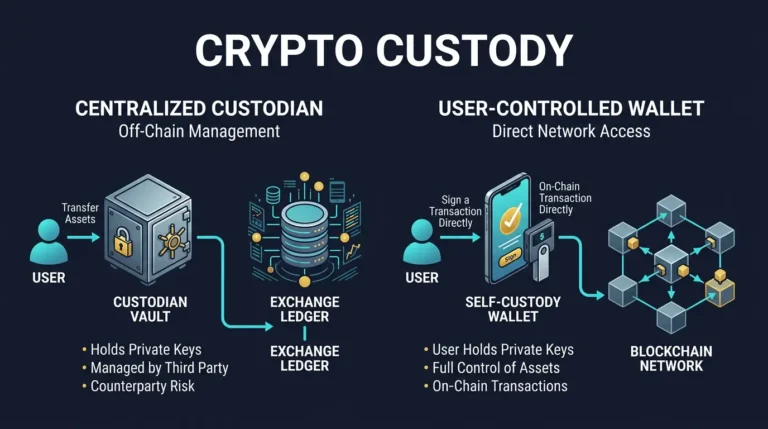
That is why a crypto exchange account can feel very different from a self-custody wallet. The exchange is not just providing software. It is operating a regulated account relationship with identity, monitoring, and compliance controls attached. For the custody side of that distinction, see What Is Crypto Custody.
What the Verification Process Often Includes
- Basic personal details: name, date of birth, and contact information.
- Government-issued identification: passport, national ID, or driver’s license.
- Address verification: sometimes a utility bill, bank statement, or other proof of residence.
- Photo or liveness checks: a selfie or live verification step to confirm the person matches the documents.
- Additional compliance questions: source of funds, occupation, or transaction context in higher-risk cases.
The exact steps differ by jurisdiction, platform type, and risk profile. A small retail account may face a lighter process than a higher-volume account, a business account, or an account that triggers ongoing compliance review.
How KYC Relates to AML
KYC is usually one piece of a broader AML framework. AML focuses on preventing money laundering, terrorist financing, sanctions evasion, and related abuse of financial systems. KYC supports that goal by helping the service know who the customer is before assessing account activity and risk patterns.
Operator insight: KYC is not the whole compliance system. It is the entry point. Once identity is established, the platform can combine that with transaction monitoring, withdrawal behavior, sanctions checks, and suspicious-activity review.
Why It Matters for Account Access
For users, the practical effect of identity verification is often felt through account permissions. Some platforms allow limited browsing or deposits before full verification, but restrict trading size, fiat transfers, or withdrawals until KYC is complete. Others require verification much earlier.
For a deeper dive into this specific angle, read Crypto Tax Mistakes Investors Make and How to Avoid Them.
Real-world scenario: a user opens an exchange account to buy crypto quickly, deposits funds, and only later discovers that full withdrawal functionality requires identity approval. The service may not be malfunctioning. It may simply be applying its compliance workflow at the stage where the user wants to move funds. That is one reason KYC can feel invisible until it suddenly becomes operationally important.
How KYC Changes the Trust Model
Once you use a KYC-enabled exchange or custodian, you are no longer interacting only with blockchain infrastructure. You are also entering a relationship with a company that can review, delay, restrict, or approve account functions based on its compliance duties. That does not automatically make the service bad. It does mean the experience is fundamentally different from self-custody.
This matters because account access, withdrawal timing, and documentation requests now depend partly on a regulated service rather than only on your wallet and the network. For the practical risk side of that relationship, the adjacent local article is Crypto Exchange Collapse.
What KYC Does Not Mean
Identity verification does not automatically mean a service is safe, honest, or low risk. It means the service is operating with identity and compliance controls that are common in regulated financial contexts. A KYC process can reduce some fraud and compliance risk, but it does not eliminate custody risk, operational failures, or poor security practices at the platform itself.
It also does not mean every crypto interaction requires it. Direct on-chain use of self-custody wallets is a different category from signing into a custodial exchange account that must manage compliance obligations.
When Users Usually Encounter It
- Opening a centralized exchange account
- Connecting bank rails for deposits or withdrawals
- Requesting higher withdrawal or trading limits
- Triggering risk reviews through unusual account activity
- Using custodial services that fall under AML obligations
A practical rule is simple: the more a service looks like a regulated account rather than a pure software wallet, the more likely identity checks become part of the experience.
Practical Usage: How to Think About It
- Expect it when using custodial exchanges: Do not assume full withdrawal access will exist before verification is complete.
- Separate identity checks from custody decisions: A verified account may still be a custodial-risk environment.
- Keep records organized: ID requests, address proofs, and account communications can become operationally important later.
- Know which relationship you are entering: A regulated exchange account is different from a self-custody wallet you control directly.
- Do not confuse compliance with immunity: KYC changes the account model, but it does not guarantee the platform cannot fail or restrict access.
A useful mental shortcut is this: identity verification tells the platform who you are. It does not change who controls the keys, who controls withdrawals, or who carries platform risk. Those are separate questions.
Risks and Common Mistakes
- Assuming verification means full independence: A verified exchange account can still face holds, reviews, or custody-related access problems.
- Waiting until a withdrawal is urgent: If the platform requires more documentation at the moment you need funds out, delay can become a real problem.
- Confusing KYC with overall safety: Identity checks do not remove solvency risk, withdrawal risk, or operational failures.
- Treating every crypto service as if it works the same way: Self-custody wallets and regulated custodial exchanges operate under different trust and compliance models.
Sources
- FATF: Guidance for a Risk-Based Approach to Virtual Assets and VASPs
- FinCEN: BSA Requirements for Money Services Businesses
- EU Regulation 2023/1113
Frequently Asked Questions
What is KYC in crypto?
It is the identity-verification process that exchanges and other regulated crypto services use to confirm who their customers are.
Why do crypto exchanges require identity verification?
They usually require it to meet anti-money laundering, fraud-prevention, sanctions-screening, and broader compliance obligations.
Does every crypto wallet require KYC?
No. The process is mainly associated with custodial platforms and regulated account-based services, not every self-custody wallet interaction.
Does KYC mean an exchange is safe?
No. It means the service uses identity and compliance controls, but it does not eliminate custody risk, withdrawal risk, or platform failure risk.
Can KYC affect withdrawals?
Yes. Many platforms use verification status to determine limits, access levels, and whether certain withdrawals or fiat functions are available.