

Contract risk in crypto is the risk that blockchain code does something unsafe, breaks under stress, or can be exploited in a way that leads to loss of funds, bad execution, or broken protocol behavior. In crypto, that matters because once users sign an interaction with on-chain code, the blockchain usually executes the logic exactly as written. If the code is flawed, the system can still behave “correctly” from the chain’s perspective while producing a terrible outcome for the user.
The useful mental model is that smart contracts remove some human discretion but replace it with code dependence. That means the main question is no longer just whether a company is trustworthy. It is also whether the code, permissions, dependencies, and incentives around that code are trustworthy enough for the value you are exposing to it.
This content is for educational purposes only and should not be considered financial or investment advice.
Quick Answer
This risk is the chance that on-chain code, protocol design, permissions, or dependencies fail in a way that harms users. That harm can come from bugs, exploits, bad upgrade paths, oracle failures, unsafe approvals, or economic assumptions that break under pressure.
Key Takeaways
- Code risk is real even when the interface looks polished: A good app design does not prove the underlying contracts are safe.
- Exploits are not the only failure mode: Logic errors, admin misuse, oracle problems, and economic design flaws matter too.
- User losses often come through normal-looking prompts: Approvals, deposits, swaps, and claims can all expose users to contract risk.
- Audits help but do not guarantee safety: Review quality matters, but audited protocols can still fail.
- Risk sits in the whole system: Contracts, dependencies, governance, and wallet behavior all shape the real danger.
Where Contract Risk Comes From
Contract risk comes from the fact that code holds and moves value directly. If a contract controls liquidity, collateral, token balances, or treasury assets, then any flaw in how it accounts for that value can become a financial loss event. Unlike ordinary web bugs, these failures can be immediate, irreversible, and exploitable at scale.
The cleanest foundation page behind this is What Is a Smart Contract?. Once code becomes the rule-enforcement layer, code quality and system design become part of the asset’s safety model.
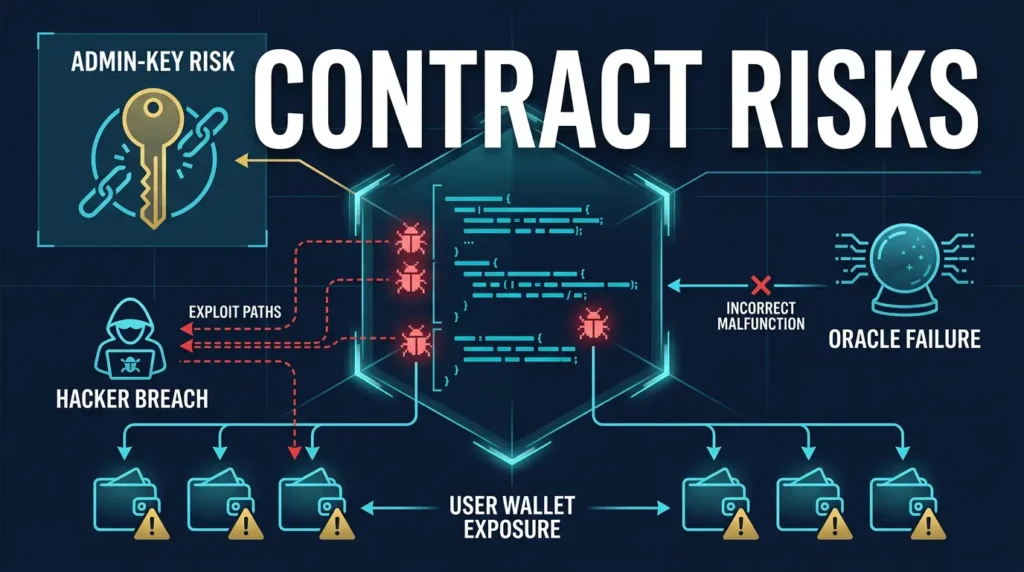
Main Categories of Risk
Implementation bugs
These are coding mistakes in how the contract updates balances, checks permissions, handles external calls, or processes state transitions. Reentrancy, incorrect accounting, missing validation, and unsafe arithmetic have all caused losses historically.
Permission and upgrade risk
Some protocols have admin keys, upgradeable contracts, pause functions, or treasury permissions that can change how the system behaves after deployment. Even if the core logic is sound, a dangerous permission model can still put users at risk.
Oracle and dependency risk
Many protocols rely on price feeds, bridges, multisigs, liquidity venues, or other external systems. If one of those dependencies fails or is manipulated, the contract can execute bad logic using bad inputs.
Economic design risk
A contract can be technically correct and still be economically fragile. Liquidation rules, incentive design, liquidity assumptions, and leverage loops can all create systems that break under stress even without a simple coding bug.
How Users Actually Get Hurt
Users usually do not experience smart-contract risk as a technical concept. They experience it as missing funds, bad redemptions, failed claims, drained tokens, or positions that liquidate unexpectedly because a protocol behaved in a way they did not expect. The chain may show a valid transaction history while the user experiences a very invalid financial outcome.
Real-world example: a user supplies collateral to a lending protocol that later suffers an oracle issue. The protocol may liquidate positions using corrupted pricing logic. Another user may approve a token-spender contract that later gets exploited or abused. In both cases, the user’s loss arrives through a normal product action that relied on unsafe code or dependencies.
Why This Is Not Just “Hacks”
People often imagine smart-contract risk as dramatic exploit headlines, but many failures are quieter. A protocol can freeze redemptions, mis-handle withdrawals, break wrapped-asset assumptions, or degrade collateral quality without a single cinematic exploit tweet. The underlying problem is still contract risk if the system’s code and assumptions created the damage path.
Operator insight: the broad question is not “Can this be hacked?” but “How does this system fail when assumptions break?” That includes code bugs, but also oracle errors, bridge dependencies, governance misuse, and fragile economic design.
How Risk Reaches Ordinary Users
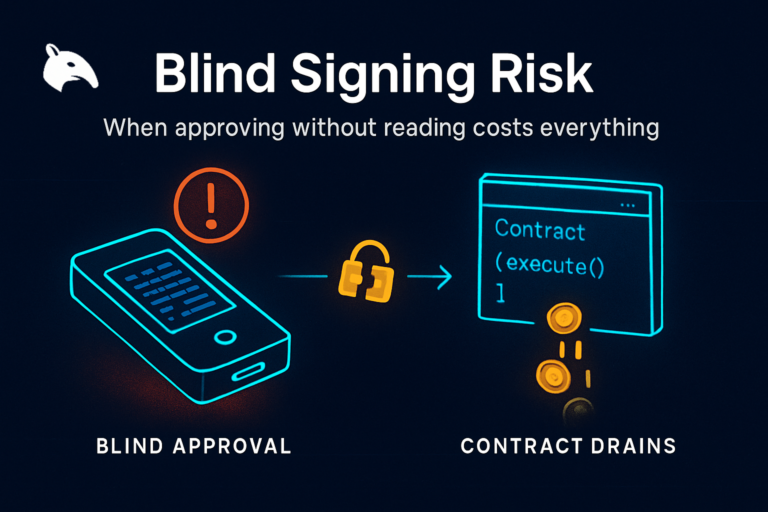
Most users do not read contract code directly. They meet smart-contract risk through wallet prompts. A token approval, liquidity deposit, bridge transfer, yield strategy, or staking action may look like a simple interface click, but underneath it is still contract interaction. That is why normal user workflows can carry protocol-level risk even when the user never sees a line of code.
For the approval and wallet-drain side of that exposure, the most relevant local references are Crypto Approval Scams and What Is a Crypto Drainer?.
Why Audits Help But Do Not Solve Everything
Audits help because they can identify implementation flaws, permission problems, and dangerous assumptions before or after deployment. But they do not guarantee that every issue was found, that future upgrades will remain safe, or that the protocol’s economics and dependencies are resilient in practice.
That is why the best local background page here is What Is a Smart Contract Audit?. An audit is a useful signal, but it should be read as a review step, not as immunity from loss.
Why Big Protocols Still Break
Large protocols can still fail because size does not remove complexity. A system can have high TVL, strong branding, and prior usage while still carrying dangerous assumptions in one part of the stack. In some cases, larger capital pools make the protocol a more attractive target, not a safer one.
For that reason, Why High TVL Does Not Mean Safe in Crypto is an important companion idea. Deposited capital is not the same thing as protocol resilience.
Concrete Failure Examples
- Bridge dependency failure: A protocol may rely on wrapped assets or cross-chain assumptions that break when the bridge layer fails. For the protocol-level version of that problem, see Crypto Bridge Hacks Explained.
- Liquidity-pool design stress: A pool can behave badly under volatility, thin liquidity, or bad token assumptions even if users only see a simple deposit screen. The closest local follow-up is Liquidity Pool Risks Explained.
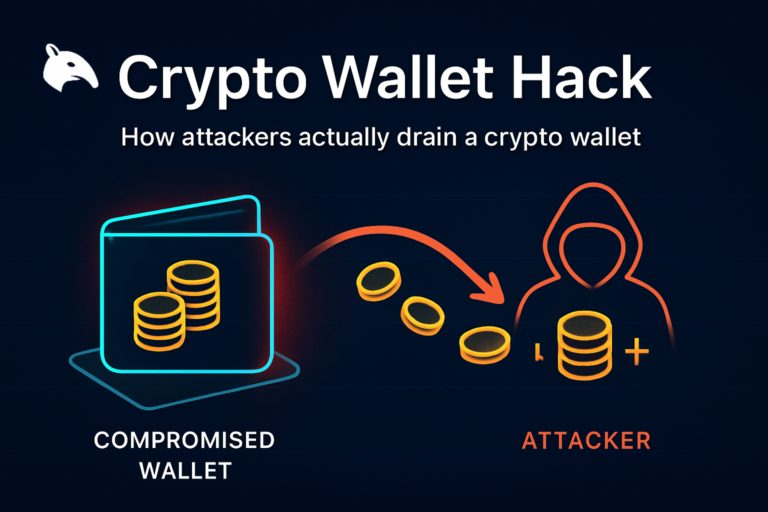
- Approval-driven drain paths: A malicious or compromised contract can pull funds through permissions the user granted in what looked like a routine DeFi workflow.
Practical Usage: How to Think About Contract Risk
- Start with the exact financial job: Lending, swapping, bridging, staking, and farming create different contract exposures.
- Check whether the protocol is audited, but read beyond the badge: The report details matter more than the label alone.
- Understand permissions and dependencies: Admin keys, oracles, bridges, multisigs, and upgrade paths are part of the risk model.
- Treat wallet prompts like contract decisions: A simple approval or deposit can expose more value than the interface suggests.
- Size exposure to uncertainty: If the protocol, route, or claim flow is unclear, reduce balance size rather than relying on optimism.
A useful operator rule is this: if you cannot explain in one or two sentences how the protocol could fail, you probably should not expose a meaningful balance to it yet.
Risks and Common Mistakes
- Equating polished interfaces with safe code: A good frontend can hide weak contracts, dangerous permissions, or fragile dependencies.
- Thinking audits eliminate protocol risk: Audits help, but they do not remove later changes, economic flaws, or hidden operational weaknesses.
- Ignoring the wider system: Bridges, oracles, governance, liquidity, and multisigs can become the real weak points around the core contract.
- Approving or depositing without understanding the action: User-side mistakes often become valid on-chain outcomes.
- Using one metric as proof of safety: TVL, brand recognition, or popularity alone do not explain how the system behaves under failure.
Sources
- Ethereum.org: Smart Contract Security
- Smart Contract Security Best Practices
- OpenZeppelin Contracts Documentation
Frequently Asked Questions
What is contract risk in simple terms?
It is the risk that on-chain code, permissions, or dependencies fail in a way that causes loss, bad execution, or unsafe behavior for users.
Can audited contracts still be risky?
Yes. Audited contracts can still fail through missed bugs, later upgrades, dependency problems, governance abuse, or economic design issues.
Is contract risk the same as wallet risk?
No, but they overlap. Wallet risk is about how you store and authorize access, while contract risk is about what the protocol code and its surrounding system can do once you interact with it.
How do ordinary users run into this kind of risk?
Usually through normal-looking actions such as approvals, swaps, bridge transfers, lending deposits, and yield interactions that rely on on-chain code behaving safely.
What is the biggest mistake people make here?
The biggest mistake is thinking protocol risk only exists when there is a famous exploit headline, instead of seeing that unsafe code, dependencies, and permissions can affect normal user actions every day.