

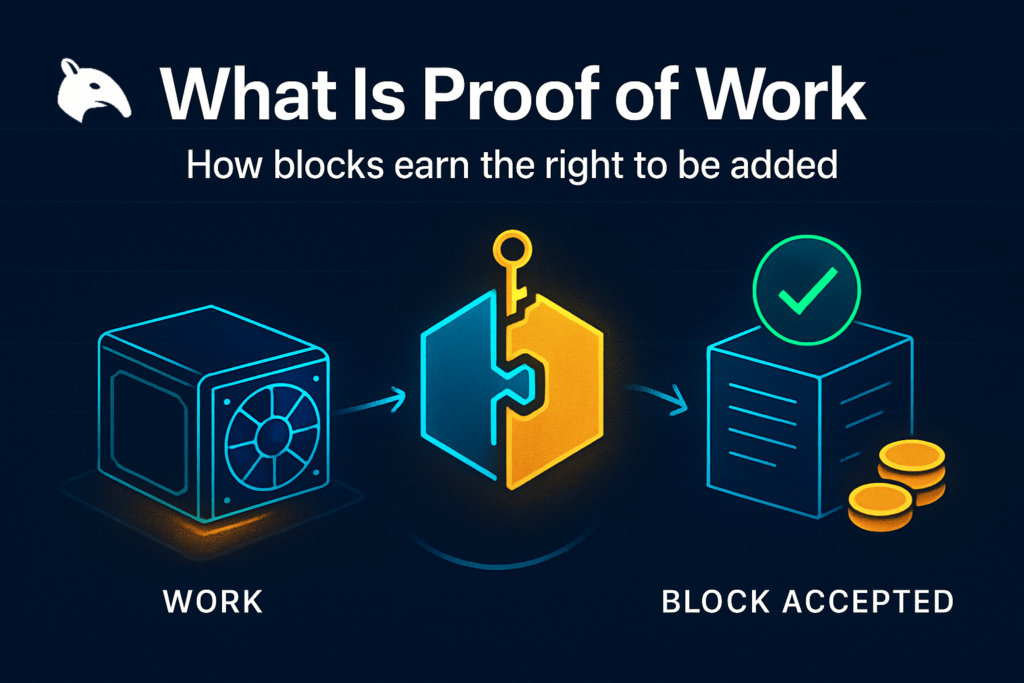
Proof of work is a consensus mechanism that secures a blockchain by requiring block producers to perform costly computation before their blocks can be accepted. In Bitcoin, that means miners repeatedly hash block headers until one of them finds a valid result below the network’s current difficulty target. The winning block can then be broadcast to the network, where full nodes verify that it obeys the rules.
For the broader overview around this topic, see What Is Blockchain?.
The practical idea is that this model turns block creation into something expensive to fake. Instead of trusting one server or authority to decide the next valid block, the network relies on measurable computational effort that anyone can verify afterward. That cost is what makes rewriting history difficult and what gives the chain a credible ordering of blocks.
This content is for educational purposes only and should not be considered financial or investment advice.
Key Takeaways
- This model uses expensive computation to secure consensus: Miners must spend real resources to propose valid blocks.
- Finding a valid block is hard, checking it is easy: This asymmetry is central to how the system works.
- Hashrate and difficulty shape the security environment: More total work and tighter difficulty targets make attacks more expensive.
- Miners propose blocks, but nodes still verify them: The mechanism does not replace rule enforcement by full nodes.
- The mechanism trades resource cost for trust minimization: Instead of trusting people directly, the network trusts work that can be independently checked.
What This Mechanism Actually Means
At its core, this mechanism means a participant must demonstrate that they performed a large amount of computation to earn the right to add a block. In Bitcoin, the participant does that by presenting a block header hash that falls below a target value set by the protocol. Because cryptographic hash outputs are unpredictable, the only practical way to find a valid result is trial and error at massive scale.
A useful mental model is to think of PoW as a lottery where tickets are purchased with electricity and hardware time. The more computation you perform, the more chances you have to find a winning hash. But unlike a normal lottery, everyone can later verify instantly whether the winning ticket was valid.
Why a Blockchain Uses Costly Computation
A blockchain needs a way for many independent participants to agree on transaction order without trusting a central operator. This model solves that problem by making block production costly and publicly verifiable. If someone wants to rewrite history, they cannot simply announce a different version of the ledger. They must redo the required work and outcompete the honest network’s ongoing work.
This is what gives the chain a strong notion of accumulated history. The deeper a transaction sits beneath additional proof-of-work-secured blocks, the more expensive it becomes to reverse. Consensus is not coming from a committee vote. It is emerging from the economic and physical cost of producing valid blocks under shared rules.
One operator insight is that the real product of this model is not “mined coins” alone. It is costly ordering. The coin issuance is the incentive layer, but the deeper function is creating a block history that is expensive to fake and easy to audit.
How Mining Competition Works in Practice
Miners gather pending transactions, build a candidate block, and repeatedly hash the block header while changing a field such as the nonce and other variable data. The goal is to find a hash result below the difficulty target. Because cryptographic hashes behave unpredictably, miners cannot reason their way directly to a valid answer. They have to keep trying.
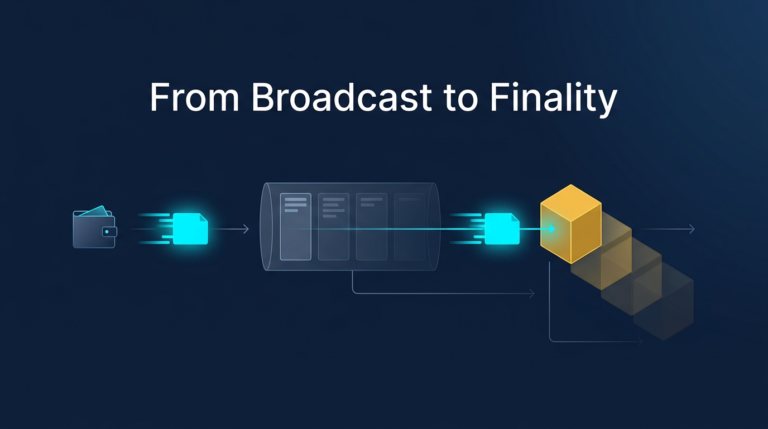
Once a miner finds a valid block, the block is broadcast across the network. Other nodes verify the proof, the transactions, the block reward, and every other consensus rule. If everything checks out, the block is accepted and built upon. If not, it is rejected no matter how much work the miner claims to have spent.
This is why the phrase “hard to produce, easy to verify” matters so much. The expensive part is creating a valid candidate. The cheap part is checking whether the candidate actually satisfies the rule.
Hashrate and Difficulty in This Model
Hashrate measures how much total computation miners are applying to the network. Difficulty controls how hard it is for that computation to find a valid block at the intended pace. If more miners join, blocks would arrive too quickly without an adjustment. The protocol solves that by increasing difficulty so the average block interval stays near target.
For the direct follow-ups behind those mechanics, the most relevant local references are Bitcoin Network Hashrate and Bitcoin Mining Difficulty Explained. They cover the measurement and adjustment layers in more detail.
A second mental model helps here: PoW is like a treadmill with an automatic speed controller. If more runners jump on, the controller speeds up the treadmill so completing a lap still takes about the same amount of time. If runners leave, it slows down. The point is not to punish or reward individual miners. It is to keep block production on schedule.
Why This Model Is Considered Secure
The security comes from the real-world cost of producing enough work to attack the network. To successfully dominate a large proof-of-work chain, an attacker would need a huge amount of hardware, energy, and operational coordination, and they would need to sustain that advantage against the honest network’s continued mining.
That does not mean the mechanism is magical or invulnerable. It means attacks are constrained by economics and physics rather than by trust in a central bookkeeper. The higher the honest network’s total work, the more expensive and less practical large-scale attacks become.
Another operator insight is that this model secures the chain only when combined with independent node verification. Miners can spend resources proposing blocks, but nodes still decide whether those blocks obey the rules. Work gives proposals weight; nodes give the system rule discipline.
What This Mechanism Is Not
- It is not just “burning electricity for no reason”: The energy cost is part of the mechanism that makes block production expensive to fake.
- It is not the same as mining rewards: Rewards are the incentive; the costly process secures block production.
- It is not blind trust in miners: Nodes still verify the resulting blocks independently.
- It is not a guarantee against every attack: It raises the cost of attack; it does not make attacks logically impossible.
- It is not the only consensus model: Proof of stake secures networks through a different economic design.
This last point matters because many explanations collapse into slogans. The value of understanding the mechanism is not memorizing that it “uses mining.” It is understanding why computation, difficulty, incentives, and node verification fit together the way they do.
Practical Usage: How to Read a PoW Network
For most users, the practical benefit is interpretive rather than operational. If you understand PoW, you can better read network security, miner incentives, and why concepts like hashrate, difficulty, and confirmation depth matter. You also become less likely to confuse block rewards with security itself or to assume miners can change rules unilaterally.
For a closely related follow-up, see Bitcoin Mempool Congestion: Why Fees Spike and Transactions Stall.
For a closely related follow-up, see UTXO Consolidation Explained: What It Is and When to Do It.
For a closely related follow-up, see Wallet Address Reuse Risks: What It Exposes On-Chain.
For a deeper dive into this specific angle, read Bitcoin vs Ethereum Transaction Model: Two Different Ways Blockchains Track Value.
- Look at hashrate as a rough security signal: More honest computation generally means a more expensive chain to attack.
- Look at difficulty as a timing control: It helps the network adapt to changing mining power while keeping block intervals near target.
- Remember that nodes still enforce the rules: A block with valid-looking work but invalid transactions is still rejected.
- Separate price stories from mechanism design: This mechanism explains consensus and security, not guaranteed market outcomes.
- Compare it to proof of stake carefully: They solve similar consensus problems with different trust and cost structures.
A practical frame is to ask: “What would an attacker have to spend to change this history, and who would verify whether their attempt obeyed the rules?” PoW answers the first part with computation and energy, and the node network answers the second with independent validation.
Risks and Common Mistakes
- Reducing it to a mining buzzword: A common beginner mistake is to think the point is just “miners get coins.” The more important mechanism is that expensive block production makes cheap history rewriting harder.
- Ignoring the role of nodes: If a miner produced a block with an invalid subsidy or broken transaction, full nodes would still reject it. The system is not “miners decide everything.”
- Assuming more electricity automatically means better security: Security depends on whether the cost structure is tied to honest rule-following history, not just on raw energy headlines taken out of context.
- Confusing hashrate with price prediction: A hashrate rise after new hardware deployment or a regional recovery does not automatically mean BTC price must follow. It mainly tells you about mining competition and network cost.
- Treating consensus models as interchangeable: PoW and proof of stake may both secure ledgers, but they rely on different attack costs, participation models, and failure modes.
Sources
Frequently Asked Questions
What is PoW?
It is a consensus mechanism that requires block producers to perform costly computation before their blocks can be accepted. The resulting work is easy for nodes to verify and helps secure the chain against cheap rewrites.
Why does Bitcoin use this model?
Bitcoin uses it to order blocks and secure history without trusting a central operator. Making block production expensive helps prevent attackers from cheaply rewriting recent transactions.
Mining is the process of performing the required work. Miners repeatedly hash candidate block headers until one finds a valid result below the target. That work is the proof-of-work component of the system.
Does PoW mean miners control the rules?
No. Miners propose blocks, but full nodes still verify whether those blocks obey consensus rules. A miner cannot override the protocol simply by spending more electricity if the proposed block is invalid.
Is PoW the same as hashrate?
No. Hashrate measures how much computation is being applied to the network. PoW is the broader consensus mechanism that uses that computation, plus difficulty adjustment and node verification, to secure block production.