

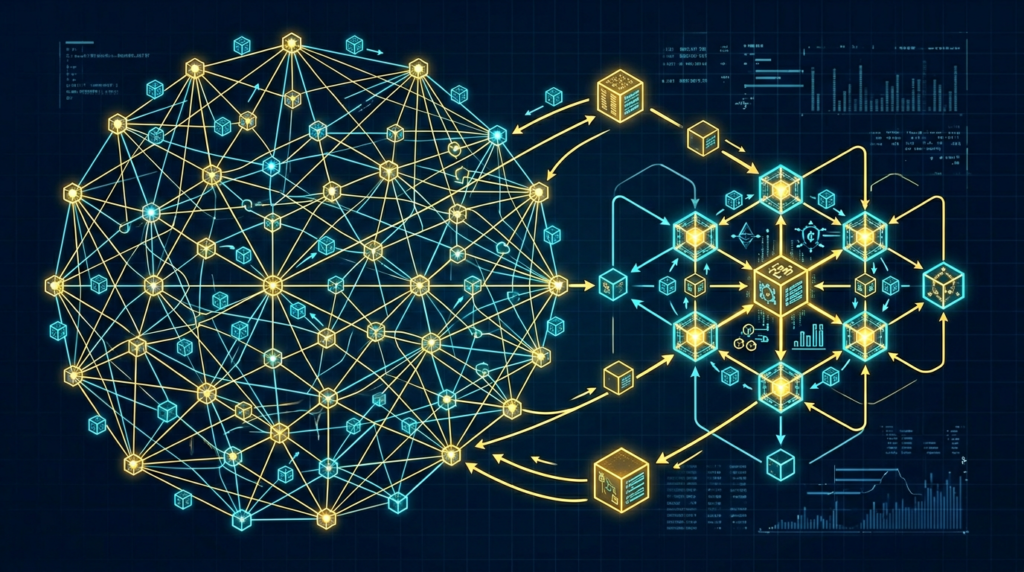
A node network in blockchain systems is the distributed set of computers that run blockchain software, share data with one another, and collectively maintain the chain’s state. Instead of relying on one central server to record balances and transactions, a blockchain uses many independently operated machines that communicate across a peer-to-peer network. Each node contributes to propagation, verification, storage, or consensus depending on its role.
The key idea is that the network’s integrity comes from many machines checking the same system from different places, not from one machine being especially trusted. That is what makes a blockchain network resilient to outages, censorship, and unilateral rule changes. If one node disappears or behaves badly, the rest of the network can continue.
This content is for educational purposes only and should not be considered financial or investment advice.
Key Takeaways
For a deeper dive into this specific angle, read UTXO Consolidation Explained: What It Is and When to Do It.
- A node network is a peer-to-peer system: Nodes connect directly to one another rather than relying on a central database server.
- Different nodes do different jobs: Some mainly validate, some produce blocks, some serve wallet data, and some store fuller copies of chain history.
- Propagation and verification are separate concepts: A node may relay data quickly, but its deeper role is to decide what is valid under the protocol rules.
- Network integrity comes from distribution: Many independent nodes make it harder for any single party to rewrite rules or suppress valid data.
- The exact design depends on the blockchain: Proof-of-work and proof-of-stake systems use different participant roles, but both rely on node communication and rule enforcement.
What a Node Network Actually Is
At the simplest level, a node network is a group of computers running the same protocol and exchanging information about transactions, blocks, and chain state. Each node maintains its own local view of the network and updates that view as new valid data arrives from peers. There is no single machine all others must trust. Agreement emerges because many nodes independently enforce the same rules.
A useful mental model is to think of the network as a room full of accountants who all keep their own ledgers. When a new transaction or block appears, each accountant checks it against the rulebook before writing it down. If one accountant makes an error or disappears, the others still have their own verified copies. The system remains trustworthy because verification is distributed.
How Nodes Communicate With Each Other
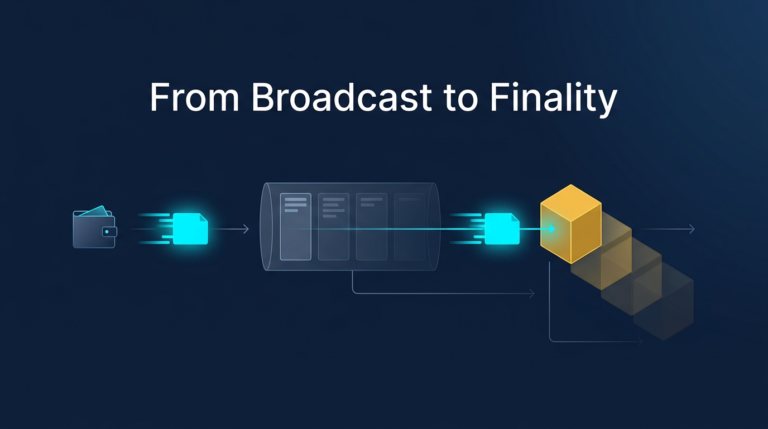
Nodes connect to peers over the internet using peer-to-peer networking. They discover peers, open connections, exchange data, and gossip new transactions or blocks across the network. This relay process is what lets a user in one part of the world broadcast a transaction and have miners or validators elsewhere hear about it quickly.
That does not mean every node talks to every other node directly. Instead, information propagates outward through many local peer connections. A transaction may move from your wallet’s connected node to a handful of peers, then to their peers, and so on until it reaches a large portion of the network.
One useful mental model is to think of propagation like rumor spreading in a crowded room. A message does not need to be shouted to every person individually. It moves from cluster to cluster until nearly everyone has heard it. The difference is that node networks do not just pass messages along. They also verify whether those messages deserve to be repeated.
What Nodes Do Beyond Relaying Data
Relay is only the visible part of the job. Nodes also validate transactions and blocks according to the blockchain’s consensus rules. That can include signature checks, supply rules, block structure, proof checks, staking rules, or state-transition logic depending on the chain.
This is the crucial distinction: a node network is not just a communications layer. It is a distributed validation layer. The network matters because nodes refuse invalid data, not merely because they forward packets efficiently.
One operator insight is that users often focus on block producers and forget the validating majority behind them. Miners or validators may create the next block, but nodes across the network still determine whether that block counts. Production creates proposals. Validation decides legitimacy.
Different Node Roles in a Network
Not all nodes are identical. Networks usually include several role types, even if ordinary users casually call them all “nodes.”
- Full nodes: Store and verify a broad or complete view of the chain and independently enforce protocol rules.
- Light nodes or wallet-connected clients: Rely on fuller nodes for some data while still participating in network access.
- Block-producing nodes: In proof-of-work these are miners; in proof-of-stake these are validators or proposers.
- Archive or infrastructure nodes: Store deeper historical state and serve exchanges, analytics tools, or advanced applications.
That role separation helps explain why “node count” alone can be misleading. The important question is not just how many machines exist, but how many independent machines are validating rules, producing blocks, and serving the network in meaningful ways.
Why Distribution Protects Blockchain Integrity
A distributed node network makes a blockchain harder to censor, harder to shut down, and harder to change by decree. If one provider, jurisdiction, or hosting cluster fails, the network can continue through other nodes elsewhere. If one participant tries to push invalid data, other nodes can reject it.
A second operator insight is that decentralization is not just about how many nodes exist on paper. It is also about where they are, who operates them, which software clients they run, and whether users actually depend on independent infrastructure instead of a small number of major providers. A network with many nominal nodes but heavy operational concentration can still be fragile.
How This Looks in Bitcoin and Proof-of-Stake Networks
In Bitcoin, the node network includes full nodes that verify blocks and transactions, plus miners that produce blocks through proof-of-work. The most relevant local definition here is What Is a Bitcoin Node?. That article focuses on the validating machine itself, while this article focuses on the broader network those machines form together.
In proof-of-stake systems, the network includes validating or attesting nodes, often called validators, alongside other infrastructure clients. The corresponding local follow-up is What Is a Validator Node?. The specific incentives differ from Bitcoin, but the network principle is the same: many participants exchange and verify state rather than trusting one central operator.
For users, the core lesson is that the details of consensus may change, but the role of the node network remains the same. It is the distributed substrate that propagates information and enforces the chain’s rules.
How Users Experience the Node Network Indirectly
Most users do not open peer connections manually or monitor network topology maps. They experience the node network indirectly when a wallet broadcasts a transaction, queries balances, or checks whether a block has confirmed. If their wallet depends on a third-party node provider, that provider becomes part of their trust path even though the chain itself remains decentralized at the protocol level.
This is why self-hosted infrastructure can matter. The more directly you connect to your own validating setup, the less you rely on someone else’s node to tell you what the chain says. Even when users do not run their own nodes, understanding the network helps them see where trust is being outsourced.
Practical Usage: How to Think About Node Networks
The practical question is not whether you need to memorize network protocols. It is whether you understand what keeps a blockchain honest. If you know that many independent nodes propagate and validate the chain, you can reason more clearly about decentralization, censorship resistance, and why self-verification matters.
For a closely related follow-up, see Bitcoin vs Ethereum Transaction Model: Two Different Ways Blockchains Track Value.
For the risk side of this topic, see How Much Crypto Should You Keep on an Exchange? A Safer Framework.
- Separate infrastructure from branding: A blockchain is not just an app or token. It is a live network of machines enforcing rules.
- Ask who validates the data you see: Wallet convenience often depends on someone else’s node unless you run or choose your own infrastructure.
- Look beyond raw node counts: Geographic spread, client diversity, and operator independence matter as much as headline totals.
- Understand the validation layer: Block producers matter, but rule-enforcing nodes are what keep protocol changes from becoming arbitrary.
- Treat node networks as the system’s nervous system: If transactions and blocks cannot propagate and be checked, the chain cannot function normally.
A practical operator frame is to ask: “If one company disappeared tomorrow, would this chain still function and would my wallet still have trustworthy ways to verify data?” The stronger the independent node network, the more confidently the answer stays yes.
Risks and Common Mistakes
- Confusing a node with the whole network: One node is one participant; the network is the collective system they form.
- Assuming propagation equals validation: Fast message relay is useful, but independent rule enforcement is the deeper security function.
- Overfocusing on block producers: Validation nodes still matter even when they are not directly creating blocks.
- Reading decentralization from raw counts alone: Provider concentration, client monoculture, and geographic clustering can still create fragility.
- Ignoring hidden trust in wallet infrastructure: Many everyday wallet experiences still rely on third-party nodes unless users deliberately reduce that dependency.
Sources
Frequently Asked Questions
What is a node network in blockchain systems?
It is the distributed peer-to-peer system of computers running blockchain software and exchanging transactions, blocks, and chain data. Together, those nodes help maintain the chain’s state and integrity.
Do all nodes do the same thing?
No. Some nodes mainly validate, some help wallets with lighter access, some produce blocks, and some store deeper historical data for infrastructure purposes. The shared idea is participation in the network, but the role can differ.
Why are node networks important?
They distribute verification and communication across many independent machines. That makes the system more resilient, harder to censor, and less dependent on any single operator or server.
How is a node network different from miners or validators?
Miners and validators are specific roles within the broader node ecosystem. The node network includes the wider set of machines that relay, verify, and maintain the chain, not only the ones selected to produce blocks.
Do regular wallet users depend on node networks too?
Yes. Wallets need nodes to broadcast transactions and retrieve chain data. Even when users do not run nodes themselves, they still rely on some node infrastructure to interact with the blockchain.