

Reading crypto charts starts with understanding what price is doing over time, not with memorizing dozens of indicators. A basic chart shows where price opened, where it moved, where it closed, and whether buyers or sellers controlled that period. Once you can read that clearly, the next useful layers are trend, support and resistance, volume, and how the current market structure affects execution.
The main beginner mistake is trying to turn chart reading into prediction magic too early. Charts are not crystal balls. They are visual summaries of price behavior, market participation, and positioning. Used well, they help you describe what the market is doing. Used badly, they tempt you to overconfidently guess what must happen next.
This content is for educational purposes only and should not be considered financial or investment advice.
Quick Answer
To read crypto charts, start with candlesticks, then identify whether price is trending up, down, or sideways. After that, look for key price zones, volume changes, and the nearby market structure that may affect entries and exits.
Key Takeaways
- Charts show behavior over time: The goal is to read price action clearly before adding complexity.
- Candlesticks are the basic language: They show open, high, low, and close for each time period.
- Trend matters before indicators: Rising highs and lows tell a different story from falling ones.
- Volume adds context: Moves with strong participation often carry more meaning than thin moves.
- Execution still matters: A chart setup can look clean while spread and depth make the trade worse than expected.
Start With the Candlestick
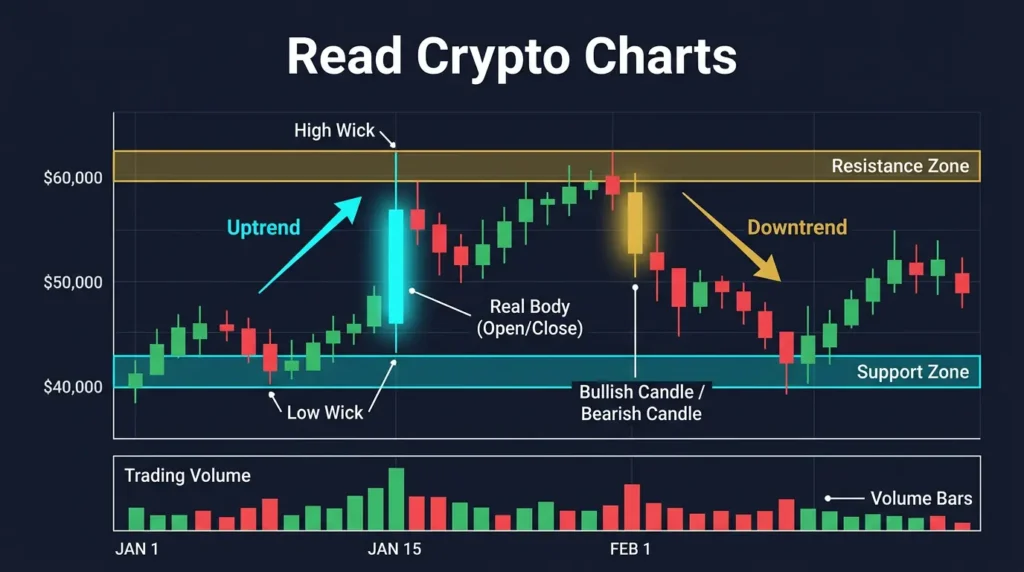
A candlestick represents price movement during one chosen time period, such as 5 minutes, 1 hour, 1 day, or 1 week. Each candle shows four core values: the open, the high, the low, and the close. If the close is above the open, the candle is usually displayed in a bullish color. If the close is below the open, it is usually displayed in a bearish color.
The candle body shows the distance between the open and the close. The wicks show how far price moved above or below that body during the same period. A long upper wick can suggest sellers pushed price back down from higher levels. A long lower wick can suggest buyers pushed price back up from lower levels.
What the Timeframe Changes
The same market can look completely different depending on the timeframe you choose. A coin may look strong on a 5-minute chart while still sitting inside a weak downtrend on the daily chart. This is why beginners often feel confused: they are switching between timeframes without realizing they are looking at different levels of market behavior.
A practical shortcut is to decide what job the chart is doing before reading it. A short-term trader may care more about intraday structure. A longer-term buyer may care more about the daily and weekly chart. The timeframe should match the decision you are making.
How to Identify Trend
The next step is trend. A simple uptrend usually shows higher highs and higher lows over time. A downtrend usually shows lower highs and lower lows. A sideways market often lacks clear progress in either direction and instead bounces within a range.
Real-world example: if BTC keeps pulling back to a level above the prior swing low and then pushing to a new swing high, buyers are maintaining control of the structure. If rallies keep failing below the prior high and new lows keep forming, sellers are controlling the structure instead.
Operator insight: many beginners focus on whether a candle is green or red and ignore the larger structure around it. One green candle inside a broader downtrend is not the same thing as a real trend reversal.
Support and Resistance
Support and resistance are price zones where the market has previously reacted strongly. Support is an area where buyers have often stepped in. Resistance is an area where sellers have often become more active. These are not exact magic lines. They are zones where market participants have shown repeated interest.
A useful mental model is to think of support and resistance as memory points in the market. If price repeatedly turns around near the same zone, traders begin paying attention to it. That attention itself can reinforce the importance of the level.
Why Volume Matters
Volume shows how much trading activity took place during a given period. It matters because price moves with strong participation often carry more weight than moves happening on weak activity. A breakout with strong volume can be more meaningful than a breakout where barely anyone is trading. A sharp move on thin volume can also reverse faster than beginners expect.
This does not mean high volume guarantees a move will continue. It means volume helps you judge whether the market is moving with broader participation or with thinner support underneath.
How This Connects to Market Structure
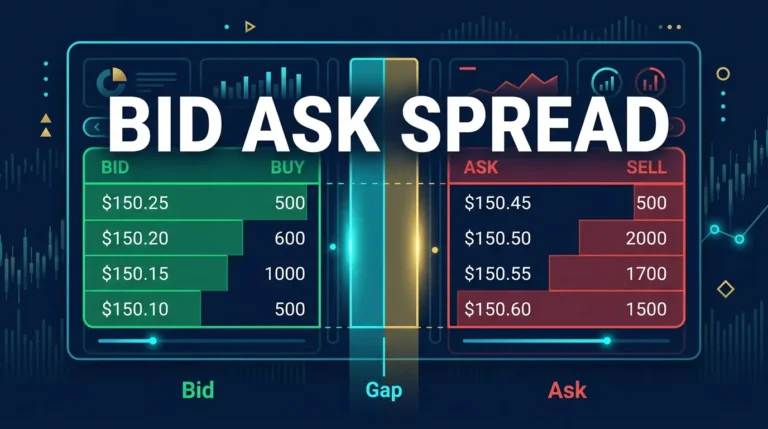
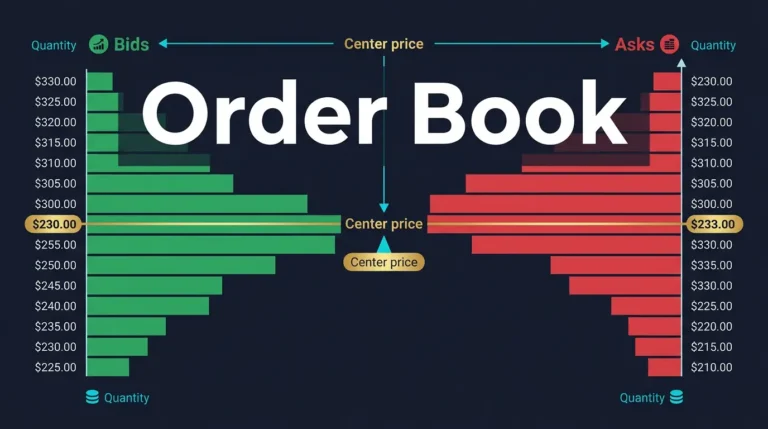
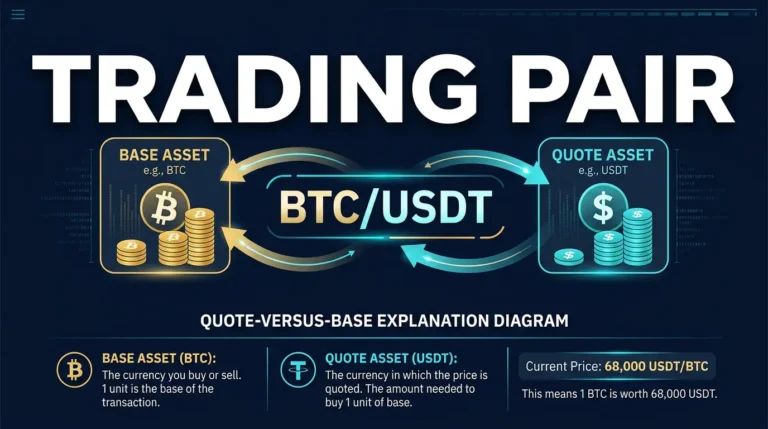
A chart is not separate from execution. The shape on the screen sits on top of a market that still has bids, asks, spreads, and order-book depth. If you are learning the basics, the best adjacent pages are What Is a Crypto Order Book?, Bid vs Ask in Crypto, and What Is a Crypto Trading Pair?.
That matters because a clean-looking chart setup can still produce poor execution if the spread is wide or the nearby depth is weak. Reading the chart tells you what price has been doing. Reading the market structure tells you what trading into that setup may actually cost.
What Beginners Should Ignore at First
Beginners often add too many indicators before they can read basic price action. Moving averages, RSI, MACD, and dozens of custom overlays can all be useful in specific contexts, but they become noise if you do not first understand candle structure, trend, and key levels. Too many signals usually create fake confidence rather than real clarity.
A better sequence is simple: learn candles, trend, support and resistance, volume, and basic execution quality. Add indicators later only if they help answer a real question you already understand.
Practical Usage: How to Read a Chart Step by Step
- Start with the timeframe: Match the chart to your decision horizon before reading anything else.
- Look at recent highs and lows: This shows whether the market is trending, ranging, or breaking structure.
- Mark obvious support and resistance zones: Focus on areas with repeated reaction, not tiny random candles.
- Check volume around key moves: Strong participation often makes a level or breakout more meaningful.
- Check execution conditions before acting: A setup matters less if the spread is wide or the market is thin.
A concrete example: suppose ETH is making higher lows on the 4-hour chart, pushing toward a prior resistance zone, and volume increases as price approaches that level. That chart tells you buyers have been improving the structure. It does not guarantee a breakout, but it gives you a clearer framework than staring at isolated candles one by one.
For broader context around where price action fits inside larger behavior, Market Cycles in Crypto Explained is the most useful next step.
Risks and Common Mistakes
- Reading one candle like a prophecy: A single candle matters far less than the surrounding structure and timeframe context.
- Changing timeframes constantly: This can create confusion instead of clarity if the time horizon is not defined first.
- Treating support and resistance like exact lines: Price often reacts in zones rather than at one perfect number.
- Ignoring volume and execution quality: A pattern on the chart can still trade poorly in a weak market.
- Adding too many indicators too early: More tools do not automatically create better understanding.
Sources
Frequently Asked Questions
What is the first thing to learn on a crypto chart?
The first thing to learn is the candlestick, because it shows the open, high, low, and close for each time period.
How do I know if a crypto chart is in an uptrend?
A simple uptrend usually shows higher highs and higher lows over time rather than repeated lower highs and lower lows.
Why does volume matter on a chart?
Volume matters because it shows how much participation backed a move, which can help you judge whether price action has stronger or weaker support.
Do I need indicators to read crypto charts?
No. Beginners are usually better served by learning candles, trend, key levels, and volume before relying on more indicators.
Can a chart tell me exactly where price will go next?
No. Charts help you understand market behavior and structure, but they do not guarantee future direction.