


Last Updated on April 20, 2026 by Snout0x
Introduction
What is blockchain? In simple terms, it is a shared digital ledger that records transactions across many computers instead of one central server.
It is often framed as revolutionary, but the core idea is easier to understand than the marketing suggests. A blockchain is just a method of recording and verifying data so that changing past records becomes extremely difficult without broad network agreement.
That matters because crypto investors do not just buy coins. They interact with systems that use different security models, different validation methods, and different trade-offs between speed, decentralization, and trust.
This guide explains what blockchain is, how it works, why it was created, where it is useful, and where its limitations still matter.
Disclaimer
This article is for educational purposes only and should not be treated as financial, legal, or security advice. Blockchain networks, wallets, and crypto platforms all carry different risks. Always verify details before moving funds or interacting with new protocols.
5 Key Takeaways
- A blockchain is a distributed ledger maintained by many computers rather than one central authority.
- Transactions are grouped into blocks and linked together using cryptographic hashes.
- Consensus mechanisms such as Proof of Work and Proof of Stake help the network agree on valid transactions.
- Some blockchains support smart contracts, which allow code to execute automatically on-chain.
- Blockchain can improve transparency and censorship resistance, but it also increases personal responsibility and security risk.
What Is Blockchain? (Simple Definition)
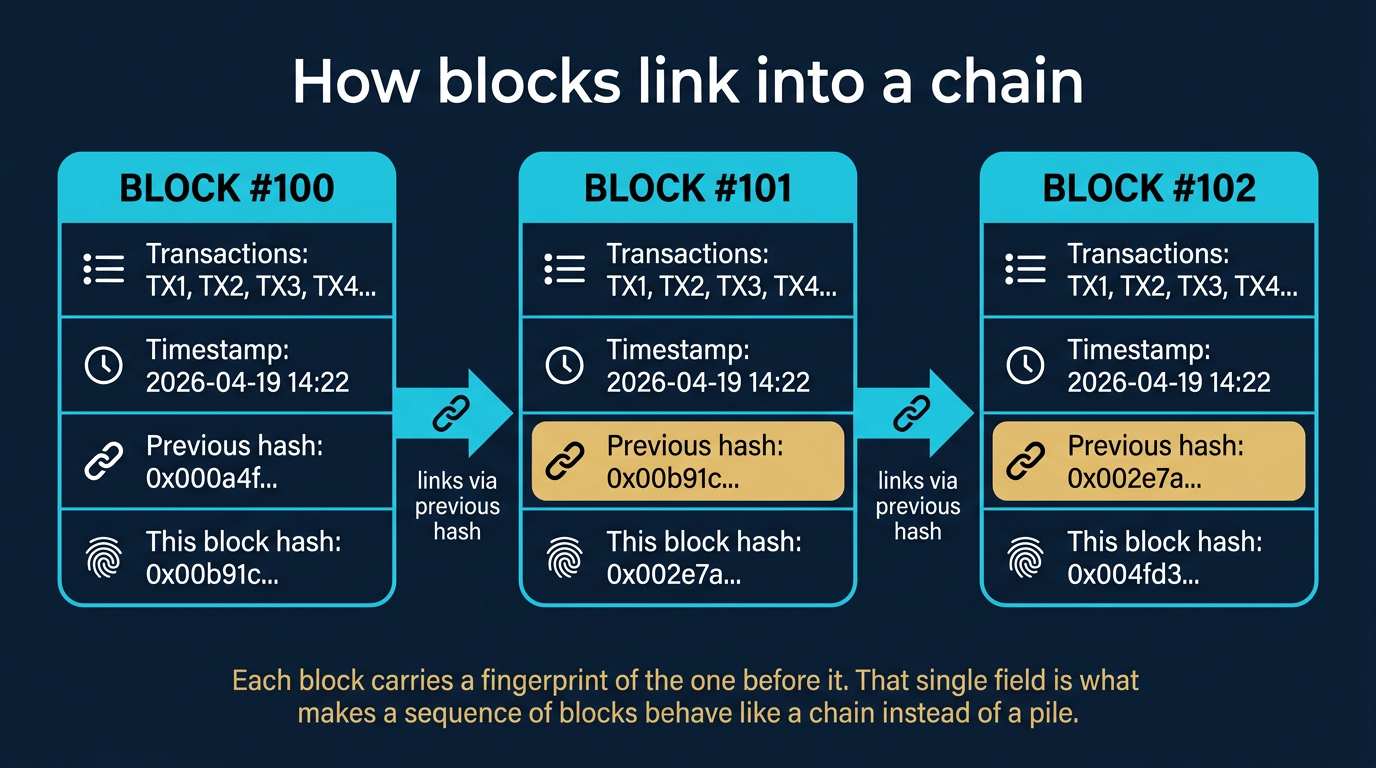
A blockchain is a shared digital record book that many computers keep in sync at once. New entries are bundled into time-ordered blocks, and each block carries a fingerprint of the one before it. That linkage is what makes the history hard to silently rewrite — change one block and every copy on the network notices.
A blockchain is a distributed database that stores records in sequential blocks linked together by cryptography.
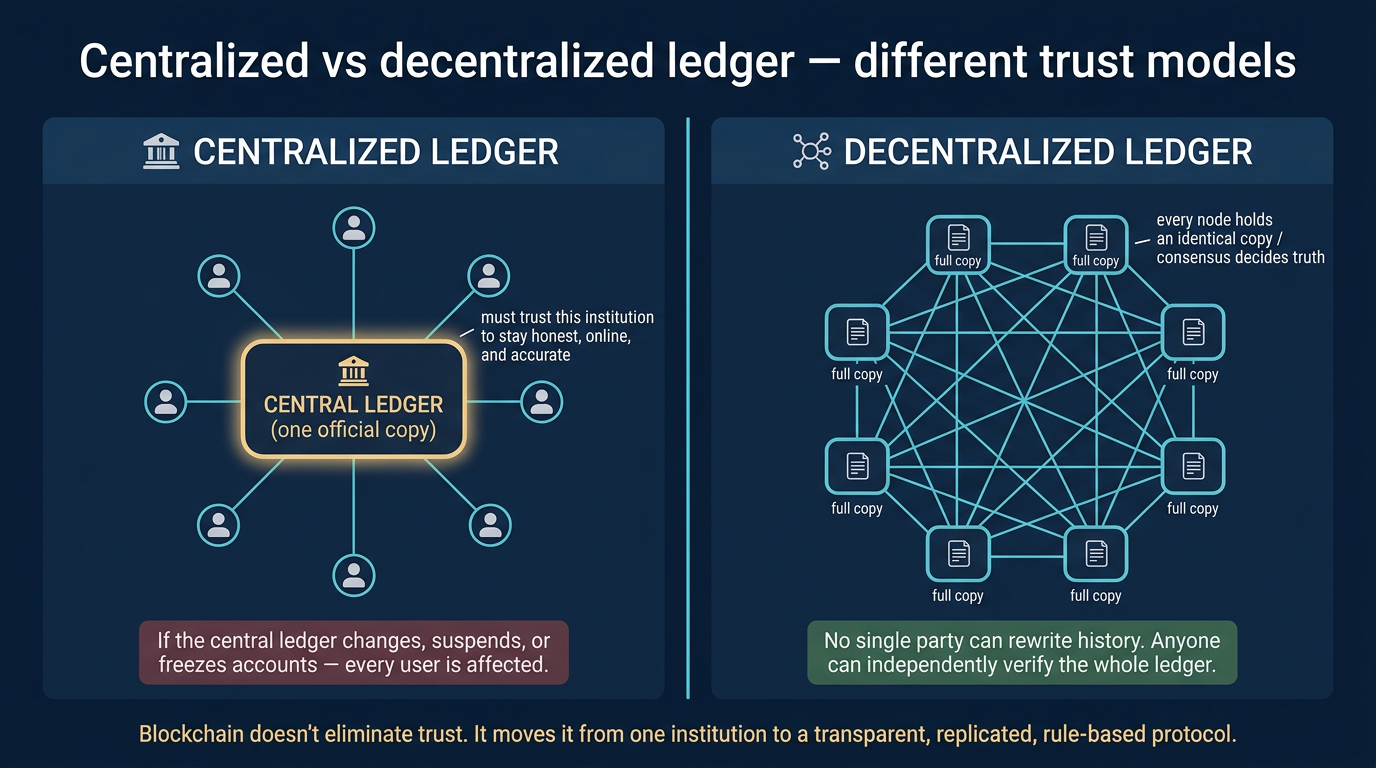
Instead of a bank, company, or government maintaining the only official version of a ledger, many independent participants keep synchronized copies of the same transaction history. The network then uses rules and consensus mechanisms to decide which new entries are valid.
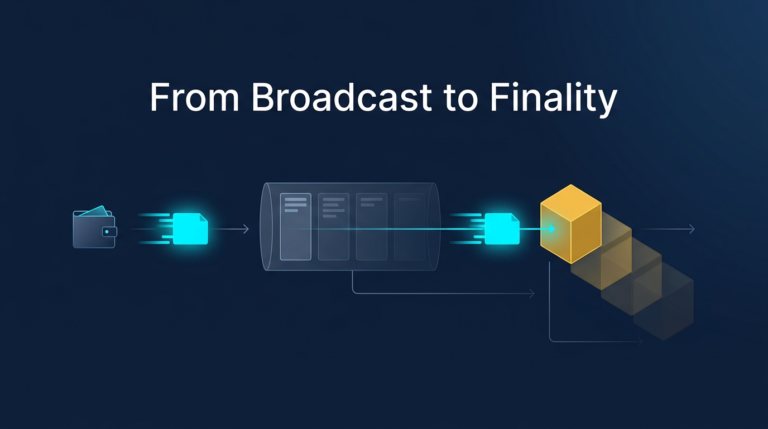
In practical terms, a transaction usually follows this path:
- It is broadcast to the network.
- Network participants verify it according to the protocol rules.
- Valid transactions are grouped into a block.
- That block is added to the existing chain of prior blocks.
- The updated ledger is shared across the network.
Between broadcast and confirmation, valid transactions can sit in a network waiting area sometimes called the mempool until they are included in a block.
On major blockchains, rewriting confirmed history is extremely difficult because an attacker would need to overpower or economically outcompete a large part of the network.
Why Blockchain Was Created
Traditional digital systems depend on trusted intermediaries. Banks maintain balances, payment processors settle transfers, and centralized platforms decide which records count as final.
That model works, but it creates a dependency: users must trust the institution running the ledger to behave honestly, stay online, resist censorship, and maintain accurate records.
Blockchain was introduced to reduce that dependency. Instead of trusting one institution to update a private database, participants can rely on open protocol rules, cryptographic verification, and distributed consensus.
The real innovation is not just digital money. It is the ability for strangers on the internet to agree on a shared transaction history without a single controller.
For a broader beginner foundation, see Crypto Starter Guide 2026.
How Blockchain Works
1. Transactions
A blockchain starts with transactions. These can include coin transfers, smart contract interactions, validator actions, or other data depending on the network.
Each transaction must follow the protocol’s rules. For example, the sender must prove they control the funds being spent through transaction signing, and the transaction must not attempt to spend the same coins twice.
2. Blocks
Valid transactions are grouped into batches called blocks. A block usually contains:
- a set of transactions
- a timestamp or other ordering data
- a reference to the previous block
- metadata required by the network’s consensus rules
Because each block references the previous one, the ledger forms a chronological chain.
3. Hashes
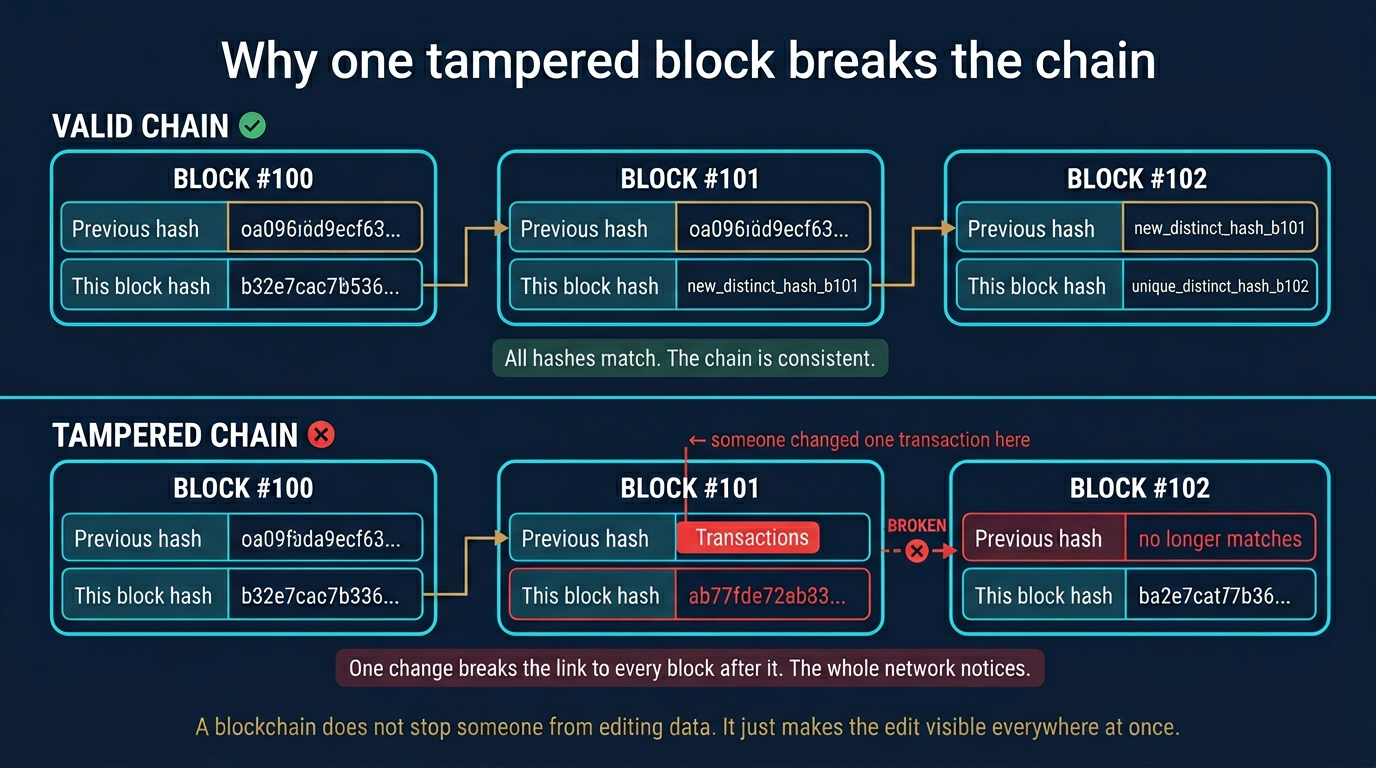
A hash is a cryptographic output generated from input data. If even a tiny part of the block changes, the resulting hash changes as well.
This matters because each block includes a cryptographic reference to the previous block. If someone tampers with one block, the chain no longer lines up correctly. On a live network, that makes silent history edits extremely difficult.
4. Network Verification
Different participants verify transactions and blocks according to the protocol. On some networks, this is done by miners, and on others by validators.
If you are new to this distinction, see What Is a Validator Node in Crypto?.
5. Consensus
The final step is consensus: how the network agrees on which block becomes part of the official ledger.
Consensus is what prevents multiple conflicting versions of history from becoming valid at the same time.
Proof of Work vs Proof of Stake
Proof of Work (PoW)
Proof of Work is the model used by Bitcoin. Miners compete to solve computational puzzles, and the winner earns the right to add the next block.
- Security comes from the cost of electricity, hardware, and ongoing competition.
- Attacking the network becomes expensive because it requires real-world resources.
- The trade-off is lower throughput and high energy use compared with many newer systems.
For a simple look at how Bitcoin’s security budget adjusts over time, see Bitcoin mining difficulty explained.
Proof of Stake (PoS)
Proof of Stake is used by Ethereum and many newer blockchains. Instead of miners expending energy, validators lock up tokens as collateral and participate in block production according to protocol rules.
- Security comes from economic incentives and penalties.
- Validators can be rewarded for honest participation.
- Misbehavior can result in penalties or slashing depending on the chain.
Proof of Stake is generally more energy-efficient, but it introduces different concerns around validator concentration, protocol design, and staking risk.
For practical risk context, see Staking Crypto in 2026: Risks & Real Yields and Validator Slashing Explained.
The Blockchain Trilemma
Many blockchain designs are shaped by a trade-off often called the blockchain trilemma. Networks usually have to balance three goals:
- Decentralization , how widely power is distributed across participants
- Security , how difficult it is to manipulate the ledger
- Scalability , how efficiently the network processes large transaction volume
Improving one side of the triangle often pressures another.
Bitcoin strongly prioritizes security and decentralization. Some high-speed chains prioritize throughput, but may ask users to accept different decentralization assumptions. Ethereum tries to improve scalability partly through Layer 2 systems that move activity off the main chain while still relying on main-chain settlement.
This is one reason there is no single “best blockchain” for every use case.
Smart Contracts
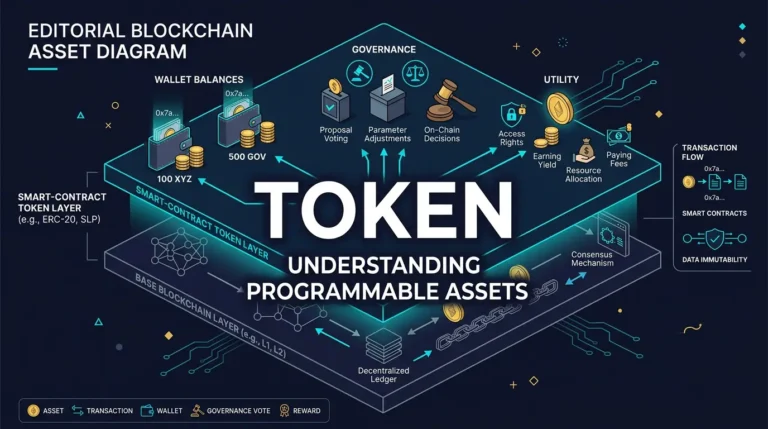
Some blockchains support smart contracts, which are programs that run on-chain when predefined conditions are met.
Instead of just recording transfers, these networks can support more complex actions such as:
- decentralized exchanges
- lending markets
- staking systems
- NFT marketplaces
- on-chain governance
Smart contracts reduce reliance on traditional intermediaries, but they do not remove risk. A bug in the code, a flawed upgrade process, or a malicious contract design can still cause major losses.
For a dedicated beginner explanation, see What Is a Smart Contract?.
Before interacting with smart contracts directly, it also helps to understand wallet setup and custody basics. See Best Crypto Wallets for Beginners (2026) and What Is Self-Custody in Crypto?.
What Blockchain Is Good At
Blockchain is not automatically better than a normal database. It becomes useful in situations where shared verification, transparent settlement, or reduced reliance on a central operator actually matter.
Typical strengths include:
- Shared recordkeeping: multiple parties can reference the same ledger without trusting one operator completely
- Censorship resistance: public networks can be harder for one party to block or control
- Transparency: transaction history can be publicly audited on many chains
- Programmability: smart contracts can automate financial logic
- Global access: users can interact with networks across borders without asking a bank for permission
These benefits are real, but they only matter when the trade-offs are understood as well.
Risks and Common Mistakes
1. Confusing Blockchain With Crypto Price Action
Beginners often think understanding “blockchain” means understanding token prices. It does not. A network can be technically interesting while the asset built on it remains speculative, risky, or poorly structured.
2. Assuming Blockchain Means Complete Safety
The blockchain itself may be difficult to alter, but users still lose funds through phishing, bad wallet hygiene, malicious contracts, exchange failures, and simple human error.
Related reading: What Is Crypto Phishing? and Crypto Wallet Hygiene Checklist: 15 Rules to Avoid Getting Hacked.
3. Treating Public Chains as Private by Default
Most major public blockchains are transparent, not truly anonymous. Wallet addresses are usually pseudonymous, and activity can often be traced through block explorers and analytics tools.
4. Ignoring Custody Risk
Self-custody gives users more control, but it also removes the safety net of password resets and customer support. Losing seed phrases or private keys can mean permanent loss of access.
If those terms are unclear, read What Is a Seed Phrase?, What Is a Private Key in Crypto?, and What Is Cold Storage in Crypto?.
5. Thinking Every Use Case Needs a Blockchain
Many systems do not need decentralization and work better with a standard database. A blockchain only makes sense when the cost and complexity are justified by the need for distributed trust, transparent settlement, or censorship resistance.
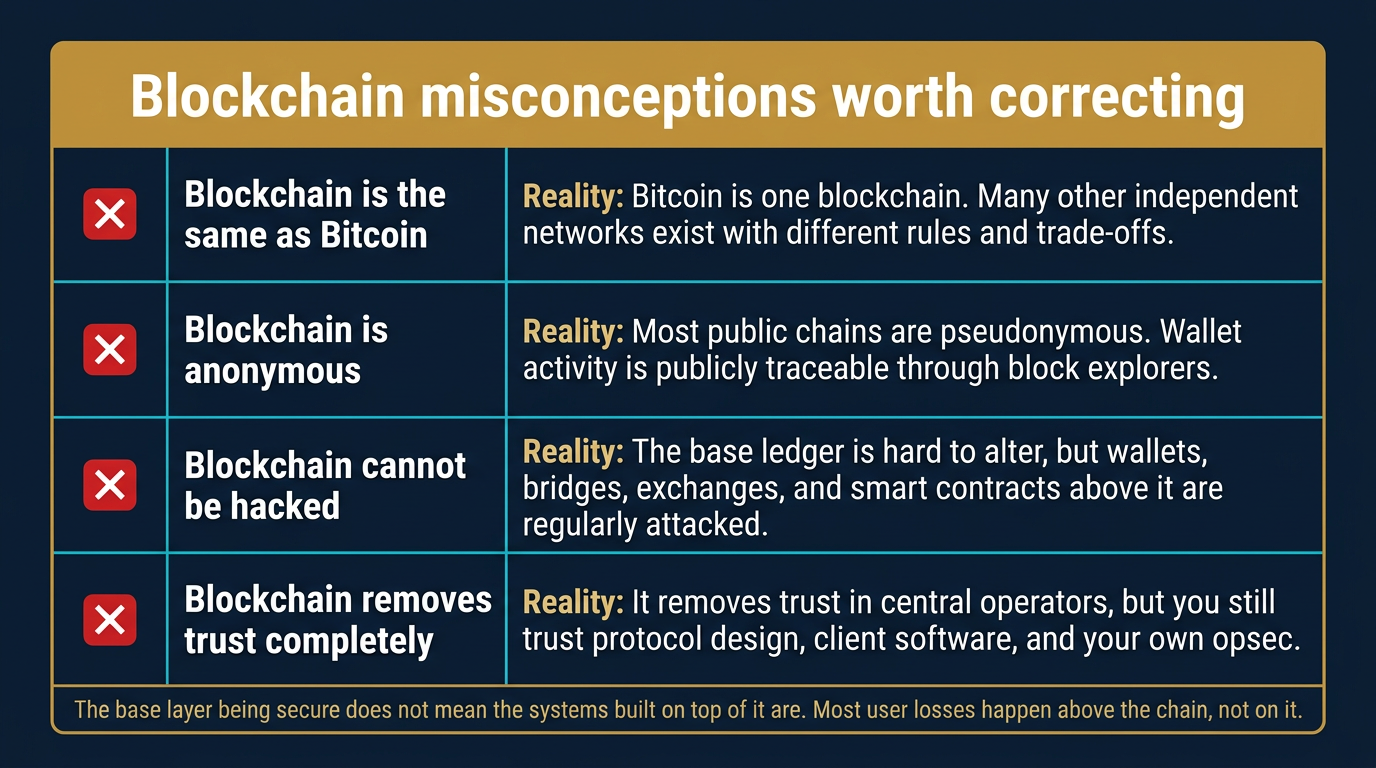
Common Misconceptions
Blockchain is the same as Bitcoin.
Bitcoin is the first major blockchain-based system, but blockchain technology also supports many other networks and applications. Major networks can also structure balances differently; for a clear comparison, read Bitcoin vs Ethereum transaction model.
Blockchain is anonymous.
Most public blockchains are pseudonymous. Addresses do not automatically reveal a legal name, but transaction history is often visible and traceable.
Blockchain cannot be hacked.
Wallets, bridges, exchanges, validator infrastructure, and smart contracts can all be attacked even if the base chain itself remains intact.
Blockchain removes trust completely.
It reduces trust in central intermediaries, but users still rely on protocol design, client software, wallet security, and their own operational habits.
Frequently Asked Questions
Is blockchain the same as cryptocurrency?
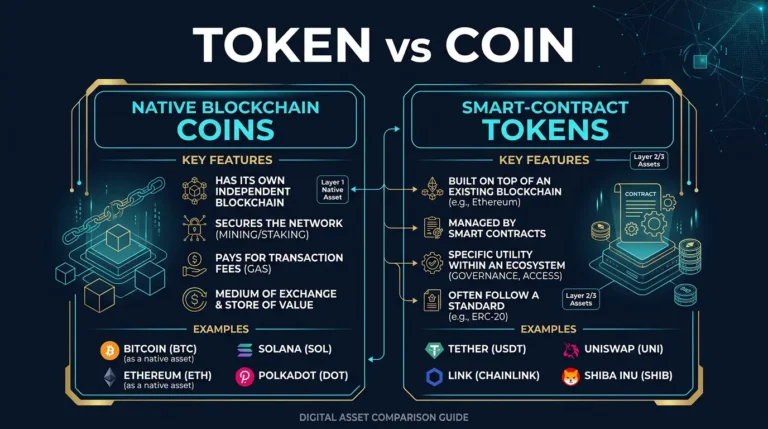
No. Cryptocurrency is one application of blockchain technology. A blockchain is the recordkeeping system; the coin or token is one asset that may operate on top of it.
Can blockchain transactions be reversed?
In most public blockchains, confirmed transactions are intended to be final. In practice, this means users should verify addresses, fees, and destination networks carefully before sending funds.
Why are some blockchains faster than others?
Different blockchains make different trade-offs around decentralization, block size, hardware requirements, consensus design, and throughput. Faster is not automatically better if it comes with weaker assumptions elsewhere.
Do I need special hardware to use blockchain?
No. Most people interact with blockchains through software wallets, hardware wallets, exchanges, or web interfaces. Specialized hardware is mainly needed for mining, validation, or infrastructure roles. If you want a beginner-friendly overview of one common infrastructure role on Bitcoin, read what a Bitcoin node is.
Is blockchain private in 2026?
Usually not by default. Most public chains are transparent, and privacy depends heavily on wallet behavior, address reuse, and the design of the network being used.
Conclusion
Blockchain is best understood as a shared ledger system that replaces single-party control with distributed verification and consensus.
That design makes decentralized money, programmable financial systems, and transparent settlement possible. It also shifts more responsibility onto the user.
For beginners, the most useful takeaway is not that blockchain is magical. It is that blockchain changes who you trust, how transactions are verified, and what risks you personally inherit.
If you are new to crypto, the safest next step is not chasing yield. It is understanding custody, wallet security, and how the systems underneath actually work.
Start with Crypto Starter Guide 2026 for the broader map, then follow How to Start Crypto Safely if you want a step-by-step onboarding path.