


Last Updated on April 16, 2026 by Snout0x
A seed phrase is a sequence of 12 or 24 words generated when you create a non-custodial crypto wallet. It encodes the master key to your wallet and every asset stored inside it. Anyone who has these words has full, immediate access to your funds. No password, PIN, or identity verification can stop them.
This content is for educational purposes only and should not be considered financial or investment advice.
Simple Definition
A seed phrase is a sequence of 12 or 24 words that encodes your wallet’s master key. Anyone who has these words has complete, immediate access to every address in your wallet — no password, PIN, or device required.
A seed phrase is a human-readable representation of your wallet’s master private key. It is generated from a controlled list of 2,048 English words defined by the BIP-39 standard (Bitcoin Improvement Proposal 39). When your wallet is created, it selects 12 or 24 of these words in a specific sequence to produce your unique phrase.
The words are not random in design. Every word on the BIP-39 list is chosen to be visually and phonetically distinct from the others, reducing transcription errors. A 12-word phrase provides approximately 128 bits of entropy. A 24-word phrase provides approximately 256 bits. Both are cryptographically resistant to brute-force attack with current computing hardware.
The seed phrase is sometimes called a recovery phrase, mnemonic phrase, or backup phrase. These terms all refer to the same thing. The terminology varies by wallet brand, but the underlying function is identical.
Why It Matters
The seed phrase is the only true backup for a self-custody wallet. It does not matter whether you use a hardware device, a mobile app, or a desktop wallet. If the device is lost, stolen, or destroyed, the seed phrase is what allows you to restore access from scratch on any compatible replacement.
This is the core trade-off of self-custody: you hold your own keys, and you bear full responsibility for them. There is no support ticket, no account recovery email, no dispute process. The seed phrase is not connected to your identity. It is the account itself. Lose it, and the funds are gone. Expose it, and the funds are gone.
This makes the seed phrase the highest-value target in a self-custody setup. Understanding what it is and why it matters is not optional knowledge for anyone holding crypto outside an exchange. If you are evaluating whether to move assets to self-custody at all, how seed phrase responsibility works should be central to that decision.
How It Works
When you initialize a non-custodial wallet, the software generates a random number called entropy. That entropy is processed through a hashing algorithm, and the result is mapped to a sequence of words from the BIP-39 list. A checksum is embedded in the final word or words to help detect transcription errors during recovery.
From your seed phrase, the wallet derives a master private key. From that master key, it generates individual private keys for each address using a derivation path, typically following the BIP-44 standard. This architecture is called a hierarchical deterministic (HD) wallet. One seed phrase can control hundreds of separate addresses across multiple blockchains, all derived in a predictable, reproducible order.
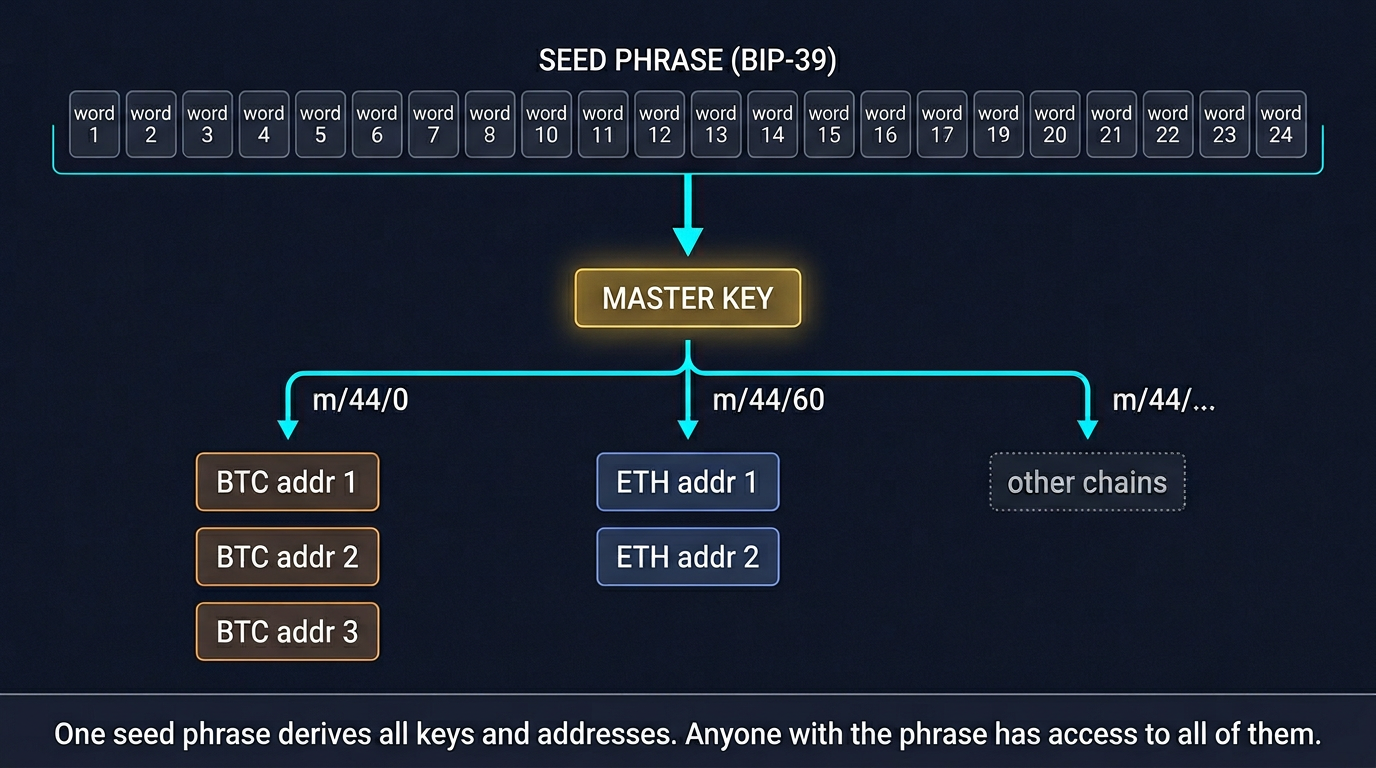
This is why recovery works. Enter your seed phrase into a new device running compatible software, and it re-derives the same keys, restoring the same addresses and balances. The blockchain has not changed. Your funds are still there. The seed phrase just re-opens access to them.
Most major wallets follow the same derivation standards, so recovery across devices is usually straightforward. For users using widely-supported wallets, an overview of which options follow these standards is in the best crypto wallets for beginners guide.
Common Mistakes
Most permanent fund losses in self-custody trace back to a small set of predictable mistakes. These are not edge cases. They happen regularly, and many are made by users who believed they were being careful.
- Storing it digitally. Screenshots, notes apps, email drafts, cloud documents, and password managers all carry exposure risk. If any connected device or account is compromised, the seed phrase is compromised with it.
- Writing it down incorrectly. A single transposed or misspelled word can render a seed phrase unrecoverable. Verify every word against what is displayed on your wallet before closing the setup screen.
- Keeping only one copy. A single physical backup stored in one location is a single point of failure. Fire, flood, or theft can eliminate it entirely.
- Storing the backup near the wallet device. If someone takes your hardware wallet and finds the written seed phrase in the same drawer, bag, or safe, they have everything they need.
- Entering it online. No legitimate wallet interface, support team, or software update will ever ask for your seed phrase. Any prompt requesting it is a scam without exception.
- Never testing recovery. Many users write down their phrase but never confirm it works. Testing recovery on a second device immediately after setup is the only way to verify the backup before you actually need it.
These failures account for a large share of self-inflicted fund losses in crypto. A broader look at how these patterns play out in practice is covered in 5 “Safe” Crypto Habits That Will Get You Rekt.
Security and Risk Considerations
The seed phrase is the single most sensitive piece of information in a self-custody setup. Hardware wallet security, strong device PINs, and careful online behavior all matter, but none of them protect you if the seed phrase itself is exposed. An attacker with your words can drain your wallet from any device, in any country, in seconds. The seed phrase bypasses every other layer of protection.
Physical storage is the minimum standard. Write the phrase on paper or, for long-term durability, on a metal backup plate. Store it somewhere secure, fire-resistant, and separate from the wallet device. A fireproof home safe generally provides better practical access than a bank safety deposit box, particularly for urgent recovery scenarios where timing matters.
The question of physical isolation and air-gapping is explored in more depth in the article on cold storage paranoia and whether your wallet is actually air-gapped. The same logic applies to seed phrase storage: physical separation matters, but the backup must remain accessible enough to actually use in a recovery situation.
Digital storage is not a valid option for most users. This includes encrypted password managers. A manager with a weak master password, one that syncs to a cloud account, or one held on a device that gets compromised provides no meaningful protection for a seed phrase. The seed phrase is not a password. It is a master key, and treating it like one changes the storage calculus entirely.
A passphrase, sometimes called the 25th word, is an additional string entered on top of the seed phrase. It creates a separate wallet that cannot be accessed without both the phrase and the passphrase together. This adds meaningful protection if a written seed phrase is physically discovered, because the attacker still cannot access funds without the passphrase. It is an advanced configuration. Forgetting the passphrase carries the same consequence as losing the seed phrase itself, so it requires its own separate backup discipline.
Splitting a seed phrase across two physical locations is sometimes suggested as a security measure. In practice, it introduces complexity and new failure modes that most users are not positioned to manage well. Unless you are using a structured approach like Shamir’s Secret Sharing, partial storage in separate locations tends to create additional risks without proportional gain.
Frequently Asked Questions
What is the difference between a seed phrase and a private key?
A private key controls access to a single wallet address. A seed phrase is a master backup that regenerates all private keys in an HD wallet. One seed phrase can restore hundreds of addresses across multiple blockchains. A private key only recovers the one address it corresponds to.
What happens if someone else gets my seed phrase?
They have complete control of your wallet and every asset in it. They can transfer everything to a different address immediately, and there is no way to reverse it or recover the funds. If you believe your seed phrase has been compromised, create a new wallet and transfer your assets to the new address as quickly as possible.
Can I store my seed phrase in a password manager?
It is generally not recommended. Password managers are cloud-connected services. If the master password is weak, the manager is breached, or the sync account is compromised, the seed phrase is exposed. Physical, offline storage is the standard approach for most users and the baseline that security-focused wallet guides consistently recommend.
What happens if I lose my seed phrase?
If the device holding your wallet is still accessible and functional, you retain control of your funds. But if the device is lost, broken, or wiped and you have no seed phrase backup, access to those funds is permanently lost. There is no recovery process. Creating and verifying a physical backup at setup is not optional.
Does every crypto wallet use the same seed phrase format?
Most non-custodial wallets follow the BIP-39 standard, which makes phrases interoperable across compatible wallets. Some older wallets or those using non-standard derivation paths may not recover correctly across different software. When switching wallet providers, always verify recovery compatibility before moving significant funds.