

Last Updated on April 16, 2026 by Snout0x
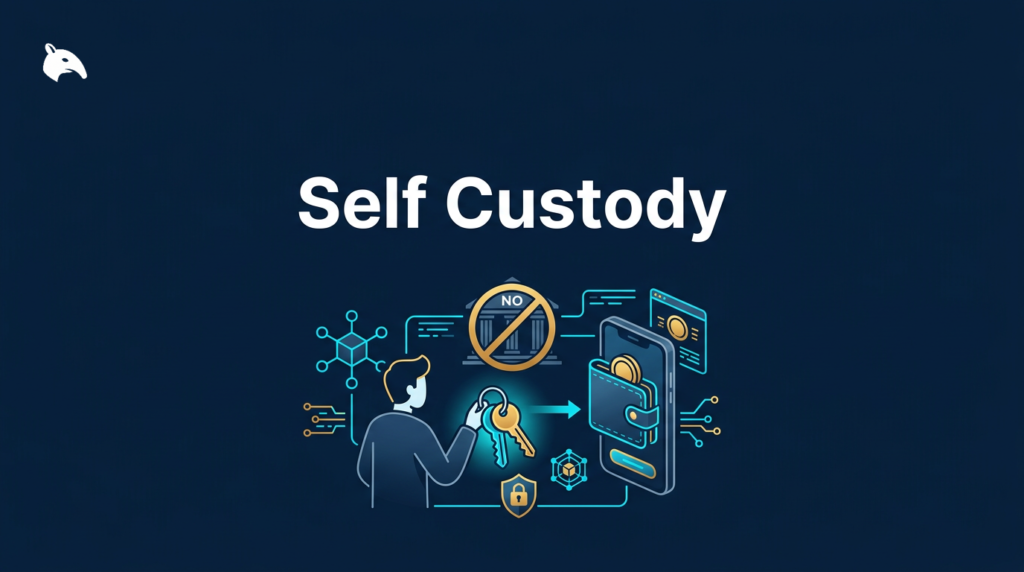
Self-custody in crypto means holding your own private keys rather than trusting a third party to hold them for you. When you leave assets on an exchange, the exchange controls access. If that exchange freezes withdrawals, gets hacked, or goes insolvent, your funds are at risk. Self-custody crypto means you are the only one in control.
This content is for educational purposes only and should not be considered financial or investment advice.
That comes with significant advantages, but it also places full responsibility on you.
Disclaimer: This content is for educational and informational purposes only and does not constitute financial, investment, tax, or legal advice. Cryptocurrency markets are volatile and involve risk. Always conduct your own research and consult a qualified professional before making financial decisions.
Simple Definition
Self-custody means you hold your own private keys directly. No exchange, platform, or third party controls access to your funds. If you do not hold the keys, someone else does — and that someone else can freeze, lose, or misuse them.
Self-custody refers to the practice of controlling your own cryptocurrency private keys. A private key is a cryptographic secret that proves ownership of a blockchain address. Whoever holds the private key controls the funds stored at that address. That is the entire foundation of the concept.
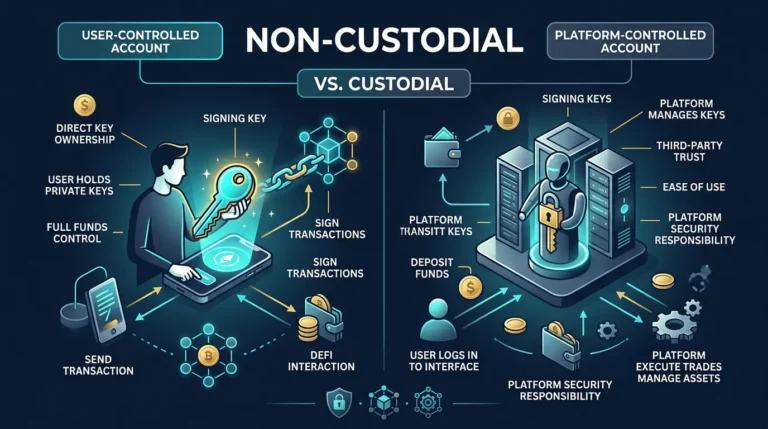
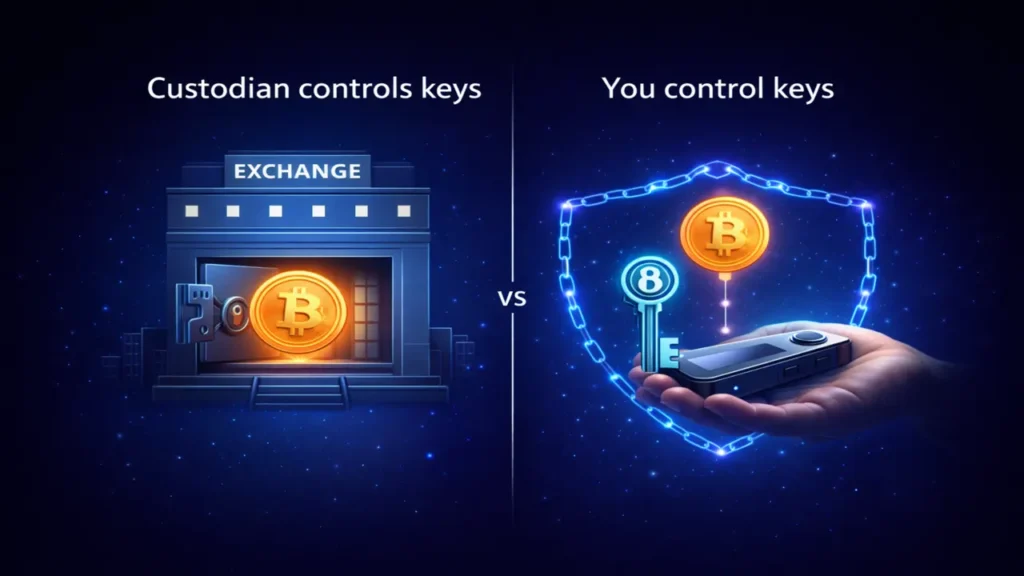
In a custodial setup, a company, such as a centralized exchange, holds your private keys on your behalf. You log into their platform and see a balance, but the underlying assets technically belong to whoever controls those keys. You hold an IOU, not direct ownership. In a self-custody setup, you generate and store the keys yourself, using a wallet you control entirely.
The phrase “not your keys, not your coins” has become a standard shorthand in crypto culture for this reason. If you do not hold the keys, you do not have direct ownership. You have a claim against a company. That distinction matters when things go wrong, and in crypto, things go wrong with exchanges at a rate that should concern any long-term holder.
Why Self-Custody Matters
Exchanges have failed. Mt. Gox collapsed in 2014, taking hundreds of thousands of bitcoin with it. QuadrigaCX’s founder died in 2019, holding the only keys to user funds. FTX imploded in 2022 in a matter of days, leaving customers unable to withdraw billions in assets. In every case, users who had moved to self-custody were not affected. Users who trusted the platform lost access or lost everything.
Self-custody removes counterparty risk. Your assets exist on the blockchain itself, and access is governed entirely by your private key. No withdrawal freeze can block you. No insolvency event can claim your funds. No rogue executive can decide access is suspended for operational reasons.
There are practical upsides too. Self-custody gives you access to decentralized applications, DeFi protocols, and NFT platforms that exchanges do not support. You interact with the blockchain directly. For long-term holders, keeping assets in cold storage also removes the temptation to make reactive trading decisions during volatile periods.
For a deeper look at why and how to move your holdings off exchanges, the Self-Custody Survival Guide covers the full process and the real history of exchange withdrawal freezes that make this a practical concern, not a theoretical one.
Self-Custody vs Exchange Custody
The core difference comes down to who controls the private keys. Here is how the two approaches compare across the factors that matter most to real users:
| Factor | Self-Custody | Exchange Custody |
|---|---|---|
| Key control | You hold the keys | Exchange holds the keys |
| Counterparty risk | None | Exchange insolvency, hack, or freeze |
| Access during a crisis | Always accessible | Can be suspended or restricted |
| Recovery responsibility | Yours alone | Exchange manages account recovery |
| Technical complexity | Higher | Lower |
| DeFi and on-chain access | Full | Limited or none |
| Insurance coverage | None typically | Partial, varies by exchange |
Exchanges offer genuine convenience and a recovery path for users who might otherwise lose access through their own errors. Self-custody offers sovereignty, but requires serious operational discipline. Neither is categorically better. The right approach depends on how much you hold, how long you plan to hold it, and how comfortable you are managing the responsibility.
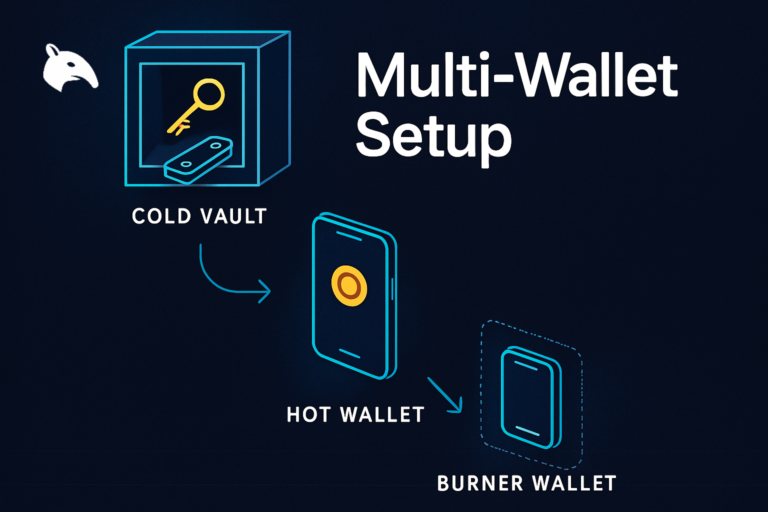
Many experienced holders use a split approach. Smaller active balances stay on an exchange for trading purposes. Larger long-term holdings move to self-custody. A structured 2-wallet setup is one practical way to implement this without overcomplicating the security model.
How Self-Custody Works
When you initialize a self-custody wallet, the software generates a private key and a corresponding public address. The private key is typically encoded as a seed phrase, a sequence of 12 or 24 words derived from the key itself. Your seed phrase is the master backup for your wallet. Anyone who has it can reconstruct your private key and access every address derived from it.
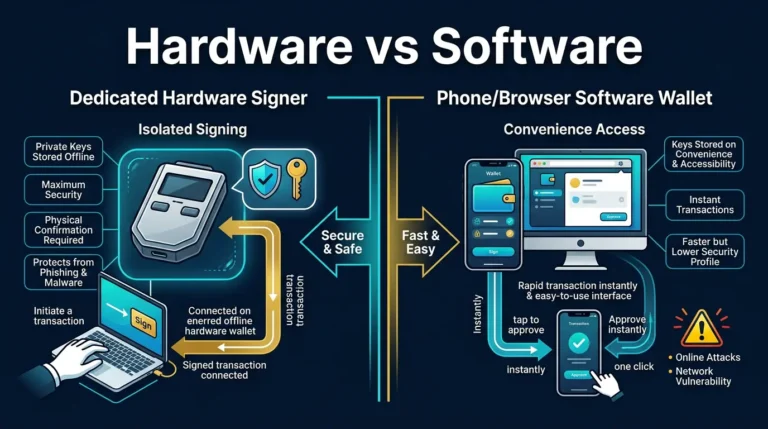
Self-custody wallets come in different forms. Software wallets run as mobile apps or browser extensions. They are convenient but remain connected to the internet, which creates attack surface. Hardware wallets are dedicated physical devices that store your private key offline. They sign transactions internally without ever exposing the key to your computer or the network. That separation is what makes them significantly more secure for larger holdings.
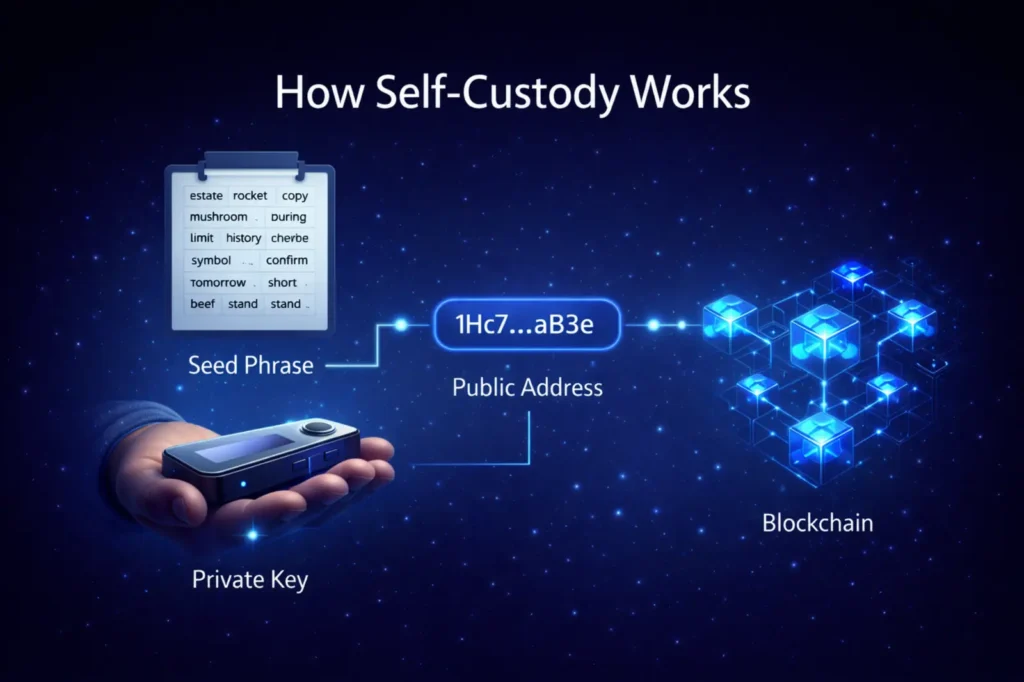
The most secure form of self-custody is cold storage, where the private key is kept on a device or medium that has never connected to the internet. This eliminates remote attack vectors entirely. Air-gapped hardware wallets, properly initialized paper wallets, and metal seed phrase backups all fall into this category.
The typical process: purchase a reputable hardware wallet directly from the manufacturer, initialize it and record the seed phrase on paper or a metal backup, store that backup securely offline, then transfer assets from the exchange to your self-custody wallet address. From that point forward, only someone with your private key or seed phrase can access the funds.
Common Mistakes
Self-custody transfers risk from the exchange to you. Most losses are not from sophisticated hacks. They are from avoidable mistakes made during setup or day-to-day use.
- Storing the seed phrase digitally. Screenshots, cloud notes, and email drafts are accessible to attackers who compromise your devices or accounts. The seed phrase must exist only on paper or metal, kept entirely offline.
- Making only one backup. A single copy can be destroyed by fire, flood, or physical loss. Store at least two copies in separate, secure locations.
- Buying hardware wallets from unofficial sources. Devices purchased secondhand or through third-party marketplaces may be pre-configured or tampered with. Always buy directly from the manufacturer.
- Use your main cold wallet for everything. Connecting your primary self-custody wallet to DeFi applications, unfamiliar sites, or token approvals increases exposure. A separate hot wallet for active use protects primary holdings from routine interactions.
- Skipping recovery verification. Before transferring significant assets, run a full recovery test with your seed phrase to confirm it is recorded correctly. Discovering an error after loading funds is costly.
Security and Risk Considerations
Self-custody does not eliminate risk. It restructures it. With exchange custody, your exposure is to the exchange’s security, solvency, and behavior. With self-custody, your exposure is to your own setup, habits, and physical environment.
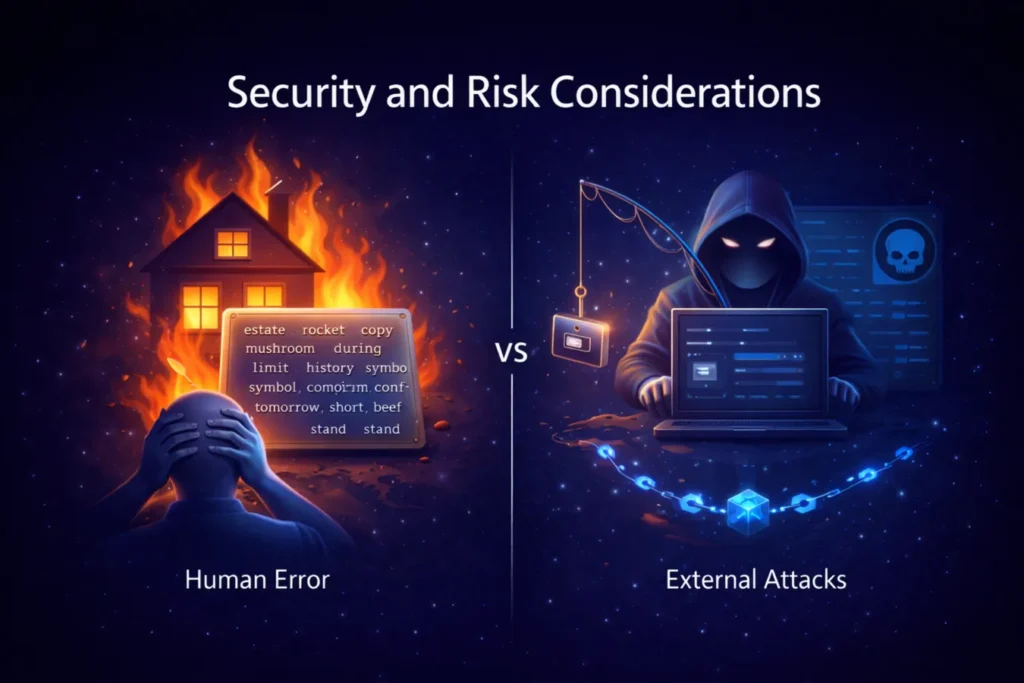
The most common cause of self-custody loss is not external hacking. It is human error. Seed phrases stored incorrectly, lost during a move, or destroyed in a house fire without a backup. The private key is irreplaceable by design. There is no customer support call to make. No recovery process to initiate. If the key is lost, the funds are permanently gone.
Phishing is a significant ongoing threat. Attackers impersonate wallet support teams, create fake airdrop sites, or distribute compromised browser extensions to trick users into entering their seed phrase. Once entered on an attacker-controlled page, funds are drained within minutes. Hardware wallets reduce this risk because the key never leaves the device, but social engineering attacks continue to target users through approval-based exploits where malicious smart contracts drain wallets through permissions the user unknowingly granted.
Physical security matters more than most guides acknowledge. If someone locates your seed phrase backup, they have everything they need. Treat it with the same physical security as the most valuable document you own, because for many holders, that is exactly what it is. Consider separate storage locations, and for very large holdings, a more structured backup approach using multi-location storage.
The Bitcoin Developer Documentation at developer.bitcoin.org provides detailed technical context on key management and wallet standards for those who want to understand the underlying cryptography behind these concepts.
For practical wallet recommendations across different budgets and use cases, the Best Crypto Wallets for Beginners guide covers verified hardware and software options worth considering when setting up self-custody for the first time.
Sources
- Bitcoin Developer Documentation , developer.bitcoin.org
Frequently Asked Questions
What does self-custody mean in crypto?
Self-custody means you hold your own private keys and control direct access to your cryptocurrency without relying on an exchange or third-party service to hold them on your behalf.
Is self-custody safe for beginners?
Self-custody can be used safely by beginners with proper setup and backup practices. The primary risk is user error, particularly around seed phrase storage. Starting with a small balance and a reputable hardware wallet reduces exposure while you build familiarity with the process.
What happens if I lose my seed phrase?
If you lose your seed phrase and have no backup, access to that wallet is permanently lost. There is no recovery mechanism. This is why multiple offline backups stored in separate physical locations are considered essential before loading significant funds.
Can I still use exchanges if I self-custody?
Yes. Many holders use exchanges for buying, selling, and active trading while keeping their primary holdings in self-custody. Moving assets to a self-custody wallet does not prevent you from using exchanges. It just means those assets are no longer sitting on the exchange between transactions.
What is the difference between a hot wallet and a cold wallet?
A hot wallet is connected to the internet, making it convenient for frequent use but more exposed to online threats. A cold wallet keeps the private key offline, removing remote attack vectors. Cold storage is generally recommended for larger holdings or assets you do not intend to move regularly.