


Last Updated on April 19, 2026 by Snout0x
A fake airdrop is a scam that pretends to offer free tokens, NFT claims, or community rewards but is really designed to steal from your wallet. The theft usually does not happen because the attacker breaks cryptography. It happens because the victim is pushed into clicking a malicious link, connecting a wallet to the wrong site, or signing an approval or message they do not fully understand.
These scams work because the promise sounds familiar. Real projects do run reward campaigns, claim pages, and token distributions. A fake airdrop borrows that structure, adds urgency, and removes the safeguards. By the time the victim realizes the site was not legitimate, the permission has often already been granted and the wallet can be drained.
This content is for educational purposes only and should not be considered financial or investment advice.
A fake airdrop scam uses a free-token story to push you into signing a malicious approval, signature, or seed-phrase entry on a cloned claim page. The drain rarely happens during the click — it happens later, through the permission you already granted. The defense is procedural: never claim from the incoming link; reopen the project from your own bookmark and verify the campaign exists before any wallet prompt.
Key Takeaways
- Fake airdrops are delivery systems for wallet theft: The reward promise is only the lure; the real goal is usually approvals, signatures, or seed phrase capture.
- The danger starts before any token appears: Connecting a wallet or signing a routine-looking prompt can be enough to create future loss.
- Urgency is part of the mechanism: Timers, surprise eligibility, and “claim before it expires” framing are designed to suppress verification.
- Legitimate-looking branding does not prove legitimacy: Scammers copy official pages, Discord announcements, X posts, and token imagery to create false confidence.
- The safest defense is procedural: Reopening the project from your own trusted source and reading wallet prompts carefully prevents most fake-airdrop losses.
How Fake Airdrop Scams Actually Work
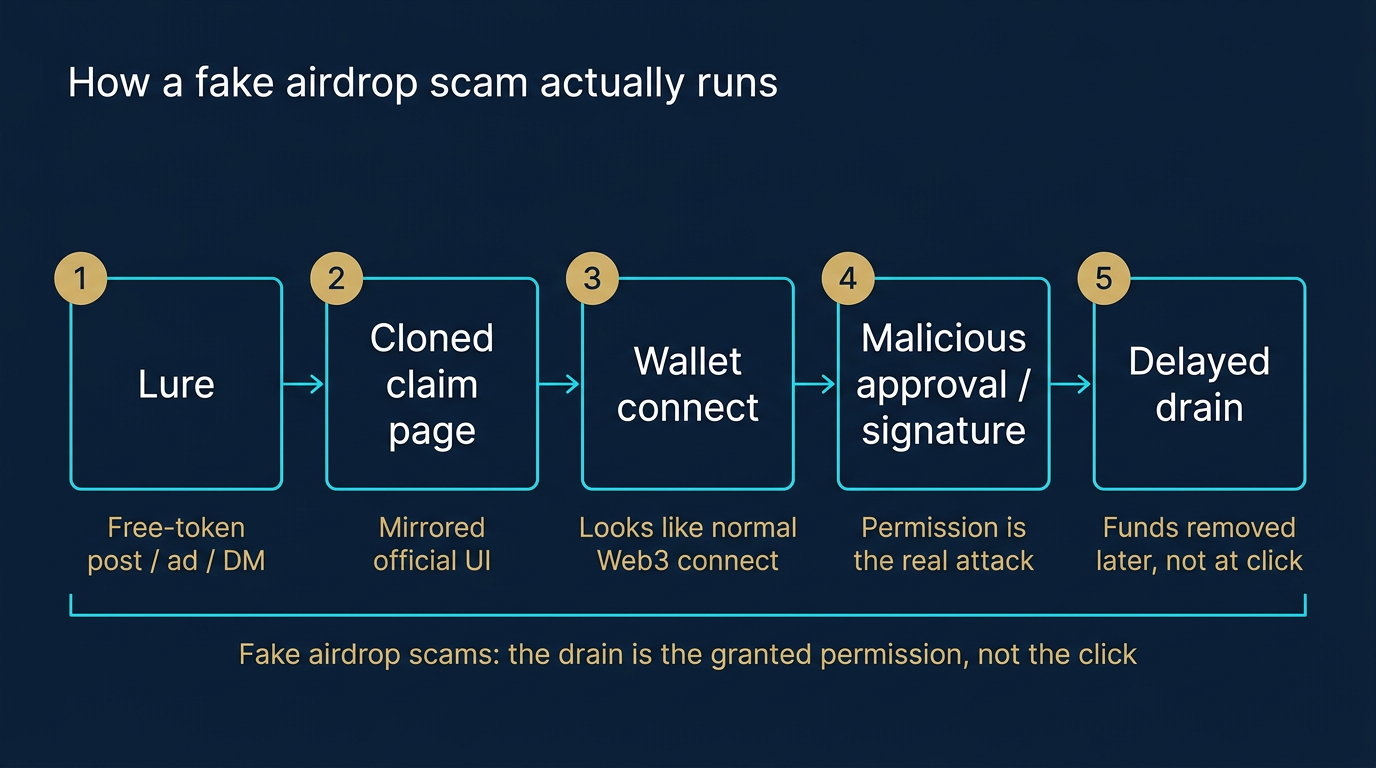
A fake-airdrop scam is usually a staged sequence rather than one single trick. First, the attacker creates interest with a post, ad, Discord announcement, fake influencer message, or “surprise eligibility” checker. Next, the victim is sent to a page that looks like a normal claim portal. The site then asks for a wallet connection and presents one or more wallet prompts that look like standard claim steps. Those prompts are where the real risk begins.
A useful mental model is to think of the fake airdrop as a counterfeit check-in desk. The free-token story gets you to line up, but the real theft happens at the desk when you hand over the wrong credentials. In wallet terms, that means approvals, malicious signatures, or recovery-phrase entry. The “airdrop” is only there to make the dangerous action feel expected.
The reward story creates permission to rush
Scammers rely on a simple psychological pattern: users treat free upside differently from obvious risk. A surprise allocation, retroactive community reward, or “unclaimed tokens from your past activity” pitch lowers skepticism because the victim wants the reward to be real. The attacker then adds scarcity: limited claim window, first-come-first-served language, or warnings that the reward will vanish if the claim is delayed.
One operator insight is that urgency in fake-airdrop campaigns is usually more important than technical sophistication. The site does not need to be perfect if the user is moving too quickly to compare domains, verify the source, or read the spender address. In practice, the time pressure is often the exploit path.
What the Wallet Prompts Usually Hide
Most victims do not lose funds because they typed a seed phrase immediately. They lose funds because the wallet interaction felt routine. A fake-airdrop page may ask for a token approval, a permit signature, a “claim verification” message, or another prompt that sounds normal in a DeFi context. The labels are familiar enough that users assume the action is harmless.
Malicious approvals dressed up as claim steps
One of the most common paths is an approval request that gives a malicious contract permission to spend a token from your wallet. The claim page may present this as a necessary pre-step before receiving the reward. In reality, the “claim” never matters. The approval is the objective. Once it is granted, the contract can later use transferFrom to drain funds without asking again.
This is why the scam-specific angle here overlaps with crypto approval scams and token approval risks. The difference is that fake-airdrop scams are a delivery format. They wrap the dangerous approval inside a high-excitement claim narrative.
Message signatures that lead to deeper compromise
Some fake-airdrop pages ask for signature-based actions that are harder for users to interpret than normal transactions. A signature request may be used to authorize future actions, set up a permit flow, or move the victim into a second step where the real transaction is hidden behind a “continue claim” button. The point is that the attacker wants the user to normalize signing before they fully understand what the wallet is showing.
A second operator insight is that many wallet users correctly fear seed phrase entry but underestimate signatures and approvals. Attackers know this. That is why modern fake-airdrop campaigns often avoid asking for the most obviously suspicious action first. They start with something that feels plausibly routine.
How These Scams Reach Users
Fake-airdrop campaigns are distributed through the same channels users already trust for real ecosystem news. That distribution strategy matters because the attack often wins before the wallet is even opened. If the victim believes the source, the later prompts feel less suspicious.
For a closely related follow-up, see Social Engineering in Crypto: How Attackers Manipulate People Instead of Code.
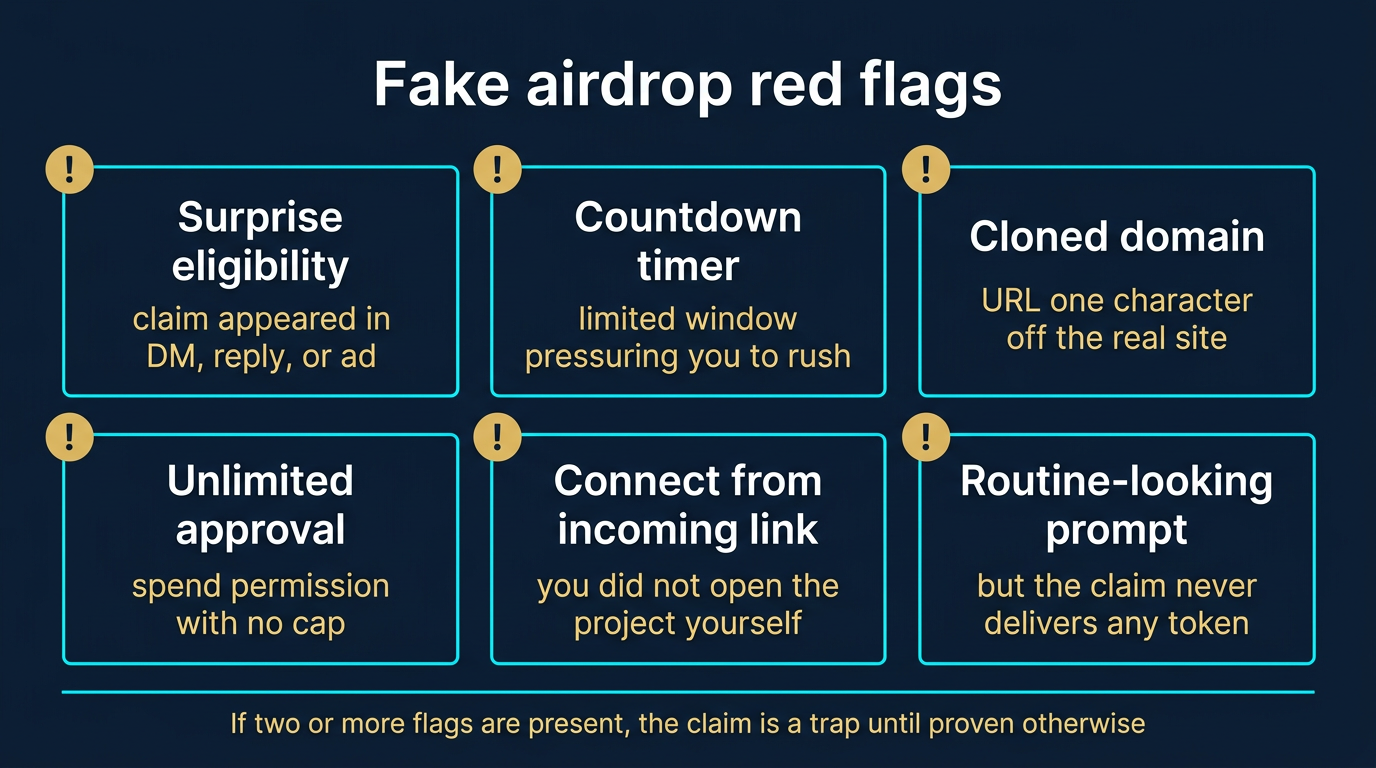
Attackers frequently hijack or imitate project accounts, community moderators, and Discord announcement channels. They post claim links that look like official launches, governance rewards, or partner campaigns. The linked page often mirrors the real site’s design closely enough that users focus on the reward mechanics instead of the domain and contract details.
This is one reason fake-airdrop scams are part of the broader family of crypto wallet phishing attacks. The technical drain may come later, but the initial compromise comes from trusting the wrong interface or announcement channel.
Search, ads, and reply-chain scams
Other campaigns use sponsored search results, replies under official X posts, Telegram groups, or wallet-specific support threads. A user searches for “claim token airdrop,” clicks the top-looking result, and lands on a malicious claim page. Or they see a reply under a real project post saying the airdrop has gone live and follow the link without leaving time for verification.
The common theme is that the scam rides on borrowed credibility. The attacker does not need you to trust them personally. They only need you to think the page is close enough to a source you already trust.
What Happens After a Fake Claim Is Signed
Once the victim signs the wrong thing, the loss may be immediate or delayed. An attacker may drain tokens right away, or they may wait until the wallet is topped up again. That delay is one reason victims often struggle to connect the loss to the original fake-airdrop session. The dangerous action may already be sitting on-chain while the wallet still looks normal.
The drain can happen later, not during the claim
A fake claim is often successful precisely because nothing dramatic happens right away. The user clicks, signs, and sees either an error or a fake “claim pending” message. Hours or days later, the attacker uses the still-open approval or permission path to remove funds. This delayed effect makes the scam feel less obvious than a direct wallet compromise.
For the broader automation pattern behind these thefts, what a crypto drainer is helps explain why one bad approval or signature can become a reusable attack path.
Practical Usage: How to Defuse a Fake-Airdrop Lure
The right workflow is not “be more careful” in the abstract. It is following the same interruption sequence every time a surprise claim appears. That sequence should happen before the wallet connects, not after the prompt is already on screen.
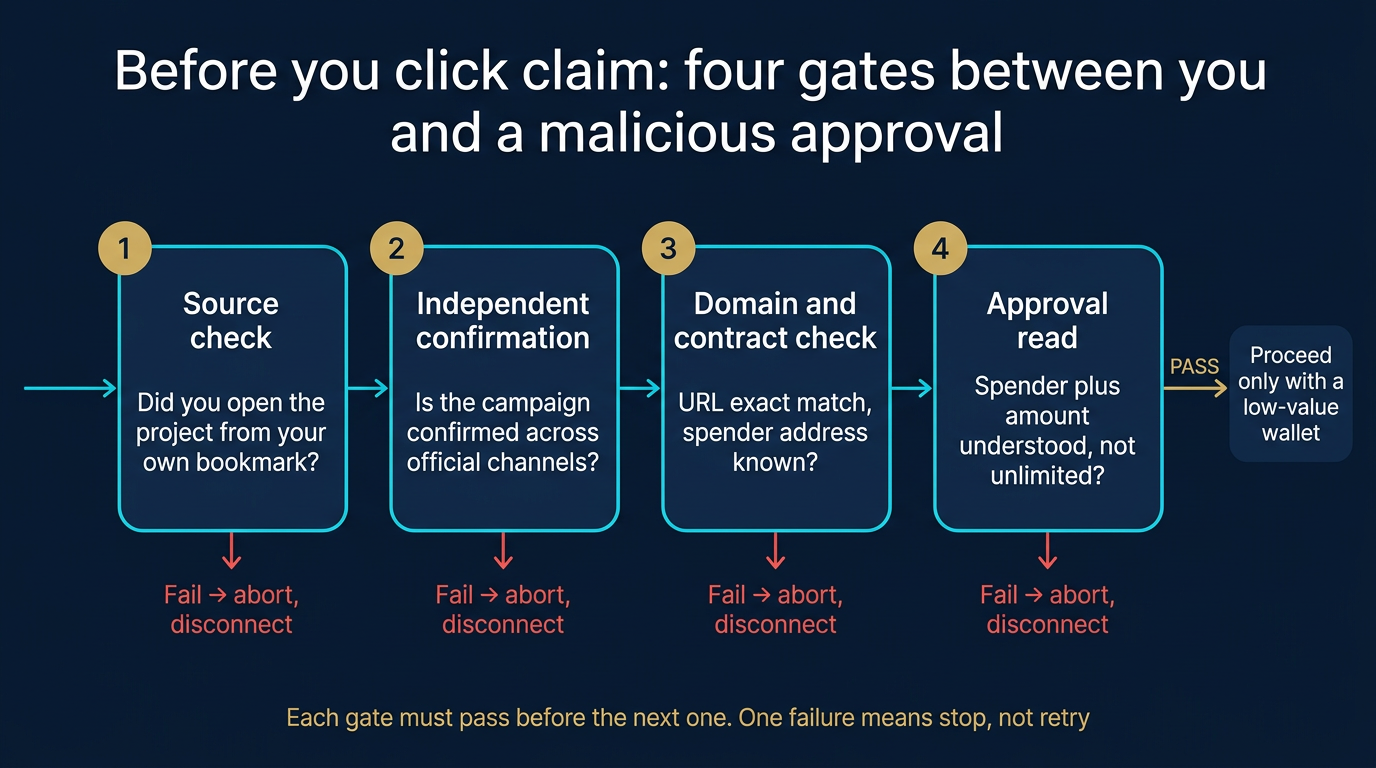
- Do not open the claim from the incoming link. Close the X post, Discord message, ad, email, or DM and reopen the project from a bookmarked official source you already trust.
- Verify the campaign exists independently. Look for confirmation across the project’s real website and verified channels — one post, one reply, or one screenshot is not enough.
- Read every approval like the real transaction. Check the spender address and the amount. If the approval is unlimited or unfamiliar, stop immediately.
- Use a separate low-value wallet for any claim attempt. A speculative wallet limits the damage if a fake campaign slips past the earlier checks.
- Review and revoke after any signed interaction. If you signed something you do not fully trust, audit your approvals and permissions before sending more funds through that wallet.
A practical scenario looks like this: you see a “retroactive reward” for a protocol you used months ago, the page says you are eligible, and the button asks you to connect your wallet. The correct move is not to “claim quickly before it expires.” It is to leave the page, reopen the protocol from your own bookmark, and confirm the campaign exists. If you cannot verify it cleanly, the reward is not real enough to touch.
If you want the wallet-side containment framework after a suspicious interaction, the most useful companion is how to store crypto safely. Compartmentalized wallets and limited balances make these lures much less catastrophic.
Risks and Common Mistakes
- Believing that “free” means low risk: The reward framing lowers skepticism precisely because the user is not mentally preparing for a payment or an attack.
- Checking branding instead of domain and spender details: A polished page can still be malicious even if the design looks official.
- Assuming nothing happened because nothing moved immediately: The loss may appear later once the attacker uses the permission path already granted.
- Using a main wallet for surprise claims: The higher the wallet balance, the more expensive one fake campaign becomes.
- Treating urgency as proof of legitimacy: “Claim now” pressure is more often a scam signal than a reward signal.
Sources
- MetaMask Support: Spoofs, Phishing, and Scams
- MetaMask Support: What Is a Token Approval?
- CISA Advisory on Cryptocurrency Theft and Related Social Engineering Patterns
Frequently Asked Questions
What is a fake airdrop scam?
A fake airdrop scam is a reward-themed lure that tries to get you to connect a wallet, sign a malicious approval, sign a dangerous message, or enter sensitive wallet information.
How do fake airdrop scams steal funds?
They usually steal funds by tricking users into signing approvals or messages through a fake claim page. Once the permission is granted, the attacker can drain tokens immediately or later. Some versions also try to steal seed phrases directly.
Can a fake airdrop drain a hardware wallet?
Yes, if you approve or sign the wrong transaction. A hardware wallet protects private keys from remote theft, but it cannot stop you from authorizing a malicious approval if you confirm it without reading the details carefully.
What should I do if I clicked a suspicious claim link?
If you only clicked, stop and verify the source before doing anything else. If you connected a wallet or signed something, review approvals immediately, revoke anything suspicious, and avoid using the wallet until you understand exactly what was authorized.
How can I check whether an airdrop is real?
Reopen the project from your own trusted bookmark or official site, then verify that the campaign is announced consistently across official channels. Never trust a claim page just because it appeared in a reply, ad, DM, or copied announcement.