

A DeFi protocol is an on-chain financial system built from smart contracts that lets users trade, lend, borrow, stake, or provide liquidity without relying on a centralized institution to operate each transaction manually. Instead of a bank, broker, or exchange employee approving every step, the protocol uses code and public blockchain state to enforce the rules automatically.
The practical idea is not that “there is no organization anywhere.” Many protocols still have teams, governance structures, interfaces, and upgrade processes. The important point is that the financial logic itself is executed through smart contracts and shared network rules rather than through a private company database making discretionary changes behind the scenes.
This content is for educational purposes only and should not be considered financial or investment advice.
Key Takeaways
- A DeFi protocol is on-chain financial logic: Smart contracts define the rules for swaps, loans, collateral, and reward flows.
- It replaces parts of the traditional intermediary stack: Users interact with contracts instead of relying on one company to manually settle everything.
- Different protocols do different jobs: Some handle trading, some handle lending, some manage yield strategies, and some provide infrastructure for others.
- The protocol is more than the app interface: The frontend is only one access layer; the underlying contracts and state are the real system.
- Code does not remove risk: Smart-contract failure, bad incentives, governance mistakes, and market stress still matter.
What a DeFi Protocol Actually Is
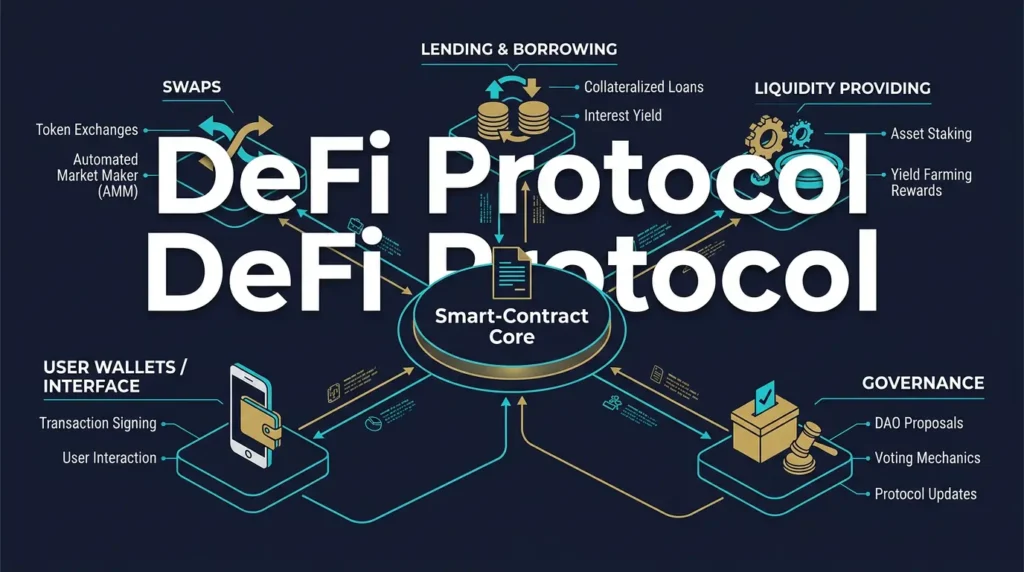
At the most practical level, a DeFi protocol is a set of smart contracts plus the rules and incentives that govern how users interact with them. Those contracts may hold assets, issue loans, manage collateral, reprice liquidity pools, distribute rewards, or execute other financial functions. The system works because every user and node can inspect the same contract state and the same transaction history on the blockchain.
A useful mental model is to think of a protocol as an automated financial engine and the app website as the dashboard. The dashboard matters for usability, but the engine is the thing actually moving funds and enforcing the rules. If the frontend disappears, another interface can often still interact with the same on-chain contracts.
How This Differs From Traditional Finance
In traditional finance, a bank or exchange usually keeps the ledger, controls the settlement system, decides the access rules, and updates balances in a private database. In DeFi, the ledger is public, the transaction logic is on-chain, and the rules are embedded in code that users can interact with directly if they have the right assets and wallet access.
That does not mean DeFi has no institutions. It means the institution is partially replaced by open contract logic and transparent state transitions. The trust model changes from “trust our company to maintain the ledger honestly” toward “inspect the code, the incentives, and the chain activity that govern the system.”
What DeFi Protocols Commonly Do
- Decentralized exchanges: Protocols such as AMMs let users swap assets directly against on-chain liquidity.
- Lending and borrowing markets: Users post collateral, borrow assets, and face automated liquidation if the collateral ratio weakens.
- Yield systems: Protocols route capital into pools, vaults, or strategies that distribute fees or incentive rewards.
- Stablecoin systems: Some protocols issue or manage dollar-linked assets using collateral or redemption mechanisms.
- Infrastructure layers: Oracles, bridges, and protocol routers help other DeFi applications function.
That variety is why “DeFi protocol” is a category, not one product type. A DEX and a lending market are both DeFi protocols, but they solve different problems and expose users to different risks.
What Makes a Protocol Work Without a Central Operator
The protocol works because the blockchain provides a shared state machine and the smart contracts define deterministic rules for how that state changes. If a user deposits collateral, the contract records it. If a loan falls below the allowed ratio, liquidation logic can trigger. If a swap goes through a liquidity pool, the pool balances update according to the pricing rule. The outcome is not decided by a support desk. It is decided by code execution.
One operator insight is that “without centralized control” does not mean “without control.” It means the main control surface shifts into code, governance, token incentives, and contract permissions. Users still need to understand who can upgrade contracts, pause the system, change fee settings, or redirect treasury flows.
Why Wallets Matter in DeFi
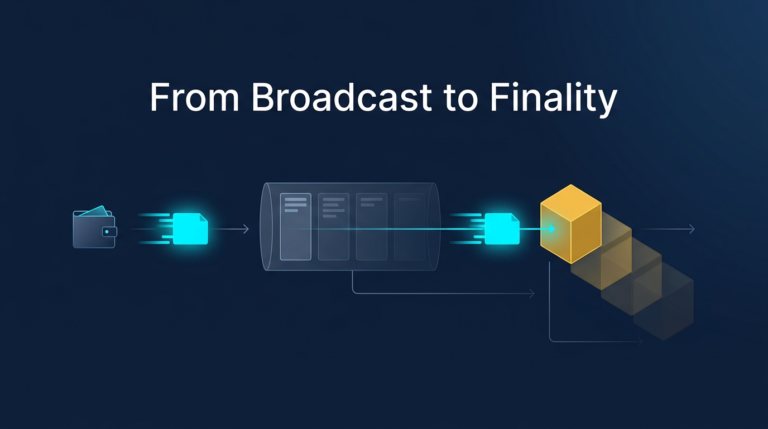
In DeFi, the wallet is not just a place where assets sit. It is also the user’s identity and signing device for interacting with the protocol. Every swap, approval, deposit, borrow, or withdrawal begins with the wallet authorizing a smart-contract interaction.
That is why wallet security matters so much for DeFi usage. If a user signs the wrong contract call or grants the wrong approval, the protocol will still do exactly what the signed transaction instructed. For the wallet-side mechanism, see What Is Transaction Signing in Crypto.
Where Yield and Liquidity Fit In
Many protocols need user capital to function well. DEXs need liquidity for swaps. Lending markets need supplied capital for borrowing. Yield systems often add incentives to attract early deposits. That is why DeFi protocols are closely tied to concepts like pools, farming, and fee-sharing.
Why the Interface Is Not the Protocol
Users often confuse the website with the protocol itself. The website is just one interface for preparing and broadcasting transactions. The protocol is the contract system those transactions call. If the frontend changes, gets blocked, or even disappears, the contracts can still exist on-chain and may still be accessible through other interfaces or directly through wallets and explorers.
A second operator insight is that this separation is one reason DeFi can feel resilient and dangerous at the same time. Resilient, because no single website necessarily controls the whole system. Dangerous, because users can still interact with persistent code long after a team’s branding, support quality, or security posture has changed.
Practical Usage: How to Evaluate a DeFi Protocol
- Check what exact financial job the protocol performs: Trading, lending, yield, stablecoin issuance, or infrastructure all imply different risks.
- Check what contracts actually control funds: The app interface is less important than the contract permissions and upgrade design.
- Check who can change the rules: Governance powers, admin keys, pausability, and treasury controls matter.
- Check where the yield or fee flow comes from: Real usage and temporary token subsidy are not the same thing.
- Check the protocol as a system, not just as a brand: TVL, audits, token design, and market behavior all shape the real trust model.
A practical frame is to ask: “If the website vanished tomorrow, what code, assets, permissions, and incentives would still exist on-chain?” That question usually reveals whether you are evaluating a real protocol or just reacting to an interface.
Risks and Common Mistakes
- Confusing the app with the protocol: A polished website says little by itself about the quality of the underlying contracts or governance.
- Assuming “decentralized” means no trust required: Users still need to assess upgrade keys, incentives, oracle design, and governance powers.
- Ignoring the protocol’s economic design: Even working code can create bad outcomes if incentives are weak or attackable.
- Using yield as proof of quality: High returns can come from subsidy, weak assets, or mercenary capital rather than strong product-market fit.
- Signing interactions you do not understand: In DeFi, user mistakes often become valid on-chain actions, not reversible support tickets.
Sources
Frequently Asked Questions
What is a DeFi protocol in simple terms?
It is an on-chain financial system made of smart contracts that lets users trade, lend, borrow, or provide liquidity without relying on one centralized company to process each action manually.
Is a DeFi protocol the same as a DeFi app?
Not exactly. The app is usually the interface. The protocol is the underlying contract system and on-chain rules that actually execute the financial logic.
How do DeFi protocols make money?
Many collect trading fees, borrowing spreads, liquidation penalties, or treasury flows depending on the protocol design. Some also use token incentives to attract capital and usage.
Do DeFi protocols need a company behind them?
Some have teams, foundations, or governance groups behind them, but the core financial logic is executed by contracts on-chain rather than by a company manually updating user balances.
Are DeFi protocols safe just because they are decentralized?
No. Decentralization changes the trust model, but users still face smart-contract risk, governance risk, market risk, and execution risk when interacting with the system.