

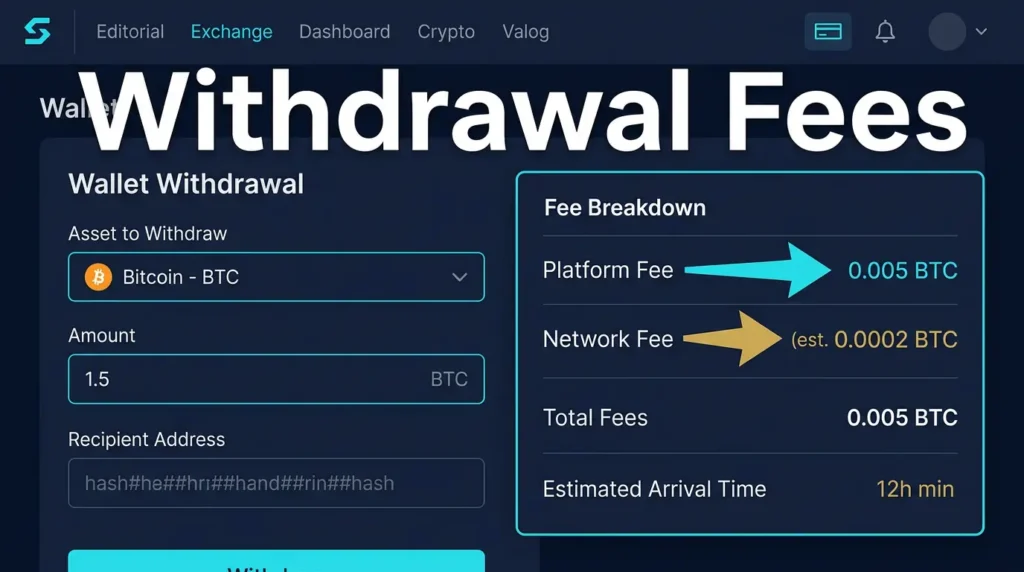
Crypto withdrawal fees are the costs users pay when moving assets off an exchange or custodial platform to an external wallet. The important distinction is that a withdrawal fee is not always the same thing as the blockchain network fee. In many cases, the exchange bundles network cost, operational overhead, and its own pricing policy into one visible charge.
A simple mental model helps: the network fee is what the blockchain needs to process a transaction, while the withdrawal fee is what the platform charges you to complete the withdrawal through its own system. Sometimes those numbers are close. Sometimes they are not.
This content is for educational purposes only and should not be considered financial or investment advice.
Key Takeaways
- A withdrawal fee and a network fee are not always identical: Exchanges may charge more than the underlying blockchain cost.
- Fees vary by asset and network: Sending BTC, ETH, USDT on Ethereum, or USDT on Tron can produce very different costs.
- Exchange pricing policy matters: Some platforms subsidize withdrawals, some mark them up, and some change them dynamically.
- Network selection can change cost dramatically: The same token can be cheaper or more expensive depending on which chain you use.
- The cheapest route is not always the safest route: Low cost means little if the destination wallet or chosen network is wrong.
What a Withdrawal Fee Actually Covers
When you withdraw from an exchange, the platform has to process the request, assemble the outbound transaction, manage hot-wallet operations, broadcast the transfer, and handle internal controls around security and compliance. The visible fee you pay can reflect some or all of that process, not just the fee ultimately paid to miners or validators.
This is why users get confused when a platform’s withdrawal charge does not match what they expect from reading about blockchain transaction fees. The exchange is not simply showing raw network cost. It is presenting the platform’s withdrawal price for that route.
Exchange Withdrawal Fee vs Network Fee
A network fee is the cost required by the blockchain itself to get the transaction processed. A withdrawal fee is the amount the exchange charges you when it sends funds out on your behalf. In the cleanest case, the exchange passes through roughly the same cost it expects to pay on-chain. In other cases, it may charge a flat rate, add margin, or smooth pricing so the user sees a simpler number.
Real-world example: a platform may charge a fixed BTC withdrawal fee that stays unchanged for a period of time even though actual on-chain fee conditions move up and down throughout the day. That means the displayed withdrawal fee is a platform policy number, not a live blockchain quote in the purest sense.
Why Fees Differ by Asset and Network
Withdrawal fees differ because the underlying networks work differently and because exchanges price routes differently. Bitcoin has its own fee market. Ethereum gas behaves differently. Stablecoins can exist on several chains, each with different cost and operational profiles. Exchanges then layer their own wallet infrastructure, batching logic, and commercial decisions on top.
That is why withdrawing USDT over Ethereum can cost much more than withdrawing the same token over Tron or another supported network. The asset label may look similar, but the route and settlement environment are different.
Why Some Exchanges Charge More Than Others
Exchanges do not all treat withdrawals the same way. One platform may keep fees low to attract active users. Another may charge more to cover infrastructure, security overhead, or simply because its pricing model allows it. Some exchanges batch withdrawals efficiently and spread cost across many users. Others may keep fee schedules more conservative to protect their own operational margin.
Operator insight: users often assume there is one objectively correct withdrawal fee for a coin. There is not. There is the network’s real cost environment, and there is the platform’s chosen way of packaging that cost for customers.
Why the Cheapest Network Is Not Always the Best Choice
Lower cost does not automatically mean better. The correct network is the one your destination wallet or receiving platform actually supports. Choosing a cheaper route that the destination cannot accept can create a recovery problem or a failed transfer path.
Real-world scenario: a user sees that withdrawing USDT on a cheaper chain costs far less than withdrawing it on Ethereum, selects the low-cost route, and only afterward realizes the receiving wallet was expecting ERC-20 USDT. The issue is no longer about saving a few dollars. It is now about compatibility and potential asset recovery.
How This Connects to Exchange Risk and Timing
Withdrawal cost is only one part of the real decision. Access, timing, and route reliability matter too. If a platform is congested, restricting networks, or slowing outbound transfers, the cheapest route on paper may not be the most useful one in practice. That broader custody layer is explained in Exchange Custody Risks Explained.
When Network Fees Matter More Than Platform Fees
On some routes, especially when congestion is high, the blockchain’s own cost structure dominates the user experience. This is common on networks where on-chain demand can spike sharply. For Bitcoin, the clean local background is Bitcoin Transaction Fees Explained. That article explains why the chain itself can become expensive even before an exchange adds its own pricing layer.
The practical lesson is that a withdrawal fee can be shaped by two different systems at once: the external network fee market and the internal exchange pricing model.
Practical Usage: What to Check Before You Withdraw
- Verify the destination network first: The cheapest option is useless if the receiving wallet does not support it.
- Compare fee schedules across supported routes: The same asset may be far cheaper on one chain than another.
- Check whether the fee is fixed or dynamic: A flat exchange fee behaves differently from a live network-driven one.
- Test with a small amount when the route is unfamiliar: This lowers the risk of a costly compatibility mistake.
- Think beyond the fee alone: Availability, speed, finality, and custody risk can matter as much as the headline cost.
A practical shortcut is this: first confirm the correct destination chain, then compare costs inside that safe set of options. Cost optimization should happen after compatibility, not before it.
Why Beginners Misread Withdrawal Fees
Many beginners assume the exchange is simply passing through a blockchain fee with no markup or policy layer. Others assume every withdrawal fee is arbitrary and unrelated to network reality. Both views are incomplete. The real answer is usually a blend of on-chain cost, platform operations, and commercial pricing choices.
Another common mistake is treating the token symbol as if it guarantees the right route. In practice, chain selection matters as much as asset name when a token exists across multiple networks.
Risks and Common Mistakes
- Choosing a route only because it is cheaper: A user may pick the lowest-fee USDT network, then realize the receiving wallet only supports a different version of the token, turning a small cost decision into a compatibility problem.
- Assuming the exchange fee equals the raw on-chain fee: A platform may charge a fixed amount while actual network conditions move throughout the day, so the visible withdrawal price can include policy and margin, not just settlement cost.
- Ignoring timing during congestion: On busy chains, a withdrawal that looked affordable yesterday can become more expensive or slower today because the network fee environment changed before the exchange processed it.
- Testing with full size on an unfamiliar route: Sending the full balance first leaves no margin for address-format mistakes, unsupported networks, or destination-side confusion that a small test transfer could have revealed.
Sources
Frequently Asked Questions
Why do exchanges charge withdrawal fees for crypto?
They charge for sending funds through their wallet infrastructure, and that price may include network cost, operational overhead, and platform pricing policy.
Is a withdrawal fee the same as a network fee?
Not always. A network fee is the blockchain cost of processing the transaction, while a withdrawal fee is the amount the platform charges the user.
Why does the same token have different withdrawal fees?
The token may be available on multiple chains, and each network can have different costs and platform pricing rules.
Can the cheapest withdrawal option be the wrong one?
Yes. A lower-cost route can still be wrong if the destination wallet or receiving platform does not support that network.
How should I reduce withdrawal mistakes?
Confirm the destination network, compare supported routes, and use a small test transfer first when the path is unfamiliar.