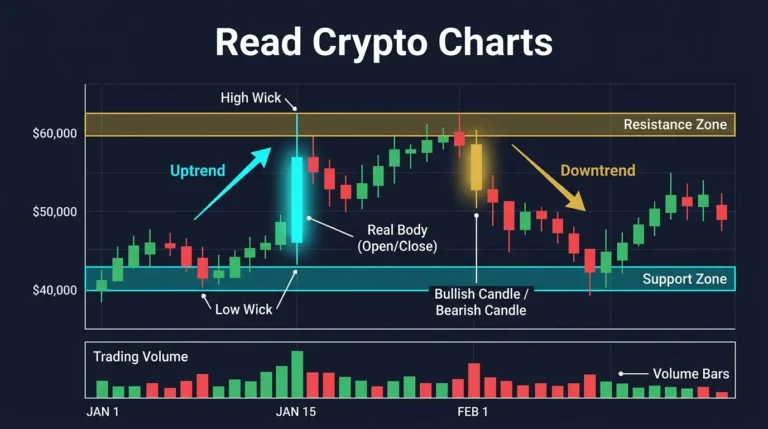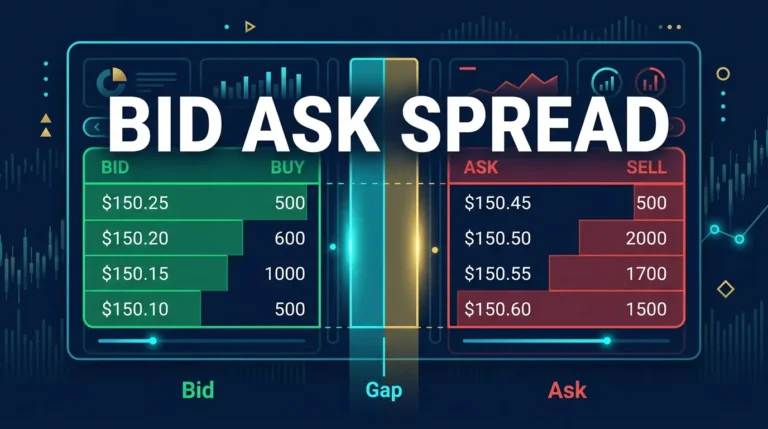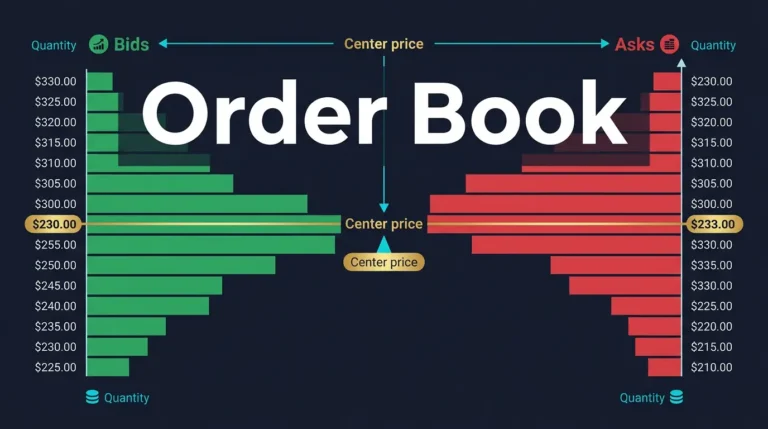


Crypto market cycles are repeating periods of optimism, acceleration, euphoria, exhaustion, decline, and recovery that shape how prices and investor behavior evolve over time. The prices look different in each cycle, but the emotional pattern is often familiar: skepticism turns into curiosity, curiosity turns into confidence, confidence turns into excess, and excess eventually breaks down into fear.
A useful mental model is to treat a market cycle as a feedback loop between price, narrative, liquidity, and behavior. Rising prices attract attention, attention attracts new buyers, and new buyers reinforce the price move. The same process can reverse once momentum fades and people begin protecting capital instead of chasing gains.
This content is for educational purposes only and should not be considered financial or investment advice.
Key Takeaways
- Cycles are more than price charts: They reflect repeated shifts in investor psychology, risk appetite, and liquidity.
- Bull and bear markets are not random opposites: They are different stages of the same broader process.
- Narratives matter: New themes often help accelerate cycle moves, but they can also exaggerate late-stage risk-taking.
- Behavior usually peaks at the wrong time: Euphoria often appears near cycle highs, while despair often dominates near cycle lows.
- Better decisions come from phase awareness: You do not need to predict exact tops and bottoms to improve behavior.
What a Market Cycle Actually Is
A market cycle is a broad pattern in which prices, sentiment, and participation rise and fall in recognizable stages. In crypto, those stages often move faster and more violently than in traditional markets because the asset class is highly narrative-driven, trades globally around the clock, and includes a large base of speculative participants.
This is why cycles in crypto often feel extreme. The same market structure that allows rapid upside can also create fast downside once leverage unwinds, narratives weaken, or liquidity thins out, sometimes culminating in exchange collapses.
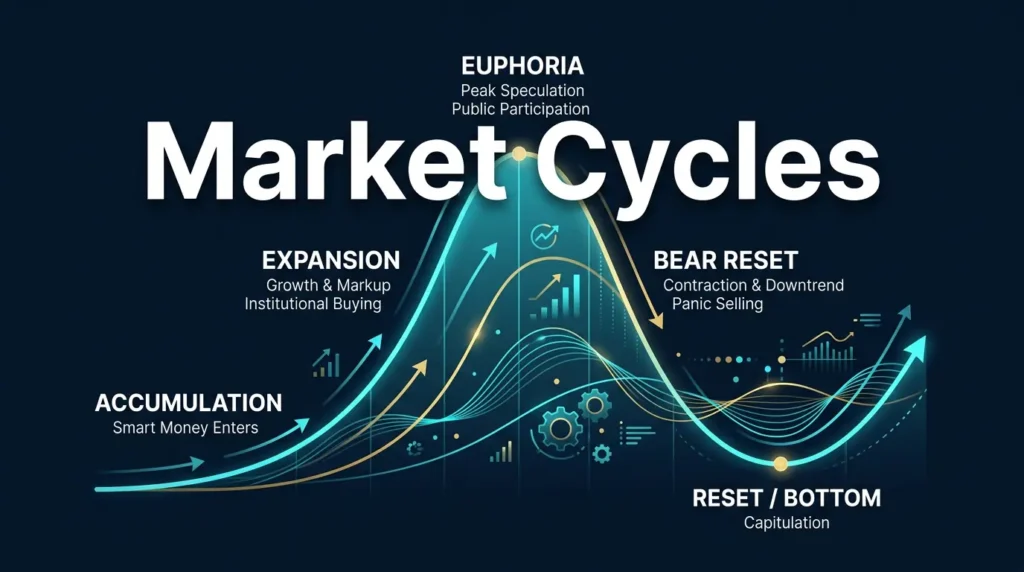
The Usual Cycle Phases
The names vary, but most cycles can be understood through a practical sequence:
- Accumulation: Prices are depressed or flat, public attention is weak, and conviction comes mostly from longer-term participants.
- Early uptrend: Prices begin improving, skepticism remains high, and early buyers are still acting before the broad crowd notices.
- Expansion: More participants enter, narratives strengthen, media attention rises, and gains begin to feel easier.
- Euphoria: Risk control weakens, confidence becomes overconfidence, and buyers start assuming recent gains are normal.
- Distribution: Strong hands begin reducing exposure into strength while public enthusiasm is still high.
- Bear phase or reset: Price declines, confidence breaks down, weak positions unwind, and attention fades until the market stabilizes again.
Real-world pattern: the public narrative usually lags the cycle. By the time mainstream attention fully arrives, the market is often much further along than newcomers realize.
Why Bull Markets Feel Smarter Than They Are
In rising markets, good outcomes can hide weak discipline. When price keeps recovering quickly, people start mistaking favorable conditions for skill. Higher-risk behavior feels validated because it keeps working, at least for a while.
Operator insight: bull markets often train bad habits. Traders over-size positions, investors chase weaker assets, and people stop asking whether the thesis is improving or whether they are simply riding broad momentum. That is one reason cycle highs are often filled with confidence that looks rational in the moment and reckless in hindsight.
Why Bear Markets Feel Worse Than They Need To
Bear phases do more than lower prices. They change perception. Narratives that looked obvious in the uptrend suddenly feel naive, and assets that seemed unstoppable begin to look permanently broken. Fear compresses time horizons, making temporary weakness feel like final failure.
That does not mean every decline is a buying opportunity. It means bear markets distort judgment in the opposite direction from bull markets. In the same way euphoria can make risk look smaller than it is, despair can make all opportunity look equally bad.
Why Investor Behavior Repeats Across Cycles
The technology changes, the tokens change, and the slogans change, but human behavior changes more slowly. Greed, FOMO, regret, denial, and panic appear in different forms in nearly every cycle. New participants enter believing this time is obvious, while experienced participants often recognize the emotional rhythm long before the public does.
This is where adjacent risk content matters. In late bullish conditions, people are more likely to rationalize low-quality moves, chase thin liquidity, or ignore red flags in the hope of fast gains. The same behavior shows up in pump-and-dump environments and in metrics-driven shortcuts like assuming TVL means safety.
What Usually Drives a New Cycle
There is no single template, but new cycles often build from a combination of improving liquidity, stronger macro conditions, major infrastructure progress, narrative renewal, or supply-demand shifts inside crypto itself. Once the price trend improves, the behavioral engine begins reinforcing it.
Real-world example: an early recovery may start quietly with better positioning and fewer forced sellers. Only later do broader narratives, media coverage, and retail participation catch up. By then, the cycle is no longer early even if it still feels that way to newcomers.
Why Late-Cycle Risk Looks Attractive
Late in a cycle, lower-quality opportunities often look strongest because they are fueled by urgency rather than durability. Small tokens can move faster than majors. Riskier strategies can temporarily outperform cautious ones. The temptation is to believe that faster gains mean better opportunity when they often mean thinner support underneath.
Real-world scenario: a participant who ignored high-risk assets during the early uptrend suddenly feels pressure to catch up after seeing others post large gains. Instead of improving process, the person expands risk at the stage where discipline matters most. That is how many cycle participants buy the most aggressively after a long rally rather than before it.
How to Use Cycle Thinking Without Pretending You Can Time Everything
Cycle awareness is not about calling the exact top or bottom. It is about improving behavior as conditions change. The most practical benefit is knowing when your own emotions are likely to become unreliable. When the market feels easiest, risk is often being underpriced. When the market feels hopeless, fear is often doing more of the thinking than the evidence is.
A practical operator rule is to separate phase awareness from prediction. You do not need to know the exact next move to know that euphoric conditions deserve stricter risk control than quiet, ignored conditions do.
Practical Usage: Questions to Ask in Any Phase
- Is this thesis improving, or is price just rising?: Strong price action can hide weak reasoning.
- Am I adding risk because the opportunity is better, or because I feel behind?: Catch-up behavior is a late-cycle danger sign.
- Would I still want this position if the market went flat for six months?: This helps separate conviction from momentum addiction.
- Has crowd confidence become a substitute for analysis?: Broad agreement is often loudest when valuation discipline is weakest.
- Am I planning exits during calm conditions, or only reacting after volatility arrives?: Good cycle behavior is prepared behavior.
A practical shortcut is this: the hotter the market feels, the more carefully you should question your own urgency. Cycle mistakes often begin with the feeling that you must act immediately because everyone else already has.
Why This Matters More in Crypto Than Many Users Expect
Crypto compresses emotion because markets move fast, narratives travel quickly, and participation is highly visible on social platforms. Gains and losses are discussed publicly in real time, which intensifies comparison and shortens patience. That environment makes cycle psychology harder to ignore than in slower asset classes.
This is also why people who think they are making purely analytical decisions can still end up behaving like the crowd. The market environment itself is designed to amplify attention and urgency.
Risks and Common Mistakes
- Assuming a bull market proves personal skill: A trader may earn easy gains during broad upside and then mistake favorable conditions for a durable edge, which leads to over-sizing just as the environment becomes less forgiving.
- Chasing because others seem ahead: After watching faster gains in higher-risk assets, an investor may abandon a disciplined plan late in the cycle and buy thin or weak projects mainly to relieve emotional pressure.
- Treating every drawdown as either disaster or opportunity: Some declines are healthy resets and some are structural breakdowns, so reflexively buying every drop or fearing every correction can both produce bad decisions.
- Using cycle language as false certainty: Calling something “mid-cycle” or “the final leg up” can create overconfidence if the label becomes a substitute for actual risk management, liquidity awareness, and position sizing.
Sources
- Investor.gov: Bull Market
- Investor.gov: Bear Market
- CFTC: Understanding the Risks of Virtual Currency Trading
Frequently Asked Questions
What are market cycles in crypto?
They are repeating phases of optimism, expansion, euphoria, decline, and recovery that shape both price action and investor behavior over time.
What is the difference between a bull and bear market?
A bull market is a sustained period of rising prices and stronger risk appetite, while a bear market is a sustained period of falling prices, weaker confidence, and tighter liquidity.
Why do market cycles repeat in crypto?
They repeat because price, attention, liquidity, and human behavior reinforce each other in similar ways across different narratives and market environments.
Can you predict the exact top or bottom of a cycle?
No. Cycle awareness is more useful for improving behavior and risk control than for calling exact turning points.
Why do people make worse decisions late in a cycle?
Because urgency, overconfidence, social comparison, and recent gains can make risk look smaller and discipline feel less necessary than it really is.