

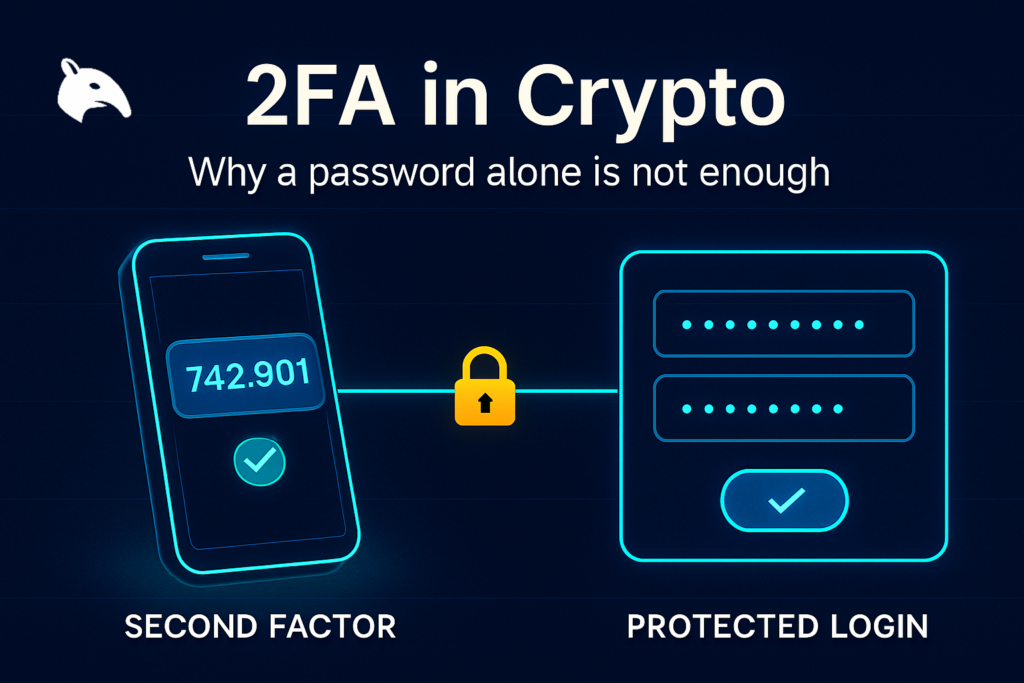
Two-factor authentication adds a second proof of identity on top of your password. In crypto, that second factor most often protects exchange logins, trading apps, portfolio tools, and the email accounts tied to those services. The point is simple: if someone steals or guesses your password, they should still fail at the next step unless they also control your second factor.
If you want the foundational definition behind this concept, read self custody.
The important nuance is that 2FA does not protect every part of crypto equally. It helps most with account-based systems such as exchanges and custodial apps. It does much less for self-custody mistakes like typing a seed phrase into a phishing site or approving a malicious wallet transaction yourself. That is why understanding where 2FA fits, and where it does not, matters more than just turning it on blindly.
This content is for educational purposes only and should not be considered financial or investment advice.
Key Takeaways
For a closely related follow-up, see How to Choose a Crypto Wallet: A Practical Security Framework.
- 2FA adds a second checkpoint: A stolen password should not be enough to access an exchange or account.
- It matters most for custodial systems: Exchanges, broker apps, and account-recovery flows benefit more than pure self-custody wallets.
- App-based 2FA is usually stronger than SMS: SMS can be undermined by SIM-swap and carrier-account attacks.
- It does not stop every crypto theft: It cannot save you from voluntarily approving a malicious transaction or sharing a seed phrase.
- Your email account is part of the threat model: If email can reset exchange access, email security matters almost as much as exchange security.
How 2FA Actually Works
Traditional login relies on one factor: something you know, usually a password. Two-factor authentication adds another category, such as something you have, like a phone app or hardware key. After you enter the password, the service asks for that second factor before access is granted.
That extra step matters because passwords leak often. They are reused, phished, stored badly, or stolen in breaches. A second factor makes account takeover harder by forcing the attacker to control another piece of the login flow.
Where 2FA Matters in Crypto
The most important place is centralized platforms. If you hold assets on an exchange, use a trading app, or depend on a platform account to withdraw funds, then account takeover becomes a real part of your crypto risk. In that setting, 2FA is one of the clearest basic defenses you can add.
- Exchange logins: Prevents a stolen password from being enough to reach your balance and withdrawal settings.
- Email accounts: Important because email is often the recovery path for exchange and app access.
- Broker or custodial apps: Any service that can hold funds, reset sessions, or approve withdrawals should be hardened.
- Recovery workflows: The second factor can block or slow account-reset abuse when someone tries to take over the account through support channels.
If you want the broader account-risk framework around centralized platforms, Exchange Custody Risks Explained is the cleanest local follow-up.
Where 2FA Does Not Help Much
2FA is often misunderstood as a general shield for all crypto loss. It is not. A self-custody wallet does not become safe just because your exchange account has a second login step. If you approve the wrong transaction, connect to a malicious site, or expose your seed phrase, 2FA may never enter the picture.
Real-world example: a user has strong exchange 2FA but types a wallet recovery phrase into a fake support portal. The attacker does not need the exchange account at all. The loss happens at the wallet layer, not the account-login layer. That is why 2FA should be treated as one control inside a bigger security system, not as proof that everything is covered.
For the behavior side of those attacks, the most useful local references are What Is Crypto Phishing? and Social Engineering in Crypto.
Common 2FA Methods
SMS codes
SMS 2FA sends a code by text message to your phone number. It is better than password-only security, but it depends on the mobile carrier and the phone-number layer staying under your control. That creates a known weakness: attackers can target the phone-number system itself through SIM swaps or carrier-account abuse.
Authenticator apps
Authenticator apps generate time-based one-time codes directly on your device. Because they do not rely on the carrier network for each login, they are usually a stronger default than SMS for exchange accounts. They are not perfect, but they remove one of the most common identity-layer attack paths in crypto.
Hardware security keys
Hardware security keys are often stronger still, especially for email and exchange accounts that support them. They require the user to physically present the key during login, which reduces remote takeover risk further. For many people this is the best option for the email account connected to exchange access.
Why SMS Is Weaker for Crypto Accounts
Crypto accounts attract targeted attacks because the payout can be immediate and hard to reverse. If the second factor is tied to a phone number, the attacker may try to control that phone number instead of breaking the app itself. That is what makes SIM swapping relevant. The mobile carrier becomes part of your security stack whether you intended that or not.
Real-world scenario: an attacker learns enough personal information to convince a carrier representative to move your number to a different SIM. Once that happens, SMS codes and some account-recovery prompts may start arriving to the attacker instead of you. The password layer might still matter, but the phone-number layer has already become the weak point.
This is one reason exchange-account security and recovery planning matter so much when funds remain on-platform. If that account model is part of your setup, read What Happens During the Collapse of a Crypto Exchange? as well, because access risk is not only about hacks.
Why Email Security Matters Too
Many crypto users focus on exchange 2FA but ignore the email account behind it. That is a mistake. If email is the route for password resets, login alerts, withdrawal confirmations, and support interactions, then email is not just a messaging tool. It is part of the custody perimeter for the account.
A practical rule is to secure the email account tied to your exchange with at least the same seriousness as the exchange itself. Strong unique password, strong second factor, and no casual reuse of that inbox across risky online activity is a sensible baseline.
Practical Usage: A Good 2FA Setup for Crypto Accounts
Operator insight: the best setup usually protects the account that can reset other accounts first. If your email can recover your exchange login, and your exchange can access your funds, then the email account deserves priority hardening even if it does not look like a crypto tool on the surface.
Risks and Common Mistakes
- Thinking 2FA fixes wallet-level mistakes: It helps with account takeover but not with seed-phrase exposure or malicious transaction approval.
- Using SMS when stronger options are available: Better than nothing, but weaker than an authenticator app or security key for crypto accounts.
- Protecting the exchange but not the email: An attacker may target the recovery route instead of the main login page.
- Failing to back up the second factor: Losing the authenticator device without recovery planning can lock out the real owner too.
- Assuming “enabled” means “well configured”: A second factor only helps if the surrounding recovery, device, and phishing habits are also strong.
Sources
- NIST Digital Identity Guidelines
- CISA: Use Multi-Factor Authentication
- OWASP: Multi-Factor Authentication
Frequently Asked Questions
What does 2FA mean in crypto?
It means adding a second login step beyond the password, usually to protect exchanges, apps, and email accounts that can affect your crypto access.
Does 2FA protect a self-custody wallet?
Not in the same way it protects an exchange account. It can help around connected services, but it does not stop seed-phrase exposure or bad transaction approvals by itself.
Is SMS 2FA good enough for crypto?
It is better than password-only security, but app-based codes or hardware security keys are usually stronger because they reduce SIM-swap and carrier-account risk.
Should I secure my email with 2FA too?
Yes. If email is the recovery path for an exchange or crypto app, email security is part of the same threat model and deserves equal attention.
What is the biggest misunderstanding about 2FA?
The biggest misunderstanding is thinking it protects every kind of crypto loss. It mainly helps with account access and recovery, not with every wallet or signing mistake.