

If you use crypto exchanges, broker apps, or any account that can reset access to funds, the type of two-factor authentication you choose matters. SMS and authenticator apps both add a second checkpoint beyond the password, but they do not fail in the same way. In crypto, that difference matters because attackers often target account recovery, phone numbers, and identity layers rather than just the password itself.
The short version is simple: authenticator apps are usually the stronger default for crypto accounts, while SMS is better treated as a weaker fallback than as the preferred option. SMS is still better than password-only security, but it depends on the mobile-carrier layer staying under your control. For accounts tied to money, recovery, and withdrawals, that is an avoidable dependency when app-based codes are available.
This content is for educational purposes only and should not be considered financial or investment advice.
Key Takeaways
- Authenticator apps are usually the better default: They remove routine dependence on the mobile carrier during login.
- SMS is still better than password-only security: It is not useless, just weaker for higher-risk crypto accounts.
- Crypto attackers often target the identity layer: SIM swaps and recovery abuse make phone-number-based security less attractive.
- Email security matters too: If email can reset exchange access, its 2FA method deserves the same level of care.
- The best option may be a hardware security key: But between these two common choices, authenticator apps usually win.
The Real Difference Between SMS and Authenticator Apps
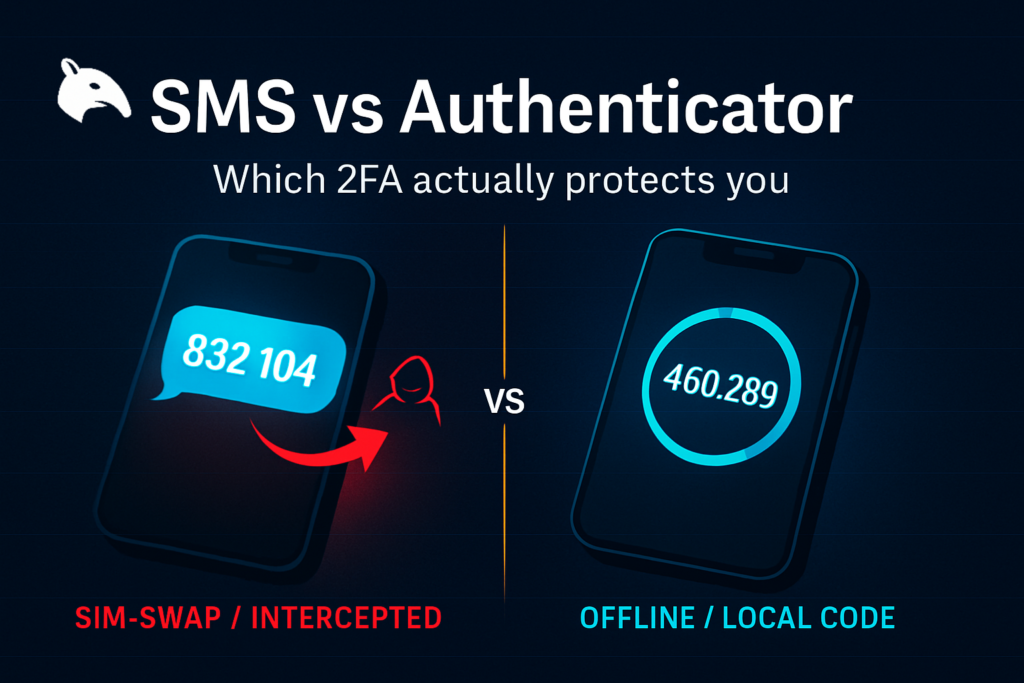
Both methods add a code after the password, but the source of that code is what changes the risk profile. SMS delivers the code through your phone number and carrier network. An authenticator app generates the code directly on a device you control, without needing the carrier path every time you log in.
That difference sounds small until you think like an attacker. If the second factor is SMS, the attacker can target the phone-number layer. If the second factor is an authenticator app, the attacker usually has to compromise the device, the recovery setup, or the user directly instead of routing through the carrier.
| Method | Default fit for crypto accounts | Main weakness | Better use case |
|---|---|---|---|
| SMS | Weaker fallback | SIM swaps, carrier abuse, phone-number recovery risk | Only when nothing stronger is available |
| Authenticator app | Best normal default | Device compromise or weak backup handling | Exchange and email accounts that support app-based codes |
| Hardware security key | Strongest of the common options | Support is uneven and backup planning still matters | Highest-value accounts that support security keys |
Why SMS Is Weaker for Crypto Accounts
Crypto accounts are high-value targets because access can lead directly to withdrawals, trading, or account takeover with limited recovery options. When a service uses SMS, your security now depends partly on the mobile-carrier account and the support processes around it. That expands the attack surface in a way many users do not realize.
Real-world example: an attacker gathers enough personal information to socially engineer a carrier representative into moving your number to another SIM card. Once the number changes hands, SMS login codes and some recovery flows may begin reaching the attacker. Your password may still exist, but the second factor has effectively moved to someone else.
Why Authenticator Apps Usually Win
Authenticator apps usually win because they do not ask the carrier network to deliver each login code. That removes one common route for remote account takeover. The code stays tied more closely to your device and your own backup setup rather than to your mobile number.
This does not make authenticator apps perfect. If the device is compromised, if recovery seeds or backup exports are exposed, or if the user is tricked into helping an attacker, risk still exists. But for a normal exchange or email account, the authenticator path is usually the cleaner and stronger baseline compared with SMS.
Where SMS Might Still Be Used
Some platforms still offer SMS because it is familiar and easy for beginners. In lower-risk contexts or where no better option exists, SMS can still be worth enabling rather than leaving an account protected only by a password. The mistake is treating SMS as equivalent to stronger methods when the account actually controls meaningful value.
Operator insight: if SMS is the only option on a service that matters financially, the response should not be false confidence. It should be tighter password hygiene, stronger email security, smaller balances on that platform, and a plan to reduce dependence on that account model where possible.
What This Means for Exchange Accounts
Exchange accounts combine login risk, recovery risk, and withdrawal risk. That is why the second-factor choice matters more there than it does on a random internet account. If an attacker reaches the exchange and the linked email, the result can move quickly from nuisance to financial loss.
If centralized accounts remain part of your setup, Exchange Custody Risks Explained and What Happens During the Collapse of a Crypto Exchange? are the most relevant local follow-ups, because account hardening is only one part of exchange risk.
Email Is Often the Hidden Weak Point
Many users compare SMS and authenticator apps on the exchange itself but forget the email account tied to password resets, alerts, and support communication. That email account is often the real control point behind the exchange account. If it is weak, the exchange’s stronger settings may matter less than expected.
A practical rule is to protect the email with at least the same seriousness as the exchange, and ideally more. If the inbox can reset the exchange, then inbox security is part of your crypto security. Overlooking this kind of dependency is one of the most frequent crypto opsec mistakes.
Practical Usage: Which Option Should You Choose?
- Choose an authenticator app when available: This is the best default for most exchange and email accounts.
- Use SMS only when it is the best option you have: Better than nothing, but not the stronger long-term choice for meaningful balances.
- Use a hardware security key where supported: For the highest-value accounts, this can be stronger than either SMS or app codes.
- Harden the whole recovery chain: Passwords, email, support flows, and backup codes all matter alongside the second factor.
- Limit value on weaker account stacks: If a platform only supports weaker recovery and login controls, size the balance accordingly.
A useful shortcut is this: if the account can move meaningful funds, choose the second factor that depends on the fewest outside parties. Between SMS and an authenticator app, that usually points to the authenticator. For assets not held on exchanges, the hardware wallet vs software wallet decision determines the next layer of key protection.
Risks and Common Mistakes
- Assuming all 2FA methods are equal: They are not. SMS and app-based codes fail through different attack paths.
- Treating SMS as “good enough” for every account: It may be acceptable for low-risk use, but meaningful crypto accounts deserve stronger defaults when possible.
- Ignoring the email account: Users often secure the exchange login better than the inbox that can reset it.
- Forgetting recovery backups: A strong second factor that locks out the real owner is still an operational failure.
- Thinking 2FA solves phishing by itself: A user can still be manipulated into bad actions even with strong login settings.
For that last risk, the behavior layer is covered better by Social Engineering in Crypto than by any 2FA comparison.
Sources
- NIST Digital Identity Guidelines
- CISA: Use Multi-Factor Authentication
- OWASP: Multi-Factor Authentication
Frequently Asked Questions
Is SMS or authenticator better for crypto accounts?
Authenticator apps are usually better because they do not rely on the phone-number and carrier layer for each login code.
Is SMS 2FA still better than nothing?
Yes. SMS is still better than password-only security, but it is weaker than an authenticator app for meaningful crypto accounts.
Why are SIM swaps relevant to crypto?
Because phone-number control can let an attacker receive SMS login codes and some account-recovery prompts, which is especially dangerous for exchange and email accounts.
Should I use a hardware security key instead?
If your exchange and email provider support it, a hardware security key can be stronger than either SMS or app-based codes for high-value accounts.
What is the biggest mistake in this comparison?
The biggest mistake is assuming every two-factor method gives the same protection, when the real issue is which attack path each method leaves open.