

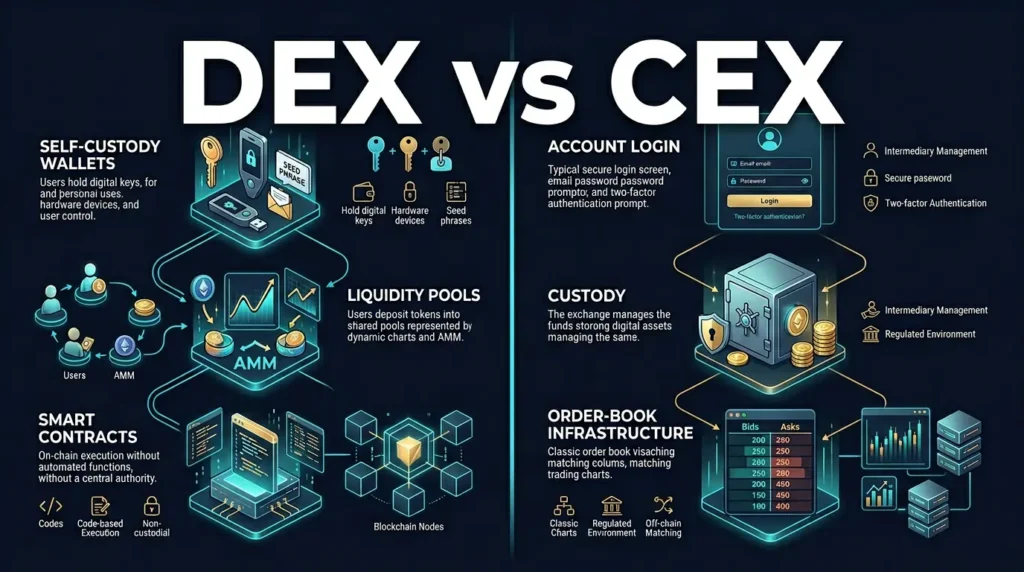
The core difference between a DEX and a CEX is who controls the trading environment and who controls the assets during the trade. A CEX, or centralized exchange, usually asks you to deposit funds into platform-controlled accounts and then trades them inside the exchange’s own system. A DEX, or decentralized exchange, usually lets you trade from a wallet you control by signing on-chain transactions that interact with smart contracts.
That distinction changes nearly everything else: custody, liquidity, execution style, account recovery, speed, compliance friction, and the kinds of mistakes that hurt users. The useful question is not “Which is better in theory?” but “Which failure mode and workflow fit this specific balance and job?”
This content is for educational purposes only and should not be considered financial or investment advice.
Quick Answer
A CEX is usually better for convenience, fiat access, and deep centralized trading infrastructure. A DEX is usually better for direct wallet control, on-chain access, and reducing dependence on a centralized custodian. Many users should not choose only one forever. They should use each where it fits best.
Key Takeaways
- CEXs optimize for convenience and operational depth: They usually offer easier onboarding, fiat rails, and familiar trading interfaces.
- DEXs optimize for direct wallet control: Users usually trade from self-custody instead of from a platform account.
- The main trade-off is custody versus user-side complexity: A CEX adds platform dependence, while a DEX adds more wallet, smart-contract, and execution responsibility.
- Liquidity can behave differently: Centralized venues often use order books, while many decentralized venues use liquidity pools or other on-chain market structures.
- The right choice depends on the job: Fiat conversion, active trading, DeFi access, and long-term storage should not all be forced into one model.
The Core Difference
A CEX holds the trading environment inside a company-run system. You create an account, deposit funds, and rely on the platform to maintain balances, settle trades, and process withdrawals. A DEX moves more of that exchange logic on-chain. You connect a wallet, approve assets if needed, and let blockchain-based protocols execute the trade.
The custody layer is what changes the trust model most. On a CEX, the platform usually controls the wallets and internal ledger. On a DEX, you usually keep control of the wallet but take more responsibility for every approval, signature, and transaction you authorize.
Where CEXs Usually Win
CEXs usually win on onboarding, fiat access, support expectations, and centralized trading tooling. If a user wants to deposit from a bank, place more familiar exchange-style orders, or move quickly between crypto and fiat, a centralized venue often provides the smoother path.
Real-world example: a user dollar-cost averaging from a bank account, occasionally converting to fiat, and placing routine trades may find a CEX much easier operationally than setting up self-custody first and routing everything through on-chain swaps.
Where DEXs Usually Win
DEXs usually win when direct wallet control, permissionless access, and DeFi-native market access matter more than centralized convenience. A user can interact directly from a wallet without first transferring assets into a platform-controlled custody environment.
That matters especially for on-chain assets and protocols that may not exist on centralized venues yet. For the clean foundation page behind that model, see What Is a DEX?.
Custody Is the Biggest Structural Difference
A CEX usually asks you to trust the platform with custody during trading and often during storage if funds remain there. That creates counterparty risk, account risk, and withdrawal dependence. A DEX usually lets you keep custody in your own wallet, but then your wallet process becomes part of the exchange risk surface.
If you want the fuller custody-risk layer for centralized venues, the best local follow-up is Exchange Custody Risks Explained. If you want the broader wallet-control comparison, Self Custody vs Custodial Wallets is the cleaner background page.
Liquidity and Market Structure
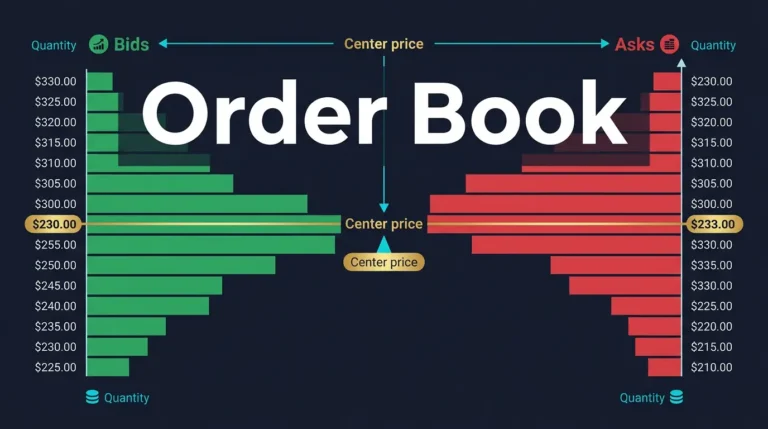
CEXs often use centralized order books and matching engines. That can make the trading environment feel more familiar to active traders, especially for large liquid pairs. DEXs often use liquidity pools or automated market maker models, though market structure varies across protocols.
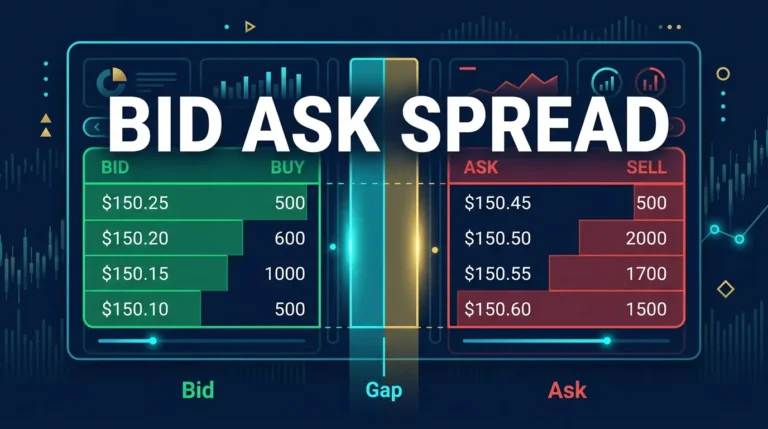
This difference affects how traders experience spread, depth, slippage, and execution. A centralized order-book venue and a pool-based DEX may both quote a price, but the path to that execution is not the same. For the order-book side of the contrast, see What Is a Crypto Order Book?.
Security Trade-Offs Are Different, Not Absent
A CEX concentrates platform and account risk. If the exchange fails operationally, freezes withdrawals, or the account recovery stack is compromised, user access can break even when the blockchain itself is working normally. A DEX reduces reliance on that one custodian, but it increases the importance of wallet hygiene, contract verification, approval review, and safe signing.
Operator insight: users often frame this as “CEX unsafe, DEX safe” or the reverse. That is too simple. These systems fail in different ways. One risk stack emphasizes counterparty and account dependence. The other emphasizes wallet control, contract risk, and user decision quality.
What the User Experience Feels Like
A CEX usually feels more like a familiar app account: login, balances, trading interface, support routes, and internal transfers. A DEX feels more like a wallet-driven protocol interaction: connect wallet, review token pair, approve if needed, sign the trade, and wait for network confirmation.
Real-world example: selling crypto into fiat and withdrawing to a bank usually fits a CEX better. Swapping directly into a DeFi-native token from a self-custody wallet often fits a DEX better. The difference is not only philosophy. It is operational fit.
Which One Fits Which Job?
- Fiat on-ramp or off-ramp: Usually fits a CEX better.
- Access to new on-chain assets and DeFi routes: Usually fits a DEX better.
- Fast operational trading with centralized tooling: Often fits a CEX better.
- Direct self-custody trading from a wallet: Usually fits a DEX better.
- Long-term storage: Often fits neither as a primary “exchange job”; storage usually deserves a separate custody decision.
A useful operator rule is to separate the trading venue from the storage venue. The system that helps you buy or swap an asset is not always the best place to keep it afterward, and the hardware wallet vs software wallet decision takes over once trading is done.
Practical Usage: How to Decide
- Start with the job: Ask whether you need fiat access, active trading tools, or direct on-chain access.
- Check the custody layer: Decide whether this balance should sit in platform custody at all.
- Match the market structure to your needs: Order-book and pool-based environments create different execution behavior.
- Price in the user-side workload: Wallet review, approvals, and contract verification are part of DEX cost even when there is no support desk.
- Keep storage separate from convenience: Funds with no immediate exchange job should be reconsidered rather than left in place by habit.
A practical shortcut is this: use CEXs for centralized convenience jobs and DEXs for direct on-chain access jobs, then make storage decisions separately. When comparing actual costs, withdrawal fees are part of the operational calculation for any CEX-based workflow.
Risks and Common Mistakes
- Leaving long-term holdings on a CEX by inertia: A trading platform can quietly become a storage layer even when the funds no longer need exchange access.
- Treating a DEX like a simple app trade: Approval prompts, slippage, fake tokens, and smart-contract interactions can create risks users do not face the same way on centralized venues.
- Choosing only by ideology: Some users force everything onto one model when the safer answer is often role-based use of both.
- Ignoring the account layer on CEXs: Email security, recovery paths, and identity-based attacks matter even when the platform itself is fine.
- Ignoring the wallet layer on DEXs: A self-custody venue does not protect users from bad signatures, malicious approvals, or poor wallet separation.
Sources
Frequently Asked Questions
Is a DEX safer than a CEX?
Not automatically. A DEX reduces custodial dependence, but it increases the importance of wallet security, approval review, and contract awareness. A CEX creates more platform and account dependence instead.
When does a CEX make more sense?
A CEX often makes more sense for fiat access, centralized trading tools, and smoother onboarding when direct on-chain access is not the main goal.
When does a DEX make more sense?
A DEX often makes more sense when you want to trade directly from self-custody, access DeFi-native assets, or avoid sending funds into a centralized custody environment first.
Do most users need both DEXs and CEXs?
Many do. The two models solve different operational problems, so a mixed setup is often more practical than trying to force one venue type to do every job.
What is the biggest mistake in this exchange decision?
The biggest mistake is treating the exchange choice like a permanent identity decision instead of a role-based operational choice about custody, access, and trading environment.