

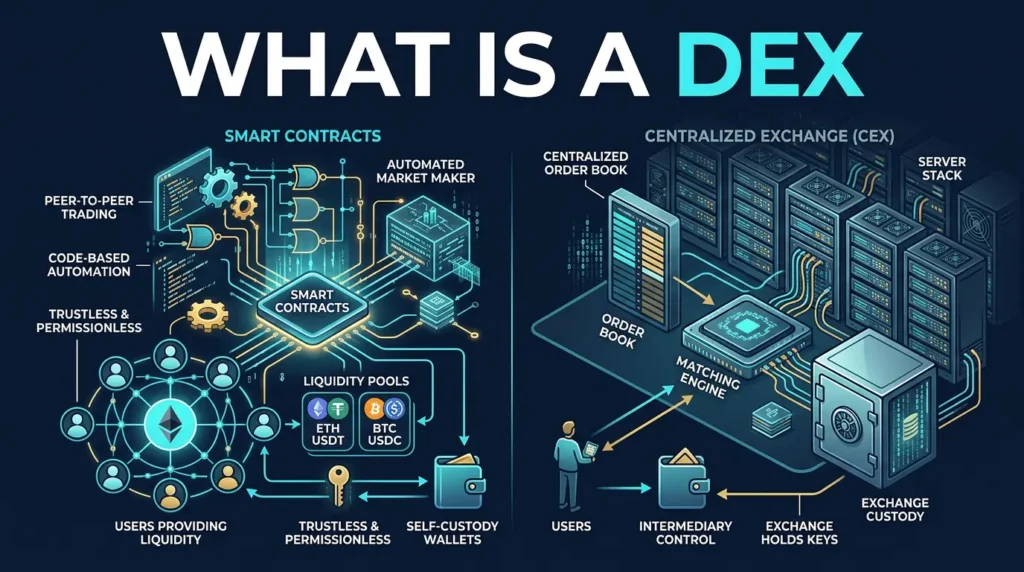
A DEX, or decentralized exchange, is a crypto trading system that lets users swap assets through blockchain-based smart contracts instead of relying on a centralized company to custody funds and settle trades internally. In practice, users connect a wallet, approve the relevant assets when needed, and send transactions directly to on-chain exchange logic.
The key difference is not just that the interface looks different. It is that the exchange process itself is handled through public blockchain rules rather than through a private exchange ledger. That changes how custody works, how liquidity is sourced, and what kinds of risks the user takes on.
This content is for educational purposes only and should not be considered financial or investment advice.
Quick Answer
A DEX is a decentralized exchange that lets users trade crypto directly on-chain through smart contracts, usually by connecting a wallet and interacting with liquidity pools or other protocol-based market structures instead of a centralized exchange account.
Key Takeaways
- A DEX is an on-chain exchange system: Trades happen through smart contracts rather than through one company’s private matching engine alone.
- Users usually keep control of their wallets: You trade from a wallet you control instead of depositing funds into a centralized platform account first.
- Many DEXs use liquidity pools: Swaps often route against pooled assets rather than a traditional order book.
- It changes the trust model: Custodial risk drops, but smart-contract, wallet, and execution risks matter more.
- Not every exchange function is identical: Centralized and decentralized venues can offer different speed, liquidity, and user-experience trade-offs.
How a DEX Works
Most DEXs use smart contracts to accept user instructions and execute swaps according to rules encoded on-chain. Instead of sending funds into a centralized exchange account and letting the platform update balances internally, the user signs a blockchain transaction that interacts with exchange logic directly.
In many modern DeFi systems, the exchange logic routes trades through liquidity pools. Those pools hold assets supplied by users, and the contract determines swap pricing according to the protocol design. In other words, the market is created by code and pooled capital rather than by a traditional centralized order-matching desk.
The closest local foundation pages for this are What Is DeFi?, What Is a DeFi Protocol?, and What Is a Smart Contract?.
How This Differs From a Centralized Exchange
On a centralized exchange, users usually deposit assets into platform-controlled wallets. The exchange then updates balances in its own internal ledger and processes trades inside its own system. On a DEX, users usually trade from wallets they control and settle directly on-chain.
That means custody risk and execution risk show up differently. A centralized exchange creates more platform dependence. A DEX reduces that custodial dependence but requires more care around wallet approvals, smart-contract calls, slippage, and network fees.
Why Liquidity Pools Matter on DEXs
Many DEXs use liquidity pools instead of a classic order book. Users deposit token pairs or other pool structures into the protocol, and traders swap against that pooled liquidity. The pricing model depends on the protocol design, but the broad idea is that liquidity providers help make trading possible without needing a centralized market maker.
This is why a DEX explanation quickly overlaps with What Is a Liquidity Pool. If you understand the pool, the DEX becomes much easier to understand.
Where Order Books Still Fit
Not every exchange system works the same way. Traditional centralized venues often rely on order books, where bids and asks wait to be matched. Many DEXs instead use automated market maker models and liquidity pools. That distinction matters because it changes how pricing, slippage, and liquidity are experienced by users.
If you want the order-book side as a contrast model, the relevant local explainer is What Is a Crypto Order Book?.
Why Users Choose DEXs
Users often choose decentralized exchanges because they want direct wallet control, faster access to on-chain assets, fewer platform custody dependencies, or entry into DeFi-native markets that may not exist on centralized venues yet. In some cases, they also want permissionless access without opening a traditional exchange account.
Operator insight: many users are not choosing a DEX because it is theoretically purer. They are choosing it because it solves a specific problem, such as accessing a new token, interacting with DeFi directly, or avoiding the extra custody step of sending funds to a centralized platform first.
What Using a DEX Feels Like in Practice
In practice, using a DEX usually means connecting a wallet, checking the token pair, reviewing the quote, watching for slippage and fees, approving the token if it is your first time using that contract, and then signing the swap transaction. That flow is simple at the interface level but still relies on multiple on-chain steps underneath.
Real-world example: a user swapping ETH for a token on a DEX may first approve the token interaction if needed, then sign the actual swap, then wait for network confirmation. The experience can feel fast in a good interface, but it still depends on wallet prompts, network conditions, and smart-contract execution.
What a DEX Does Not Remove
A decentralized exchange does not remove all trust or all risk. Users still need to assess contract quality, token legitimacy, slippage conditions, liquidity depth, and wallet-security practices. A DEX can reduce reliance on one centralized custodian while increasing the importance of user-side judgment.
That is why the wallet side matters so much. If you want the interaction-risk layer behind DEX usage, the most relevant local pages are How DeFi Wallet Connections Work and Crypto Approval Scams.
Practical Usage: How to Think About a DEX
- Start with custody: You usually trade from a wallet you control instead of sending assets into an exchange account first.
- Check the market structure: Pool-based exchange logic behaves differently from an order-book venue.
- Review token legitimacy carefully: Permissionless markets can list copycats, scams, or illiquid assets.
- Watch slippage and fees: Bad execution can come from thin liquidity, volatile prices, or network congestion.
- Treat wallet prompts as part of trading risk: The trade is not only about price; it is also about what you authorize on-chain.
A useful shortcut is this: a DEX lets you exchange assets through blockchain protocols instead of through one company’s custody and internal ledger.
Risks and Common Mistakes
- Assuming non-custodial means low risk: A DEX removes some platform dependence but leaves users exposed to smart-contract, approval, and token-quality risks.
- Ignoring slippage and pool depth: A quoted price can look fine while the actual execution becomes much worse in a thin or volatile pool.
- Trusting any token that appears tradable: Permissionless listing is not proof of legitimacy, quality, or safety.
- Signing approvals without understanding them: The swap flow can include permission steps that outlast the trade itself.
- Using the wrong mental model: Treating a DEX exactly like a centralized exchange can hide differences in custody, fees, and execution behavior.
Sources
Frequently Asked Questions
What does DEX mean in crypto?
DEX means decentralized exchange, a trading system that lets users swap assets through blockchain protocols and smart contracts rather than through one centralized exchange operator.
Do I need a wallet to use a DEX?
Usually yes. Most DEXs require a wallet connection so you can approve assets and sign the on-chain transactions needed for swaps.
Is a DEX the same as an order-book exchange?
Not always. Many DEXs use liquidity pools and automated market maker models instead of the classic order-book structure common on centralized exchanges.
Is using a DEX safer than using a centralized exchange?
It depends on what risk you mean. A DEX can reduce custodial dependence, but it can increase the importance of wallet security, contract risk, approval hygiene, and execution awareness.
What is the biggest mistake beginners make on DEXs?
The biggest mistake is treating a DEX like a normal app trade instead of as an on-chain sequence of wallet approvals, contract interactions, slippage conditions, and token-verification decisions.