

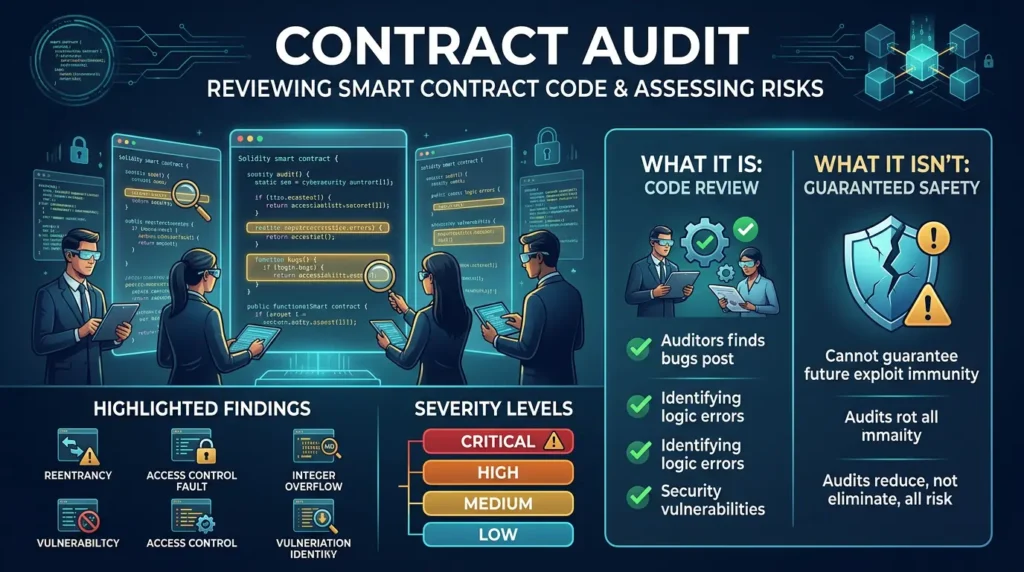
An audit of blockchain contract code is a structured security review conducted before or after deployment to identify vulnerabilities, unsafe assumptions, logic flaws, and other risks in how the system is designed to behave. In simple terms, it is an expert review process meant to catch problems in on-chain code before users trust meaningful funds to it.
The most important thing to understand is that an audit is a risk-reduction step, not a magic certificate of safety. A protocol can be audited and still fail. A report can improve confidence, reveal known issues, and show that serious review happened, but it does not eliminate bugs, governance problems, or bad economic design.
This content is for educational purposes only and should not be considered financial or investment advice.
Quick Answer
This kind of audit is a security-focused review of blockchain code and protocol logic. Auditors look for vulnerabilities, unsafe behaviors, and implementation mistakes, then document issues and recommendations in a report. The result is useful, but it is not a guarantee that the code is safe forever.
Key Takeaways
- An audit is a review, not an insurance policy: It can reduce unknowns, but it cannot prove permanent safety.
- Auditors inspect more than syntax: Good audits look at logic, edge cases, access control, upgradeability, and protocol assumptions.
- The report matters as much as the label: “Audited” alone is weaker than reading what issues were found, fixed, or left unresolved.
- Audited protocols can still be exploited: New attack paths, changed code, bad governance, and economic design flaws can still break the system.
- An audit is one signal among many: Admin keys, TVL quality, dependency risk, and exploit history still matter.
What Auditors Actually Review
Auditors usually review the contract code, the architecture around it, and the intended protocol behavior. That includes looking for common vulnerability classes such as reentrancy, access-control mistakes, oracle manipulation risk, incorrect accounting, unsafe upgrade paths, poor validation, and logic flaws that could lead to loss of funds or unintended behavior.
They also review whether the code matches what the protocol says it is supposed to do. A contract can compile and run successfully while still behaving in a way that creates dangerous edge cases. That is why audits are not only bug hunts. They are also checks on assumptions, architecture, and failure modes.
The cleanest background layer here is What Is a Smart Contract?. If the code is what governs the protocol, the audit is the attempt to inspect that governance before users rely on it.
What the Audit Process Often Looks Like
A typical audit begins with the team providing code, documentation, system architecture, and sometimes threat-model assumptions to the audit firm. The auditors review the code manually, run analysis tools, test logic paths, and identify issues. Those issues are then categorized by severity and discussed with the protocol team, which may patch the code and return revisions for follow-up review.
The final deliverable is often a public report listing findings, severity levels, recommendations, and the project team’s remediation status. That means the useful output is not just the word “audited.” It is the substance of what the report says happened.
What an Audit Can Catch Well
- Implementation bugs: Mistakes in code logic, accounting, access checks, or state updates.
- Known vulnerability patterns: Reentrancy, unsafe external calls, precision issues, or dangerous permission design.
- Upgrade and admin weaknesses: Problems around who can change the code or pause the system.
- Mismatch between design and implementation: The code may not behave the way the protocol team or users believe it does.
What an Audit Does Not Guarantee
An audit does not guarantee that every bug was found, that future changes will remain safe, or that the protocol’s economics are resilient under all market conditions. It also does not eliminate governance abuse, key-management failures, bad oracle dependencies, or social engineering around upgrade and admin controls.
Real-world example: a protocol can pass a reputable code review, then later add new contracts, change parameters, integrate risky dependencies, or expose users to a market condition that the original audit did not fully model. The code review may still have been useful, but the system moved beyond the exact review scope.
This is one reason “audited” should never be read as the same thing as “safe.” The best local follow-up for that mindset is Why High TVL Does Not Mean Safe in Crypto. Big numbers and audit badges are both signals, but neither should replace analysis.
How to Read an Audit Report Better
Audit reports are most useful when you read beyond the badge. Look at how many issues were found, how severe they were, whether they were fixed, and whether any issues were acknowledged but intentionally left unresolved. Also check whether the report covers the exact deployed contracts you plan to use, not just an earlier version or a partial module.
Operator insight: many users stop reading at the logo of the audit firm. That misses the main value. The real signal is often in the details: unresolved medium-severity findings, strong or weak admin assumptions, and whether the report scope was broad enough to matter.
Why Audited Protocols Still Get Exploited
Audited protocols still get exploited because software security is probabilistic, not absolute. Complex systems create edge cases. Integrations add dependency risk. Teams change code after review. Governance powers can be misused. Oracles, bridges, and external components can fail even if the audited core code was strong.
Real-world example: a protocol may have solid core contracts but depend on a bridge, oracle, multisig, or off-chain signer process that creates the real weak point. The exploit then happens around the protocol, not necessarily inside the exact function an auditor reviewed most closely.
How Users Should Use the Audit Signal
The best way to use an audit is as one input in a broader trust model. It should increase your questions, not end them. An audit can tell you the team submitted the code to serious outside review and that certain known issues were handled thoughtfully. It should not make you ignore admin-key risk, incentive design, dependency exposure, or wallet-side signing risk.
For a closely related follow-up, see DeFi Wallet Connection: How It Works and What You Approve.
For the broader protocol context around that decision, What Is DeFi? and What Is a DeFi Protocol? are the best foundation pages.
Practical Usage: What to Check Beyond “Audited”
- Read the actual report: Do not stop at the audit-firm logo or badge.
- Check scope and version: Make sure the reviewed contracts match the deployed contracts you plan to use.
- Look for unresolved findings: A protocol can still launch with meaningful known issues or risky assumptions.
- Check admin and upgrade powers: A strong audit does not remove the need to understand who can still change the system.
- Treat audits as one signal among many: TVL, dependency risk, exploit history, liquidity quality, and wallet interaction risk still matter.
A practical shortcut is this: an audit can tell you whether qualified reviewers looked for problems, but it cannot promise that the protocol has no problems left.
If you want the foundational definition behind this concept, read What Is a DEX? How Decentralized Exchanges Work.
Risks and Common Mistakes
- Treating “audited” as a safety guarantee: It is a review signal, not proof that all failure modes are gone.
- Ignoring what the report actually found: Resolved and unresolved issues matter more than the badge alone.
- Forgetting that code can change after review: Upgrades, new modules, and integrations can create fresh risk outside the original report.
- Ignoring non-code risks: Admin keys, governance capture, bridge dependencies, or oracle problems can still break the system.
- Using audit status as a substitute for protocol understanding: Users still need to understand what the system does and what could fail around it.
Sources
- Smart Contract Security Best Practices
- OpenZeppelin Contracts Documentation
- Ethereum.org: Smart Contract Security
Frequently Asked Questions
What is a contract audit in simple terms?
It is a professional security review of blockchain code meant to identify vulnerabilities, dangerous assumptions, and logic flaws before or after deployment.
Does an audit mean a protocol is safe?
No. It can improve confidence and reduce some unknowns, but audited protocols can still fail through missed bugs, later changes, bad governance, or dependency issues.
What should I read in an audit report?
Look at the report scope, severity of findings, remediation status, unresolved issues, and whether the reviewed code matches the deployed contracts you plan to use.
Can unaudited code still work?
Yes. Unaudited code can work, but it has not gone through the same level of external security review, which usually increases uncertainty for users.
What is the biggest mistake people make with audits?
The biggest mistake is treating the word “audited” like a blanket promise instead of reading the report and understanding the wider risk model around the protocol.