

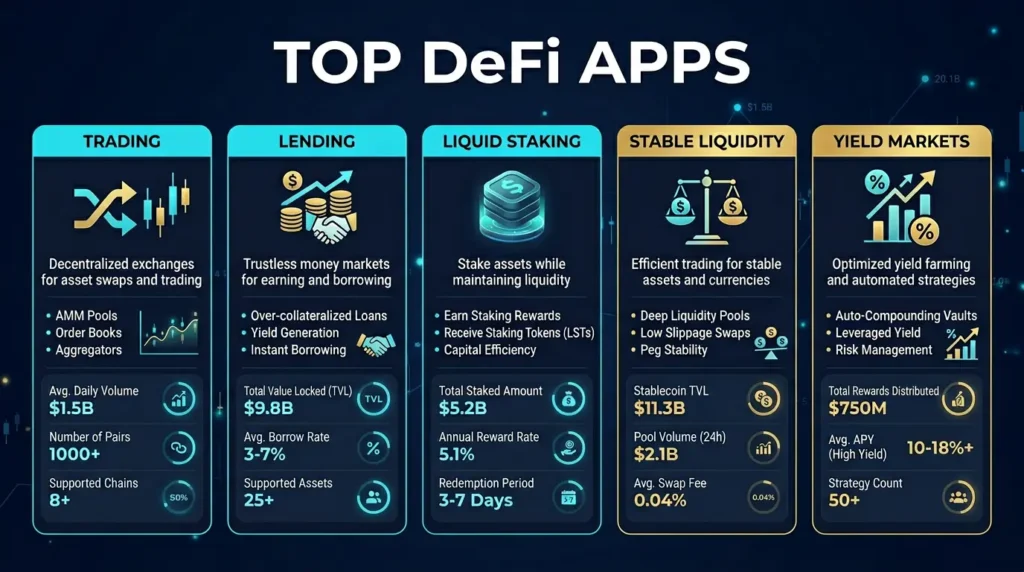
There is no single “best” DeFi platform. You match the task to five defaults: swap on-chain, borrow against collateral, hold a liquid staking token, move stables or near-pegs cheaply, or use Pendle when you want yield split into pieces you can trade. Each path uses different contracts and fails differently. The usual mistake is picking from hype or a clean UI and assuming the layout proves the code is safe. Here we map what you need done to those defaults and say plainly when to sit out.
This content is for educational purposes only and should not be considered financial or investment advice.
Read what you sign. A polished layout is not a security review.
Quick Answer
Key Takeaways
- Pick the task first: swaps, loans, liquid staking receipts, stable pools, and Pendle-style yield trades are different machines with different failure modes.
- Clean UI is not a safety certificate. Deposits still hit contracts, oracles, governance, and approvals.
- High APY without a story is suspect. If you cannot explain the mechanism, do not size like you can.
- If you cannot name what liquidates you, shrink the trade or do not open it.
- Perps and spot DeFi are different games. Leverage and funding get their own homework, not a footnote here.
Who Should Read This Page and Who Should Skip It
Use this page if you hold your own keys, you actually read prompts before you sign, and you want a named default for one clear task: swap, lend, stake, run stables, or trade Pendle-style yield.
Stay out of on-chain DeFi until you have a wallet you control, a loss budget you can afford, and a habit of revoking approvals you no longer need. If collateral ratios, liquidations, or why a receipt trades off peg are still fuzzy, pause. Read DeFi Wallet Connection: How It Works and When to Use a Burner Wallet before you chase “top platform” lists.
Swaps, Loans, Staking, Yield, and Perps
- Swapping: exchange one token for another through pools and routers; primary risks include bad tokens, thin liquidity, MEV, and mistaken approvals.
- Lending / borrowing: post collateral, draw debt, maintain health; primary risks include oracles, liquidation cascades, interest-rate shifts, and governance parameter changes.
- Staking (especially liquid): delegate stake or hold a liquid receipt; adds validator, depeg, and composability risk wherever that receipt is reused.
- Yield farming: often layers LP rewards, governance tokens, and other people’s code. The number on the screen is not a paycheck; it is a bundle of incentives and tail risk.
- Perps / advanced: funding, leverage, and liquidation are first-class mechanics. They sit next to spot swap and money markets, not inside them.
For plain-language definitions by category, Types of DeFi Protocols is the local map.
Platform UX vs Protocol / Contract Risk
Interfaces hide most of the wiring. Protocols run bytecode you approved, lean on oracles and incentives, and break in ways no animation shows. Before you hit Deposit or Swap, know what leaves your wallet, what you get back, what can change without another signature from you, and what triggers liquidation.
For what actually fails under the hood, read Smart Contract Risks Explained next. Skip another platform roundup.
Headline APY vs What You Control
Marketing loves peak APY screenshots. Ask whether the return survives a bad week, whether the incentives are built to last, and whether you can explain the trade out loud when price chops. Boring and understood beats clever and stuck. For how farm incentives hide tail risk, read Yield Farming Risks Explained.
How This Page Picks Defaults
We pick defaults by fit to the job, time in production, liquidity at normal size, docs you can actually read, and whether you can see what you approved. We do not rank by “safest” hand-waving, TVL screenshots, or token hype. For why big TVL is not safety, see Why High TVL Does Not Mean Safe in Crypto.
At-a-Glance Comparison
| Protocol | Primary job | Main risks | Best when | Skip when |
|---|---|---|---|---|
| Uniswap | DEX routing and swaps | Token fraud, route quality, approvals, MEV | You need a mainstream EVM swap default you verify each trade | You confuse brand liquidity with asset safety |
| Aave | Lend and borrow | Oracles, liquidations, rate and collateral params | You want a mature money-market mental model | You will not monitor health and governance changes |
| Lido | Liquid staking receipts | Receipt depeg, validator set, downstream composability | Liquid staking is the actual thesis | You want minimal moving parts in staking |
| Curve | Stable and correlated pools | Peg assumptions, pool parameters, governance | Like-kind liquidity is the bottleneck | You equate stable pools with “no homework” |
| Pendle | Yield and term positioning | Structure and market-expectation risk | You already model yield components explicitly | You want passive yield without term literacy |
Scope note: The table is about roles, not live yields or fees. Confirm numbers in the app when you trade. Pendle V2 and Boros share a row because both are Pendle products; the Pendle section spells out the difference.
Best Picks by Use Case
You mainly swap spot on EVM
If you mostly need to swap spot on EVM, Uniswap is the common first stop for depth on big pairs. You still check contracts and routes yourself. New to DEXs? Read What Is a DEX?
You need a collateralized loan or supply yield
If you need a collateralized loan or supply yield, Aave is the usual classroom: heavy docs, lots of users. Put on only what you will watch for health and liquidation.
You want liquid staking exposure
If you want liquid staking exposure (especially ETH), Lido is the name people say first. The liquid token moves through other apps; your risk follows it.
If you route stables or correlated assets, Curve is built for tight swaps between things that should hug the same price. Read Stablecoin Depeg Risk before you call any stable “safe” at size.
You trade yield exposure as a structure
If you want to treat yield as something you trade (split principal from yield, or trade funding with margin), use Pendle. If that sentence felt heavy, read more and keep size tiny.
These apps want you to finish the click path. They will not save you from a bad trade. Slow down on approvals, use a hardware wallet for real money, and treat unfamiliar pools as guilty until you check addresses, oracles, and how you get out. Hacks and governance mistakes still happen.
Protocol Deep Dives
Uniswap
Uniswap turns a wallet balance of token A into token B through pools and automated routing. Each trade is you signing transfers, hops, and sometimes long-lived router approvals until you revoke them. There is no custodial account in the middle.
In practice we point swap-sized problems here first: you want depth on a pair and you are willing to double-check the route. Need a loan? That is Aave. Need stables that hug a peg? Curve. Want to trade how yield splits? Pendle. You can use aggregators on top; many people still open Uniswap when they want to see the pool and the path with their own eyes.
The interface looks like a clean token picker. It is not a filter. Junk pools can sit next to real ones. Most pain comes from wrong contract addresses, careless slippage, sleepy approvals, or thin liquidity that punishes you when you leave.
- What it does: turns one token balance into another through pools and routers, using liquidity already on-chain.
- The catch: the router does not vet tickers for you. Speed outruns understanding if you let it.
- When it fits: you check addresses, limits, and approvals before you lean on size.
- Wrong tool if: you need a loan book, stable-only routing, or Pendle-style yield splits. Use the right lane.
- Not a substitute for: reading calldata, or trusting popularity as quality.
Best for: verified on-chain swaps. Skip if: you outsource token due diligence to popularity.
Aave
Aave is an on-chain money market: lock collateral, borrow another asset, and keep a health factor above liquidation lines that oracles and governance parameters set. A “simple” supply still changes contract state and hands the protocol liquidation rights if you also borrow.
Uniswap is for swapping balances. Aave is for collateral in, debt out, floating rates, and a health readout you refresh. If you only need a one-off trade, skip the borrow side. Pendle is elsewhere on this page for yield splits; on Aave the job is staying solvent when prices and rates move.
People read supply APY like a savings headline and ignore what happens if their collateral dumps or their borrow rate spikes. Liquidation is the bill for that inattention.
- What it does: collateralized borrow and supply under one set of governed parameters.
- The catch: simple screens sit on top of oracles, caps, governance, and liquidation engines.
- When it fits: you watch health, debt mix, and parameter changes like a book.
- Wrong tool if: you want a one-off swap or will not touch collateral ratios.
- Reality check: variable rates and votes move. This is not a fixed deposit.
Best for: collateralized borrow/supply workflows. Skip if: you will not track liquidation thresholds.
Lido
Lido is staking with a movable receipt: you put in stake-eligible assets, you get a liquid token that tracks the stake, and you can send that token to other apps. Under the hood you are touching staking contracts plus whatever each next app adds.
Pick Lido when you want staking exposure you can actually use on-chain, not when you just needed a quick swap (that is still Uniswap) or a plain loan book (that is still Aave). Each place the receipt lands is another set of prices and rules to track.
The receipt trades under a friendly ticker, so it feels like dollars. It is not. Watch depeg, any exit queue rules that apply, and what happens if you post it as collateral and markets move. Borrowing against the receipt without a clean exit plan is how people get surprised.
- What it does: staking participation with a liquid token you can move across apps.
- The catch: every venue that holds the receipt adds contracts and price paths you must track.
- When it fits: liquid staking is the plan and you list every downstream use.
- Wrong tool if: you want the fewest hops between you and the validator.
- Reality check: not a boosted savings rate. It is staking plus wrapper risk plus whatever you stack on top.
Best for: liquid staking thesis with discipline. Skip if: you want minimal layered staking risk.
Curve
Curve focuses on pools where prices should stay close: stablecoins, liquid staking tokens, and other pairs built to track. You still sign deposits, gauge choices, and parameters that governance can change. The curve math is for tight relationships, not for random volatile crosses.
Reach for Curve when you are moving between assets that ought to trade near each other. Uniswap stays the broad swap venue. Aave stays the borrow lane. Many setups use Curve for the tight leg and another protocol for the rest of the book.
Stable pairs look boring, so people add size without thinking. Pegs slip, pool economics shift, incentives rotate. Treating a stable pool like a savings vault is how you get caught flat-footed.
- What it does: tight swaps and liquidity where assets are supposed to track.
- The catch: the whole design assumes correlation. When that breaks, it breaks fast.
- When it fits: your book is mostly stable or correlated legs you already stress-test.
- Wrong tool if: you want a general volatile discovery venue or ignore peg tail risk.
- Reality check: not a “safe” vault. Incentives and governance still move outcomes.
Best for: stable and correlated routes. Skip if: you confuse correlation with safety.
Pendle
Pendle runs two different front doors. V2 is the yield-token split (PT and YT). Boros is the margined funding side with liquidations. Nice UI does not shrink either problem.
Pendle V2 (app.pendle.finance) lets you trade yield-bearing positions in pieces. You wrap the underlying into a standard yield token (SY). You split that into PT (principal) and YT (yield). You trade those legs in Pendle’s AMM. Buyers use it when they want a cleaner bet on rates, a fixed-style view, or pool strategies around those tokens. Markets can be created on-chain; the main app only highlights some of them.
Boros (boros.pendle.finance) is the heavier setup. You work in yield units (YU). Prices and funding come from oracles, including CEX-style funding feeds. You can go long or short funding-type exposure. There is maintenance margin. Breach it and you face liquidation. Think borrowing desk with margin calls, not a simple stake screen.
Pick V2 when you already understand the yield asset and you want to trade how principal and yield separate. Pick Boros when you care about a floating rate from oracles and you accept margin rules. If you cannot say which case you are in, keep size near zero.
Folks click in because the charts look organized. The usual slip is payoff math you never wrote down, size you cannot hold through a volatile week, and token approvals you cannot unwind quickly.
- What it does: V2 trades split yield tokens; Boros runs margined funding exposure with its own liquidation path.
- The catch: layered products. Model the payoff, watch liquidity, and on Boros respect margin and oracle risk.
- When it fits: you can explain the trade, know which market feeds the price, and accept the AMM or margin terms.
- Wrong tool if: you only needed a spot swap, a plain Aave loan, or vanilla staking with no derivatives.
- Reality check: two products, two risk stacks. This is not beginner DeFi with extra buttons.
Best for: readers who do the homework before they size. Skip if: you want one-click yield with no derivatives reading.
Final Routing Verdict
Start with the way you are most likely to lose money, then pick the tool that matches that job.
For spot swaps on EVM, our default lane is Uniswap. You still confirm addresses and routes yourself.
For borrow and supply, we point to Aave. You watch health, rates, and governance shifts on purpose. This is not set-and-forget savings.
For liquid staking, Lido is the usual name; you follow the liquid token across every app it touches.
For stable or tightly linked pairs, Curve is the tight-swap lane; you still sanity-check pegs and incentives.
For traded yield and funding exposure, Pendle V2 covers PT/YT splits. Boros covers margined funding with liquidation risk.
High leverage and perp venues are their own chapter. Give them a separate risk budget and reading list.
For the wider toolkit, see Essential Crypto Tools 2026.
Security and Risk Lens
Easy UX does not delete protocol risk. Deep pools and familiar names help you see what is happening; they do not guarantee outcomes. Keep approvals tight, revoke after experiments, and treat governance parameter shifts as things that change while you sleep, not fine print.
Practical Usage Checklist
- State the job in one sentence before opening an app.
- Verify addresses from official docs or bookmarks, not search ads.
- Match position size to explainability; shrink when prompts feel unfamiliar.
- Separate marketing APY from mechanism; read docs when incentives look outsized.
- Assume interfaces lag risk; explorers and protocol-native status pages still matter.
Risks and Common Mistakes
- Chasing peak APY without mapping incentives and unwind paths.
- Using TVL as trust instead of reading why TVL misleads.
- Signing fast on new pools without reading token contracts and permissions.
- Mixing perps psychology with spot DeFi and underestimating liquidation.
- Ignoring stablecoin tail risk on Curve or stable LPs. See Stablecoin Depeg Risk.
Sources
- Uniswap Docs: Protocol Concepts
- Aave Docs
- Lido Docs
- Curve Resources
- Pendle Docs
- Pendle V2 Introduction (docs)
- Boros Overview (Pendle GitBook)
Frequently Asked Questions
What is the best DeFi platform for beginners?
There is no universal beginner platform. Learn to verify token contracts first; Uniswap is a common place to practice swaps. For lending, Aave has strong docs, and you still manage collateral and rates yourself. Smaller size, fewer approvals, and more reading beats chasing the flashiest interface.
Which DeFi platform is safest?
No on-chain platform is safe in an absolute sense. Longer history and deeper liquidity improve execution quality and observability, but users still face smart-contract, oracle, governance, and wallet-approval risk.
Is Aave better than Uniswap?
Neither is better in general: Aave is for collateralized lending and borrowing; Uniswap is for token swaps. Pick based on whether you need credit against collateral or on-chain exchange.
Should users chase the highest DeFi yield?
Usually not as a primary strategy. High displayed yield often stacks incentives, extra code paths, or structural risks that only become obvious under stress. Understand the mechanism before sizing.
What is the biggest mistake when choosing a DeFi app?
The biggest mistake is choosing from hype, APY screenshots, or branding before you can explain the protocol job, the approvals you granted, and the first liquidation or depeg scenario that applies to you.
What is the difference between a DEX and a lending protocol?
A DEX matches trades against liquidity pools and routers; a lending protocol locks collateral, mints debt, and prices liquidations against oracles and parameters. Swaps and loans are different contracts, different risks, and different monitoring habits.
When should someone avoid DeFi entirely?
Avoid on-chain DeFi until you control keys deliberately, you have a written loss budget, and you can read an approval screen slowly. If those prerequisites feel unrealistic, stay on educational reading and centralized rails until they are.
Focus Keyword: best DeFi platforms SEO Title: Best DeFi Platforms 2026: Route by Job and Risk Surface Meta Description: Pick DeFi platforms by the job: swaps, lending, liquid staking, stable liquidity, or structured yield. Not by headline APY. Clear UX vs contract risk, who should stay out, and practical routing for 2026. Slug: best-defi-platforms-2026 Primary Category: Tools & Reviews Subcategory: Research Platforms Tags: DeFi, defi yield, crypto tools, ethereum, risk management, crypto education, real yieldInternal Links Used: What Is DeFi? [What Is DeFi? How Decentralized Finance Works], Types of DeFi Protocols [DeFi Protocol Types Explained: DEXs, Lending, Yield, and More], CeFi vs DeFi [CeFi vs DeFi Explained], What Is a DEX? [What Is a DEX?], Yield Farming Risks Explained [Yield Farming Risks Explained: What DeFi Yield Can Hide], Stablecoin Depeg Risk [Stablecoin Depeg Risk], DeFi Wallet Connection [DeFi Wallet Connection: How It Works], When to Use a Burner Wallet [When to Use a Burner Wallet: Safer DeFi and Web3 Habits], Smart Contract Risks Explained [Smart Contract Risks Explained], Why High TVL Does Not Mean Safe in Crypto [Why High TVL Does Not Mean Safe in Crypto], Essential Crypto Tools 2026 [Essential Crypto Tools 2026]Featured Image Prompt: Dark editorial “routing board” graphic: five labeled lanes (Swap, Lend, Liquid stake, Stable liquidity, Yield term) as clean typographic strips on deep navy, subtle grid lines suggesting risk surfaces—not neon city clichés. Large white overlay title: “DeFi by Job”. Small caption strip: “UX ≠ contract safety”. No protocol logos, no token icons, no fake APY numbers. Suggested Filename: best-defi-platforms-2026.webp Alt Text: DeFi platform routing graphic comparing swap lend staking stable liquidity and yield jobs for 2026 Title Attribute: Best DeFi Platforms 2026 — Route by Job Caption: The best DeFi platform is the one that matches your actual on-chain job—and the failure modes you will monitor.