

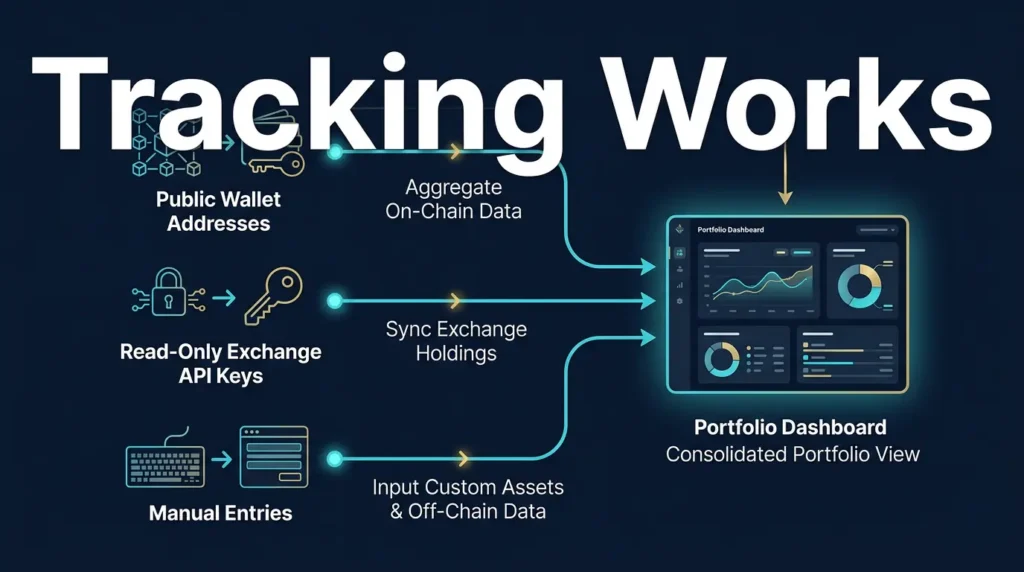
Portfolio tracking for crypto works by pulling data from the places where your assets already live and translating that information into one dashboard. In practice, that usually means reading public wallet addresses on-chain, syncing exchange balances through API keys, or letting you add transactions manually. The tool is not magic. It is an aggregator that tries to turn fragmented wallet, exchange, and protocol data into something you can actually use.
This article is the practical follow-up to What Is a Portfolio Tracker for Crypto?. That page explains what a tracker is. This one explains how the underlying tracking methods actually work and where they start to break down.
This content is for educational purposes only and should not be considered financial or investment advice.
Key Takeaways
- Most trackers use three main methods: wallet address imports, exchange API sync, and manual transaction entry.
- Read-only access is the right default: A tracker should observe data, not hold the credentials that can move funds.
- API keys improve convenience but add trust exposure: They can automate exchange history, but permission scope matters.
- Manual tracking is slower but sometimes necessary: Unsupported chains, niche assets, and incomplete imports often require human cleanup.
- Complex portfolios produce messier data: DeFi, bridges, LP tokens, and staking rewards are harder to classify than simple spot balances.
The Core Idea Behind Tracking
The basic process is simple: the tracker gathers portfolio data from different sources, normalizes it into a common format, and then calculates balances, allocations, and performance from that combined record. The hard part is not displaying the dashboard. The hard part is getting clean data from many systems that were never designed to report into one screen.
Operator insight: most tracking problems are not really dashboard problems. They are data-ingestion problems. If the source information is incomplete, delayed, or misclassified, the portfolio view will inherit those weaknesses.
Method 1: Wallet Address Tracking
This is usually the cleanest and safest tracking method. The user provides a public wallet address, and the tracker reads balances and transaction history from the blockchain. Because blockchain data is public, the tool can monitor the wallet without needing the private key.
- What the tracker gets: token balances, transfers, and sometimes protocol positions that are visible from the address.
- Why it is popular: it is read-only and avoids giving the tracker account-level control.
- Where it struggles: some protocols, wrapped assets, or obscure chains are harder to interpret correctly.
Real-world scenario: a user pastes an Ethereum address into a tracker. The tool can see ETH, ERC-20 balances, and basic transfers immediately. It may also detect major DeFi positions. But if that same wallet holds niche LP tokens or newer protocol receipts, the dashboard may lag, mislabel them, or miss them entirely.
Method 2: Exchange API Keys
Exchange syncing usually works through API keys generated inside the user’s exchange account. Those keys let the tracker request balance and trade-history data directly from the platform so the account can be included alongside wallets in the same dashboard.
The critical detail is permission scope. For tracking, the API key should usually be read-only. It should not have withdrawal rights or trading permissions just to display balances and past activity.
- What the tracker gets: exchange balances, trade history, deposits, withdrawals, and sometimes cost-basis clues.
- Why it is useful: it saves the user from manually reconciling exchange activity.
- Where it struggles: exchange exports vary, older data may be incomplete, and bad permission choices create unnecessary risk.
Operator insight: an API key is not harmless just because it is not a private key. A poorly configured key can still reveal more account history than you intended, and an overly broad key creates real exchange custody risk beyond what a monitoring tool requires.
Method 3: Manual Tracking
Manual tracking means the user enters balances, trades, or transactions directly instead of relying entirely on wallet scanning or exchange integration. This is slower, but it is still important because many portfolios contain unsupported chains, off-platform assets, or custom situations that automation does not capture cleanly.
Real-world scenario: someone holds a token on a smaller chain that the tracker does not support yet, or they moved assets through a niche bridge that the dashboard cannot interpret properly. In those cases, manual entry may be the only way to keep the portfolio view approximately accurate until native support improves.
- What the tracker gets: whatever the user enters manually.
- Why it matters: it fills gaps where automation is incomplete.
- Where it struggles: it is time-consuming and easy to drift out of date if the user is not disciplined.
Why DeFi Makes Tracking Harder
Spot balances are relatively simple. DeFi positions are not. Once assets are staked, lent, bridged, wrapped, supplied to a pool, or represented by another token, the tracker must infer what those assets mean from protocol-specific data. That is where accuracy becomes much harder.
Real-world scenario: a user deposits tokens into a liquidity pool, receives LP tokens, compounds rewards, and later bridges the proceeds to another chain. The dashboard may need to interpret several contracts and multiple transaction types just to show the true exposure. Some tools do that well for major protocols. Many do not.
This is also why different tracking products specialize in different types of portfolios. If the next question is which tools handle those workflows best, the relevant follow-up is Best Crypto Portfolio Trackers.
How Pricing and Allocation Are Calculated
After balances are gathered, the tracker still needs market data to estimate portfolio value. That usually means matching token quantities with price feeds and then calculating totals, category weights, and performance changes over time. If price feeds are wrong, delayed, or missing for thinly traded assets, the dashboard can look cleaner than the underlying data really is.
Operator insight: portfolio tracking is really two data systems stacked together. One system figures out what you hold. The other tries to price it. Errors in either layer can distort the final number on screen.
Why Privacy Matters in Tracking
Every time you connect a public address, exchange API, or manual account profile to a tracker, you make it easier for that service to understand your portfolio as one unified record. That is an operational security trade-off worth considering before connecting everything. The more wallets and exchanges you cluster together in one place, the more complete your profile becomes.
For some users, that is worth it because convenience matters more. For others, especially users with larger cold-storage balances, the privacy cost changes how they choose to track those assets.
Why Manual Review Still Matters
Even when automation works well, manual review still matters because dashboards can hide broken assumptions. A wallet transfer might be classified as a deposit without context, an exchange sync might miss older trades, or a protocol position might appear as a generic token balance instead of the underlying exposure. Users who never audit the output can end up trusting a polished display built on partial data.
This is especially important if the same data later feeds taxable event reporting or major rebalancing decisions. Monitoring and accounting are related, but they are not the same job.
Practical Usage: A Safe Tracking Workflow
- Use public wallet addresses whenever possible: This is usually the safest starting point for on-chain visibility.
- Use exchange APIs only with read-only permissions: The dashboard should not need power to trade or withdraw.
- Keep manual notes for unsupported assets: Niche chains and custom positions often need temporary manual handling.
- Spot-check high-value balances at the source: Large cold-wallet holdings, major LP positions, and tax-relevant transfers deserve direct verification.
- Review privacy before linking everything: Convenience improves as more accounts are connected, but so does data concentration in one service.
A useful rule is to let the tracker do the aggregation while you keep control of verification. If the tool can see your portfolio without gaining power over it, the setup is usually pointed in the right direction.
Risks and Common Mistakes
- Using overly broad exchange API permissions: A key meant only for monitoring should not also be able to trade or withdraw, because that turns a visibility tool into a possible account risk.
- Assuming every wallet import is complete: A dashboard may show base assets correctly while missing bridged tokens, LP receipts, or newer protocol positions that still matter financially.
- Letting manual entries go stale: If unsupported balances are entered once and never updated, the portfolio view slowly drifts away from reality.
- Trusting one dashboard for tax or allocation decisions without review: A mislabeled transfer or missing trade can distort both performance and reporting conclusions.
- Ignoring privacy clustering: Linking a cold wallet, exchange account, and DeFi wallet into one profile may create a far more revealing account record than the user intended.
Sources
Frequently Asked Questions
How does portfolio tracking for crypto work?
It usually works by reading public wallet addresses, syncing exchange balances through APIs, and sometimes using manual entries to combine everything into one dashboard.
Are exchange API keys safe for portfolio tracking?
They can be safe if they are configured as read-only. The key should not have withdrawal or unnecessary trading permissions just to support monitoring.
Why do some balances show incorrectly in trackers?
Balances can display incorrectly when protocols are unsupported, price feeds are weak, assets are wrapped or bridged, or exchange and on-chain data imports are incomplete.
When is manual tracking still useful?
Manual tracking is still useful for unsupported chains, niche assets, custom transactions, and any situation where automation does not capture the full picture reliably.
Should a portfolio tracker ever need a seed phrase?
No. A monitoring tool should not need a seed phrase or private key just to show balances and transaction history.