

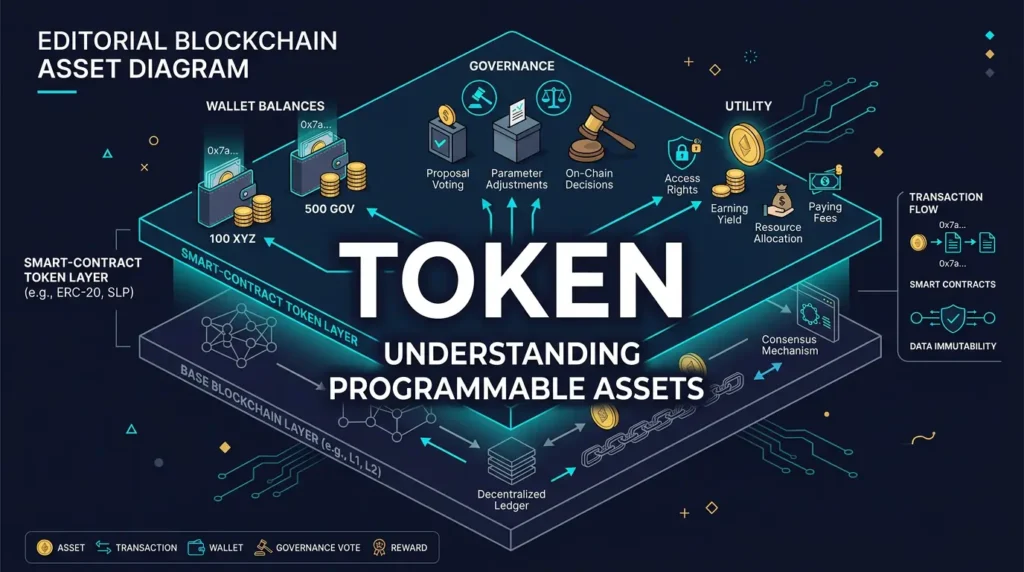
A token in crypto is a digital asset created and managed by a smart contract on top of an existing blockchain. Unlike a native coin such as BTC or ETH, a token usually does not run its own base blockchain. Instead, it relies on another network’s infrastructure while the token contract defines supply, balances, transfer rules, and sometimes additional utility such as governance, access, or rewards.
The simplest mental model is this: the blockchain is the underlying system, while the token is an asset layer built on that system. That makes tokens extremely flexible. A project can launch an asset, define its rules, and integrate it into apps without needing to build an entirely new blockchain from scratch.
This content is for educational purposes only and should not be considered financial or investment advice.
Quick Answer
A token is an asset issued by a smart contract on an existing blockchain. It can represent utility, governance rights, access, rewards, or economic value, but it depends on the host chain for security and transaction settlement.
Key Takeaways
- Tokens usually live on top of another chain: They rely on a host blockchain such as Ethereum, Solana, or another smart-contract network.
- They are often created by smart contracts: The contract defines balances, transfer rules, and other token behavior.
- They are not the same as native coins: Coins secure the base network, while tokens typically operate within applications built on top of it.
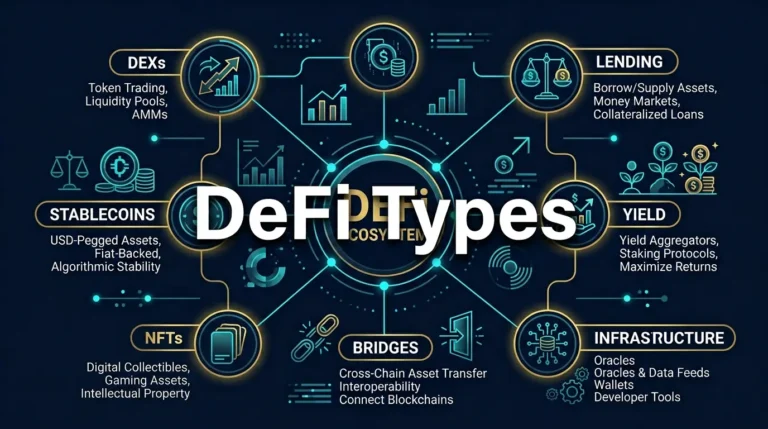
- Tokens can serve many roles: Common uses include governance, utility, rewards, stable value representation, and app-specific economics.
- Not every token has durable value: A token can exist technically without having strong demand, liquidity, or long-term usefulness.
How Tokens Work
On smart-contract blockchains, a token is usually implemented as contract code that tracks who owns how much and under what conditions it can move. When your wallet shows a token balance, the wallet is reading blockchain state maintained by that contract rather than opening a separate blockchain just for that asset.
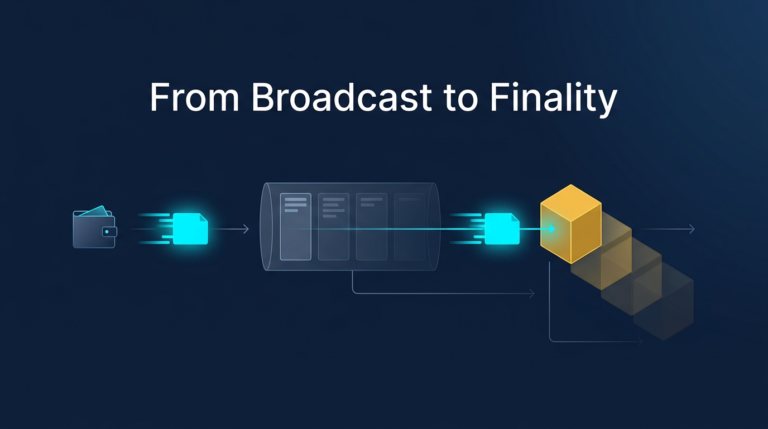
When you send the asset to someone else, you are really interacting with contract logic that updates balances according to the token’s rules. That is why tokens are closely tied to smart contracts, transaction signing, and wallet prompts. The asset may feel simple at the interface level, but under the hood it is a set of contract-defined records on the host chain.
The cleanest local background layer for that is What Is a Smart Contract?. If you want the user-side action behind token movement, What Is Transaction Signing in Crypto is the best follow-up.
How Tokens Differ From Coins
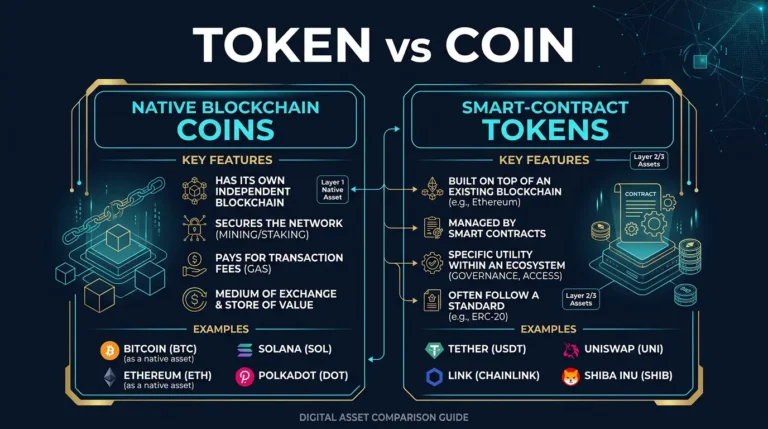
The practical difference is that native coins belong to the base blockchain itself, while tokens are built on top of that blockchain. ETH is native to Ethereum. SOL is native to Solana. By contrast, many DeFi assets, governance assets, and stablecoins are tokens issued by contracts running on those networks.
That means a token depends on the host chain for final settlement and security. It does not usually pay validators directly or define the chain’s base consensus rules. Instead, it exists as an application-layer asset within the broader ecosystem.
Why Projects Use Tokens Instead of Building New Chains
Launching on an existing chain is much easier than creating a new blockchain from scratch. The project gets wallets, developer tooling, liquidity rails, exchanges, and an established user base immediately. That lowers the cost of experimentation and speeds up distribution.
Operator insight: many teams do not need a new blockchain. They need an asset, a reward system, a governance mechanism, or an application economy. A token can deliver those functions without forcing the project to solve base-layer infrastructure problems first.
Common Token Categories
Utility tokens
These are designed to be used inside an app or protocol, for example for fees, access, incentives, or product-specific functionality.
Governance tokens
These are used to vote on protocol upgrades, treasury decisions, or other community proposals. Ownership may translate into influence over how the system evolves.
Stablecoins
Many stable assets are implemented as tokens on existing chains. Their purpose is usually to track a reference value such as the US dollar rather than to serve as a base-network coin.
Reward and ecosystem tokens
These are often used to reward users, bootstrap communities, or distribute ownership through staking, app activity, or airdrops.
For a distribution-focused example, see What Is a Crypto Airdrop?.
What Gives a Token Value
A token can have code, a ticker, and a market listing without having durable value. Value usually depends on demand, liquidity, utility, speculation, governance relevance, revenue-sharing expectations, network effects, or some mix of those factors. In other words, the technology can create the asset, but the market decides whether that asset matters economically.
Real-world example: one token may be central to a widely used protocol and supported by deep liquidity, while another may exist mostly as a marketing asset with little real usage. Both are technically tokens, but their economic quality can be completely different.
Why Tokens Can Also Create Risk
Because tokens are easy to issue compared with building a full blockchain, the space includes everything from legitimate infrastructure assets to low-quality speculation and outright scams. A token can be created quickly, branded convincingly, and distributed aggressively before users fully understand what it does or whether it has real utility.
Claim flows, token approvals, fake listings, and copycat contracts can all create confusion. The asset may look legitimate because it exists on-chain, but being on-chain is not the same as being credible. That is one reason token education overlaps with phishing, approval risk, and smart-contract risk.
For the security side of interacting with unfamiliar assets, the most relevant local pages are Crypto Approval Scams and What Is Crypto Phishing?.
Practical Usage: How to Think About a Token
- Ask what chain it lives on: That tells you the base network the asset depends on.
- Ask what the token actually does: Utility, governance, rewards, stable value tracking, or pure speculation are very different roles.
- Check whether the contract is official: Copycat contract addresses are common in scams.
- Separate technical existence from economic quality: A token can be real on-chain and still be weak, illiquid, or low quality.
- Treat wallet prompts carefully: Sending, approving, and claiming all involve contract interactions that deserve verification.
A useful operator rule is to stop asking only “Is this token real?” and start asking “What system is it part of, what rights does it actually give, and what makes anyone want it?” Those questions are usually more revealing than the ticker alone.
Risks and Common Mistakes
- Confusing tokens with native coins: The two can look similar in a wallet but play very different roles in blockchain architecture.
- Assuming every token has real utility: Many exist mainly for speculation, incentives, or marketing rather than durable product use.
- Ignoring the host chain: The asset depends on another network’s security, fees, and ecosystem conditions.
- Trusting a ticker without verifying the contract: Fake or copycat assets can imitate legitimate names closely.
- Treating token ownership as automatic quality: Receiving or holding an asset does not prove strong tokenomics, demand, or long-term value.
Sources
- Ethereum.org: ERC-20 Token Standard
- Ethereum.org: ERC-721 Token Standard
- OpenZeppelin Contracts Documentation
Frequently Asked Questions
What is a token in simple terms?
It is a digital asset created by a smart contract on an existing blockchain rather than being the base coin of its own chain.
Is a token the same as a coin?
No. A coin is usually native to its own blockchain, while a token usually exists on top of another blockchain through contract logic.
Can a token have real utility?
Yes. Some tokens are used for governance, app access, rewards, payments inside a protocol, or stable value representation. Others have weak or mostly speculative utility.
Are all tokens built with smart contracts?
Most modern tokens on programmable blockchains are created and managed through smart contracts, though exact implementation details differ by network.
What is the biggest mistake when evaluating a token?
The biggest mistake is assuming that because an asset exists on-chain it must also have strong utility, quality, or long-term value.